"...I Love INLNews.com.......INLnews.com is easy to find but hard to leave....".. Mr Wijat's friend Magic Rabbit http://www.easterlingentertainment.net
While the 2008 presidential campaign is in full swing, Simon Schama travels through America to dig deep into
the conflicts of its history to understand what is at stake right now,,,,
An Iraqi court sentenced a shaken but defiant Saddam Hussein to hang on Sunday for crimes against humanity, sparking joy for Shi'ites he oppressed and resentment among his fellow Sunnis across Iraq's violent sectarian divide-
Sat 12-30, 02:17PM Saddam Hussein reportedly executed
One:Chief judge Mohammed Oreibi al-Khalifa speaks with prosecutors during the trial of former Iraqi leader Saddam Hussein inside the heavily fortified Green Zone Wednesday, Nov. 8, 2006 in Baghdad, Iraq. Hussein and 6 other defendants are facing charges of crimes against humanity for their roles in the Anfal military operation from 1987-88 that prosecutors say killed thousands of Iraqis.
Two:Lead prosecutor Munqith al-Faroon addresses the court during the continuing trial of Saddam Hussein in Baghdad's heavily fortified Green Zone. Hussein called on Iraqis to unite and "forgive" each other, but a suicide bomber later blew himself up in a cafe in Baghdad, killing 17 people and wounding 20 more.
Three: Iraqi Judge Rauf Rashid Abdel Rahmen addresses former Iraqi President Saddam Hussein after sentencing him to death during his trial in Baghdad's heavily-fortified Green Zone, during his trial held under tight security in Baghdad's heavily-fortified Green Zone. A shaken but defiant Hussein was sentenced to death by hanging, as the dramatic end to his first trial drove another wedge between Iraq's already bitterly divided factions.
Fourt: Former Iraqi President Saddam Hussein yells in court as he receives his verdict, as a bailiff attempts to silence him, during his trial held under tight security in Baghdad's heavily fortified Green Zone, November 5, 2006.
Five: just a few of the many faces of Saddam Hussein and the 63 doubles that he had impersonating him before a man the austhorities call Saddam Hessein
Watch Live TV 5 Now News you need to stay informed. Unlimited viewing from $9.95/month.
www.JumpTV.com
BSc European Computing Spend one year studying in the country of your choice www.shu.ac.uk
Soka Gakkai Controversies-- Fact or Fiction? sokaissues.info
Next Pope is John Paul II Impersonated. Bible Prophecy Shows He Will be Last Pope. Learn More www.worldslastchance.com
"We wanted to have one specificdateforSaddamso people remember thisdateto be linked toSaddam's executionand nothing else." Rubaie said theexecution...
www.cnn.com/2006/WORLD/meast/12/29/hussein/index.html - 57k -Cached-Similar pages-
SaddamHussein Abd al-Majid al-Tikriti (Arabic: ???? ???? ??? ?????? ????????...9Execution; 10 Marriage and family relationships; 11 List of government...
en.wikipedia.org/wiki/Saddam_Hussein - 181k -Cached-Similar pages-
No further appeals were taken andSaddamwas ordered executed within 30 days of thatdate. Thedateand place of theexecutionwas secret until the sentence...
en.wikipedia.org/wiki/Trial_of_Saddam_Hussein - 213k -Cached-Similar pages-
A section of the site will be converted into a museum, featuringexecutionchamber exhibits and other displays of torture tools used bySaddam'sregime.... saddamhusseinstrial.blogspot.com/ - 68k -Cached-Similar pages-
29 Dec 2006...BAGHDAD, Iraq —SaddamHussein'sdatewith death appears to be just hours....Al-Nauimi said the timing ofSaddam'simminentexecutionis...
www.foxnews.com/story/0,2933,239783,00.html - 57k -Cached-Similar pages-
FM spokesman onexecution of SaddamHussein BEIJING, Dec. 30...to comment on theexecution of SaddamHussein. He said China hopes...in an earlydate....
www.highbeam.com/doc/1P3-1207037731.html - 58k -Cached-Similar pages-
"Camp Justice"? place ofexecution of SaddamHussein?...(Date of executionDecember 30, 2006) Hussein was reportedly transported here by a UH-60 Black...
wikimapia.org/1097605/Camp-Justice-place-of-execution-of-Saddam-Hussein - 18k -Cached-Similar pages-
Al-Takriti, AwadDateof imprisonment and two Epkian how witness theexecution of Saddamand want to know how to reduce or postpone etc....
daphnebarak.homestead.com/SaddamHussein.html - 47k -Cached-Similar pages-
Nodateset forexecutionof topSaddamaides. 07 Jan 2007 04:40:18 GMT...Jan 7 (Reuters) - Nodatehas been set for the hanging ofSaddam Hussein's...
www.alertnet.org/thenews/newsdesk/PAR715467.htm - 60k -Cached-Similar pages-
ofSaddam Hussein: * ** *There is no question that theexecutionof any person, be it by hanging, or...date. descending; ascending. AdvancedSearch Lite...
cgi.stanford.edu/group/wais/cgi-bin/index.php?p=7651 - 51k -Cached-Similar pages-
Labels: corruption, iraq, oil for food,saddam hussein, uk, UN...Among those on the watchlist are rather bizarrelySaddam Husseinwho was actually hanged... saddamhusseinstrial.blogspot.com/ - 68k -Cached-Similar pages-
4 Jan 2007...shouts during a protest in Jordan against theexecution of Saddam Hussein....giving rise to confusion over the likelyexecution date....
www.guardian.co.uk/world/2007/jan/04/iraq.iraqtimeline - 77k -Cached-Similar pages-
The Trial ofSaddam Husseinwas the trial of the deposed President of...Thedateand place of theexecutionwas secret until the sentence was carried out....
en.wikipedia.org/wiki/Trial_of_Saddam_Hussein- 213k -Cached-Similar pages-
1 Jan 2007...Theexecution of Saddam Hussein, though he was undeniably guilty of a....Name: ajiarcher,Date: Jan 18, 2007.Saddam'sdemise was ordained...
www.fpif.org/fpiftxt/3846 - 27k -Cached-Similar pages-
Iraq:Execution of Saddam Husseinaides is a further slide into errors of the past. Download:. HTML · PDF. Index Number: MDE 14/002/2007.DatePublished: 15...
www.amnesty.org/en/library/info/MDE14/002/2007 - 23k -Cached-Similar pages-
Death penalty forSaddam Hussein/Edit:Executioncomplete....JoinDate: Nov 2006. Location: LONDON UK. Posts: 4.SaddamIs The Best Ruler...
www.flashback.org/showthread.php?t=2967 - 67k -Cached-Similar pages-
29 Feb 2008...Council has approved theexecution of Saddam Husseincousin. Ali will be hanged, however adatehas not yet been set for theexecution....
www.product-reviews.net/2008/02/29/chemical-ali-execution-approved-ali-hassan-majid-saddam-husseins-cousin/ - 38k -Cached-Similar pages-
Left: Supporters of former Iraqi leader Saddam Hussein chant anti-U.S. and Iraqi government slogans in Tikrit, 175 km (110 miles) north of Baghdad, November 5, 2006. A visibly shaken Saddam Hussein was found guilty of crimes against humanity on Sunday and sentenced to hang by the U.S.-sponsored court that has been trying him in Baghdad for the past year.
Jordanian lawyers take part in a sit-in at the ministry of Justic to show their solidarity with former Iraqi President Saddam Hussein in Amman November 7, 2006. Ousted Iraqi leader Saddam Hussein was back in court on Tuesday to face charges of genocide against ethnic Kurds, two days after being sentenced to hang for the killing and torture of Shi'ites.
Palestinians throw eggs Monday Nov. 6, 2006 at the building of the United Nations in Gaza City during a protest against the sentencing of former Iraqi President Saddam Hussein Sunday. In the Gaza Strip city of Khan Younis, masked gunmen from a previously unknown group calling itself Arafat's Army threatened reprisals against foreign citizens in the Palestinian territories if the death sentence against Saddam is carried out.
Supporters of former Iraqi leader Saddam Hussein set ablaze tires in reaction to the verdict against Saddam in Tikrit, 175 km (110 miles) north of Baghdad Baghdad, November 5, 2006. A visibly shaken Saddam Hussein was found guilty of crimes against humanity on Sunday and sentenced to hang by the U.S.-sponsored court that has been trying him in Baghdad for the past year.
A woman weeps in reaction to the verdict against former Iraqi leader Saddam Hussein, in Tikrit, 175 km (110 miles) north of Baghdad, November 5, 2006. A visibly shaken Saddam Hussein was found guilty of crimes against humanity on Sunday and sentenced to hang by the U.S.-sponsored court that has been trying him in Baghdad for the past year.
REFILE - CORRECTING NAME OF CITY An activist holds a placard during a protest against former Iraqi leader Saddam Hussein's death sentence, in Kolkata November 7, 2006. Saddam, back in court two days after being sentenced to hang for crimes against humanity in a separate trial, urged Iraqis on Tuesday to seek reconciliation.
Tamil Nadu Muslim Munnetra Kazhagam (TMMK) activists wear the US flag as socks and stomp on a poster of US President George W. Bush at a demonstration near the American Consulate, protesting against the conviction of former Iraqi President Saddam Hussein in Chennai, India, Wednesday, Oct. 8, 2006.
Palestinian boys hold up pictures of former Iraqi President Saddam Hussein during a protest in support of Saddam, in Gaza November 6, 2006.
An activist of the Communist Party of India (Marxist) raises anti-U.S. slogans at a protest in New Delhi, India, Tuesday, Nov. 7, 2006, against the death sentence awarded to former Iraqi President Saddam Hussein.
Palestinians throw eggs Monday Nov. 6, 2006 at the building of the United Nations in Gaza City as others hold pictures of former Iraqi President Saddam Hussein during a protest against his sentencing Sunday. In the Gaza Strip city of Khan Younis, masked gunmen from a previously unknown group calling itself Arafat's Army threatened reprisals against foreign citizens in the Palestinian territories if the sentence against Saddam is carried out.
Activists with the Democratic Youth Federation of India (DYFI) burn an effigy of U.S President Bush during a demonstration against the death sentence awarded to former Iraqi President Saddam Hussein, in Hyderabad, India, Tuesday, Nov. 7, 2006. The placard reads 'Murderer George Bush, Don't hang Saddam Hussein.
Activists from the Communist Party of India (Marxist) hold placards and shout anti-U.S. slogans during a protest against former Iraqi leader Saddam Hussein's death sentence, in New Delhi November 7, 2006. Saddam, back in court two days after being sentenced to hang for crimes against humanity in a separate trial, urged Iraqis on Tuesday to seek reconciliation.
Members of the Socialist Unity Center of India burn effigies of U.S. President Bush and England's Prime Minister Tony Blair, during a protest against the conviction of former Iraqi President Saddam Hussein, near the American Consulate in Calcutta, India, Wednesday, Nov. 8, 2006.
Activists of the Communist Party of India shout slogans against U.S. President Bush to protest the death sentence awarded to former Iraqi President Saddam Hussein during a protest rally near the American Center, in Calcutta, India, Monday, Nov. 6, 2006.
Palestinian school girls, one holding a poster showing former Iraqi President Saddam Hussein, during a march against the death penalty verdict in the West Bank town of Jenin Monday Nov. 6, 2006.(
Pakistani supporters of former Iraqi President Saddam Hussein, burn a U.S. flag to condemn the sentence against him in Multan, Pakistan, Monday, Nov. 6, 2006. Saddam was convicted Sunday and sentenced to hang for crimes against humanity in the 1982 killings of 148 people in a single Shitte town.
A Palestinian girl holds a poster depicting former Iraqi President Saddam Hussein during a rally in support of Saddam in the West Bank town of Jenin November 6, 2006. The words on the poster read, 'The national committee to support Iraq and the imprisoned Arab leader Saddam Hussein in Palestine, Jenin.'
1. George W Bush the Predident of the USA; 2.Saddam at his trial 2006; 3.Appearing on New Year's day 2001; 4.The Iraqi leader stares down on his citizens ; 5.Saddam Hussein insists that the Gulf War was a victory for Iraq; 6.His son was Uday was injured in an attack. 7. Saddam became the Ace of Spades and became one of the four most mosted men in the world after the President Bush ordered the final take of Iraq by the USA
The Kurds were persecuted by the Iraqi regime
Saddam Hussein Abd al-Majidida al-Tikriti (Arabic: ???? ???? ??? ?????? ????????? - addam -usayn -abdu-l-maid al-tikriti[1]; born April 28, 1937[2]),
was the President of Iraq from July 16, 1979 until April 9, 2003, when he was deposed during the United States-led invasion of Iraq. As a leading member of the Iraqi Baath Party, which espoused secular pan-Arabism, economic modernization, and Arab socialism, Saddam played a key role in the 1968 coup that brought his party to long-term power. As vice president under his cousin, the frail General Ahmed Hassan al-Bakr, Saddam tightly controlled conflict between the government and the armed forces by creating repressive security forces and cementing his own firm authority over the apparatus of government. As president, Saddam ran an authoritarian government and maintained power through the Iran-Iraq War (1980–1988) and the Gulf War (1991). Saddam's government repressed movements that it deemed threatening, particularly those of ethnic or religious groups that sought independence or autonomy. While he remained a popular hero among many Arabs for standing up to Israel and the United States, some in the international community continued to view Saddam with deep suspicion following the 1991 Gulf War. Saddam was deposed by the US-led 2003 invasion of Iraq, and captured by U.S. forces on December 13, 2003. On November 5, 2006, he was convicted of crimes against humanity by the Iraq Special Tribunal and was sentenced to death by hanging.
Youth
Saddam Hussein was born in the town of Al-Awja, 8 miles (13 km) from the Iraqi town of Tikrit, to a family of shepherds. His mother, Subha Tulfah al-Mussallat, named her newborn son "Saddam", which in Arabic means "One who confronts". He never knew his father, Hussein 'Abd al-Majid, who disappeared six months before Saddam was born. Shortly afterward, Saddam's 13-year-old brother died of cancer, leaving his mother severely depressed in the final months of the pregnancy. Saddam's mother also tried to abort the baby by attempting suicide. The infant Saddam was sent to the family of his maternal uncle, Khairallah Talfah, until he was three.[4] His mother remarried, and Saddam gained three half-brothers through this marriage. His stepfather, Ibrahim al-Hassan, treated Saddam harshly after his return. At about the age of 10, Saddam fled the family and returned to live in Baghdad with his uncle, Kharaillah Tulfah. Tulfah, the father of Saddam's future wife, was a devout Sunni Muslim. Later in his life, relatives from his native Tikrit would become some of his closest advisors and supporters. According to Saddam, he learned many things from his uncle, a militant Iraqi nationalist. Under the guidance of his uncle, he attended a nationalistic secondary school in Baghdad. In 1957, at age 20, Saddam joined the revolutionary pan-Arab Ba'ath Party, of which his uncle was a supporter. Revolutionary sentiment was characteristic of the era in Iraq and throughout the Middle East. The stranglehold of the old elites (the conservative monarchists, established families, and merchants) was breaking down in Iraq. Moreover, the populist pan-Arab nationalism of Gamal Abdel Nasser in Egypt would profoundly influence the young Ba'athist, even up to the present day. The rise of Nasser foreshadowed a wave of revolutions throughout the Middle East in the 1950s and 1960s, which would see the collapse of the monarchies of Iraq, Egypt, and Libya. Nasser challenged the British and French, nationalized the Suez Canal, and strove to modernize Egypt and unite the Arab world politically. In 1958, a year after Saddam had joined the Ba'ath party, army officers led by General Abdul Karim Qassim overthrew Faisal II of Iraq. The Ba'athists opposed the new government, and in 1959, Saddam was involved in the attempted United States-backed plot to assassinate Qassim.[12] Saddam was shot in the leg, but escaped to Tikrit with the help of CIA and Egyptian intelligence agents. Saddam then crossed into Syria and was transferred to Beirut for a brief CIA training course. From there he moved to Cairo where he made frequent visits to the American embassy. During this time the CIA placed him in a upper-class apartment observed by CIA and Egyptian operatives. (UPI 'analysis' article) He was sentenced to death in absentia. Saddam studied law at the Cairo University during his exile.
Rise to Power
Concerned about Qassim's growing ties to Communists, the CIA gave assistance to the Ba'ath Party and other regime opponents.[5] Army officers with ties to the Ba'ath Party overthrew Qassim in a coup in 1963. Ba'athist leaders were appointed to the cabinet and Abdul Salam Arif became president. Arif dismissed and arrested the Ba'athist leaders later that year. Saddam returned to Iraq, but was imprisoned in 1964. He escaped prison in 1967 and quickly became a leading member of the party. In 1968, Saddam participated in a bloodless coup led by Ahmad Hassan al-Bakr that overthrew Abdul Rahman Arif. al-Bakr was named president and Saddam was named his deputy. Saddam soon became the regime's strongman. According to biographers, Saddam never forgot the tensions within the first Ba'athist government, which informed his measures to promote Ba'ath party unity as well as his ruthless resolve to maintain power and programs to ensure social stability. Soon after becoming deputy to the president, Saddam demanded and received the rank of four-star general despite his lack of military training.
Modernization
Saddam consolidated power in a nation riddled with profound tensions. Long before Saddam, Iraq had been split along social, ethnic, religious, and economic fault lines: Sunni versus Shi'ite, Arab versus Kurd, tribal chief versus urban merchant, nomad versus peasant. Stable rule in a country rife with factionalism required the improvement of living standards. Saddam moved up the ranks in the new government by aiding attempts to strengthen and unify the Ba'ath party and taking a leading role in addressing the country's major domestic problems and expanding the party's following. Saddam actively fostered the modernization of the Iraqi economy along with the creation of a strong security apparatus to prevent coups within the power structure and insurrections apart from it. Ever concerned with broadening his base of support among the diverse elements of Iraqi society and mobilizing mass support, he closely followed the administration of state welfare and development programs. At the center of this strategy was Iraq's oil. On June 1, 1972, Saddam oversaw the seizure of international oil interests, which, at the time, had a monopoly on the country's oil. A year later, world oil prices rose dramatically as a result of the 1973 energy crisis, and skyrocketing revenues enabled Saddam to expand his agenda. Within just a few years, Iraq was providing social services that were unprecedented among Middle Eastern countries. Saddam established and controlled the "National Campaign for the Eradication of Illiteracy" and the campaign for "Compulsory Free Education in Iraq," and largely under his auspices, the government established universal free schooling up to the highest education levels; hundreds of thousands learned to read in the years following the initiation of the program. The government also supported families of soldiers, granted free hospitalization to everyone, and gave subsidies to farmers. Iraq created one of the most modernized public-health systems in the Middle East, earning Saddam an award from the United Nations Educational, Scientific and Cultural Organization (UNESCO). [13] [14] To diversify the largely oil-based economy, Saddam implemented a national infrastructure campaign that made great progress in building roads, promoting mining, and developing other industries. The campaign revolutionized Iraq's energy industries. Electricity was brought to nearly every city in Iraq, and many outlying areas. Before the 1970s, most of Iraq's people lived in the countryside, where Saddam himself was born and raised, and roughly two-thirds were peasants. But this number would decrease quickly during the 1970s as the country invested much of its oil profits into industrial expansion. Nevertheless, Saddam focused intensely on fostering loyalty to the Ba'athist government in the rural areas. After nationalizing foreign oil interests, Saddam supervised the modernization of the countryside, mechanizing agriculture on a large scale, and distributing land to peasant farmers.[7] The Ba'athists established farm cooperatives, in which profits were distributed according to the labors of the individual and the unskilled were trained. The government's commitment to agrarian reform was demonstrated by the doubling of expenditures for agricultural development in 1974-1975. Moreover, agrarian reform in Iraq improved the living standard of the peasantry and increased production, though not to the levels Saddam had hoped for. Saddam became personally associated with Ba'athist welfare and economic development programs in the eyes of many Iraqis, widening his appeal both within his traditional base and among new sectors of the population. These programs were part of a combination of "carrot and stick" tactics to enhance support in the working class, the peasantry, and within the party and the government bureaucracy. Saddam's organizational prowess was credited with Iraq's rapid pace of development in the 1970s; development went forward at such a fevered pitch that two million persons from other Arab countries and Yugoslavia worked in Iraq to meet the growing demand for labor. In 1976, Saddam rose to the position of general in the Iraqi armed forces, and rapidly became the strongman of the government. At the time Saddam was considered an enemy of Communism and radical Islamism. Saddam was integral to U.S. policy in the region, a policy which sought to weaken the influence of Iran and the Soviet Union.[citation needed] As the weak, elderly al-Bakr became unable to execute his duties, Saddam took on an increasingly prominent role as the face of the government both internally and externally. He soon became the architect of Iraq's foreign policy and represented the nation in all diplomatic situations. He was the de facto ruler of Iraq some years before he formally came to power in 1979. He slowly began to consolidate his power over Iraq's government and the Ba'ath party. Relationships with fellow party members were carefully cultivated, and Saddam soon accumulated a powerful circle of support within the party. Succession In 1979 al-Bakr started to make treaties with Syria, also under Ba'athist leadership, that would lead to unification between the two countries. Syrian President Hafez al-Assad would become deputy leader in a union, and this would drive Saddam to obscurity. Saddam acted to secure his grip on power. He forced the ailing al-Bakr to resign on July 16, 1979, and formally assumed the presidency. Shortly afterwards, he convened an assembly of Ba'ath party leaders on July 22, 1979. During the assembly, which he ordered videotaped, Saddam claimed to have found spies and conspirators within the Ba'ath Party and read out the names of 68 members who he thought could oppose him. These members were labeled "disloyal" and were removed from the room one by one and taken into custody. After the list was read, Saddam congratulated those still seated in the room for their past and future loyalty. The 68 people arrested at the meeting were subsequently put on trial, and 22 were sentenced to execution for treason.
Saddam Hussein as a secular leader
Saddam saw himself as a social revolutionary and a modernizer, following the Nasser model. To the consternation of Islamic conservatives, his government gave women added freedoms and offered them high-level government and industry jobs. Saddam also created a Western-style legal system, making Iraq the only country in the Persian Gulf region not ruled according to traditional Islamic law (Sharia). Saddam abolished the Sharia law courts, except for personal injury claims. Domestic conflict impeded Saddam's modernizing projects. Iraqi society is divided along lines of language, religion and ethnicity; Saddam's government rested on the support of the 20% minority of largely working class, peasant, and lower middle class Sunnis, continuing a pattern that dates back at least to the British mandate authority's reliance on them as administrators. The Shi'a majority were long a source of opposition to the government's secular policies, and the Ba'ath Party was increasingly concerned about potential Sh'ia Islamist influence following the Iranian Revolution of 1979. The Kurds of northern Iraq (who are Sunni Muslims but not Arabs) were also permanently hostile to the Ba'athist party's pan-Arabism. To maintain his regime Saddam tended either to provide them with benefits so as to co-opt them into the regime, or to take repressive measures against them. The major instruments for accomplishing this control were the paramilitary and police organizations. Beginning in 1974, Taha Yassin Ramadan, a close associate of Saddam, commanded the People's Army, which was responsible for internal security. As the Ba'ath Party's paramilitary, the People's Army acted as a counterweight against any coup attempts by the regular armed forces. In addition to the People's Army, the Department of General Intelligence (Mukhabarat) was the most notorious arm of the state security system, feared for its use of torture and assassination. It was commanded by Barzan Ibrahim al-Tikriti, Saddam's younger half-brother. Since 1982, foreign observers believed that this department operated both at home and abroad in their mission to seek out and eliminate Saddam's perceived opponents.[8] Saddam justified Iraqi nationalism by claiming a unique role of Iraq in the history of the Arab world. As president, Saddam made frequent references to the Abbasid period, when Baghdad was the political, cultural, and economic capital of the Arab world. He also promoted Iraq's pre-Islamic role as Mesopotamia, the ancient cradle of civilization, alluding to such historical figures as Nebuchadrezzar II and Hammurabi. He devoted resources to archaeological explorations. In effect, Saddam sought to combine pan-Arabism and Iraqi nationalism, by promoting the vision of an Arab world united and led by Iraq. As a sign of his consolidation of power, Saddam's personality cult pervaded Iraqi society. Thousands of portraits, posters, statues and murals were erected in his honor all over Iraq. His face could be seen on the sides of office buildings, schools, airports, and shops, as well as on Iraqi currency. Saddam's personality cult reflected his efforts to appeal to the various elements in Iraqi society. He appeared in the costumes of the Bedouin, the traditional clothes of the Iraqi peasant (which he essentially wore during his childhood), and even Kurdish clothing, but also appeared in Western suits, projecting the image of an urbane and modern leader. Sometimes he would also be portrayed as a devout Muslim, wearing full headdress and robe, praying toward Mecca.
Foreign affairs
In foreign affairs, Saddam sought to have Iraq play a leading role in the Middle East. Iraq signed an aid pact with the Soviet Union in 1972, and arms were sent along with several thousand advisers. However, the 1978 executions of Iraqi Communists and a shift of trade toward the West strained Iraqi relations with the Soviet Union, leading to a more Western orientation from then until the Gulf War in 1991, though Saddam continued to receive the largest share of his armaments from the Soviet bloc. He made a state visit to France in 1976, cementing close ties with some French business and conservative political circles. Saddam led Arab opposition to the 1979 Camp David Accords between Egypt and Israel. In 1975 he negotiated an accord with Iran that contained Iraqi concessions on border disputes. In return, Iran agreed to stop supporting opposition Kurds in Iraq. Saddam initiated Iraq's nuclear enrichment project in the 1980s, with French assistance. The first Iraqi nuclear reactor was named by the French "Osirak", a portmanteau formed from "Osiris", the name of the French experimental reactor that served as template and "Irak", the French spelling of "Iraq". Osirak was destroyed by an Israeli air strike (Operation Opera), because Israel suspected it was going to start producing weapons-grade nuclear material. After Saddam had negotiated the 1975 treaty with Iran, Shah Mohammad Reza Pahlavi withdrew support for the Kurds, who suffered a total defeat. Nearly from its founding as a modern state in 1920, Iraq has had to deal with Kurdish separatists in the northern part of the country. Saddam did negotiate an agreement in 1970 with separatist Kurdish leaders, giving them autonomy, but the agreement broke down. The result was brutal fighting between the government and Kurdish groups and even Iraqi bombing of Kurdish villages in Iran, which caused Iraqi relations with Iran to deteriorate.
The Iran-Iraq War (1980–1988) In 1979 Iran's Shah, Mohammad Reza Pahlavi, was overthrown in the Islamic Revolution, thus giving way to an Islamic republic led by Ayatollah Ruhollah Khomeini. The influence of revolutionary Shi'ite Islam grew apace in the region, particularly in countries with large Shi'ite populations, especially Iraq. Saddam feared that radical Islamic ideas — hostile to his secular rule — were rapidly spreading in southern Iraq among the majority Shi'ite population. There had also been bitter enmity between Saddam and Khomeini since the 1970s. Khomeini, having been exiled from Iran in 1964, took up residence in Iraq, at the Shi'ite holy city of An Najaf. There he involved himself with Iraqi Shi'ites and developed a strong, worldwide religious and political following. Under pressure from the Shah, who had agreed to a rapprochement between Iraq and Iran in 1975, Saddam agreed to expel Khomeini in 1978. After Khomeini gained power, skirmishes between Iraq and revolutionary Iran occurred for ten months over the sovereignty of the disputed Arvandrud/Shatt al-Arab waterway, which divides the two countries. During this period, Saddam Hussein continually maintained that it was in Iraq's interest not to engage with Iran, and that it was in the interests of both nations to maintain peaceful relations. However, in a private meeting with Salah Omar Al-Ali, Iraq's permanent ambassador to the United Nations, he revealed that he intended to invade and occupy a large part of Iran within months. Iraq invaded Iran by attacking Mehrabad Airport of Tehran and entering the oil-rich Iranian land of Khuzestan, which also has a sizeable Arab minority, on September 22, 1980 and declared it a new province of Iraq. The United Nations and the United States supported him with artillery and medical supplies during this time. In the first days of the war, there was heavy ground fighting around strategic ports as Iraq launched an attack on Khuzestan. After making some initial gains, Iraq's troops began to suffer losses from human wave attacks by Iran. By 1982, Iraq was on the defensive and looking for ways to end the war. At this point, Saddam asked his ministers for candid advice. Health Minister Riyadh Ibrahim suggested that Saddam temporarily step down to promote peace negotiations. Ibrahim’s chopped up body was delivered to his wife the next day.[9] Iraq quickly found itself bogged down in one of the longest and most destructive wars of attrition of the twentieth century. During the war, Iraq used chemical weapons against Iranian forces fighting on the southern front and Kurdish separatists who were attempting to open up a northern front in Iraq with the help of Iran. On March 16, 1988, the Kurdish town of Halabja was attacked with a mix of mustard gas and nerve agents, killing 5,000 civilians, and maiming, disfiguring, or seriously debilitating 10,000 more. (see Halabja poison gas attack) [15]. The attack occurred in conjunction with the 1988 al-Anfal campaign designed to reassert central control of the mostly Kurdish population of areas of northern Iraq and defeat the Kurdish peshmerga rebel forces. The United States now maintains that Saddam ordered the attack to terrorize the Kurdish population in northern Iraq ([16]), but Saddam's regime claimed at the time that Iran was responsible for the attack[10] and the US supported the claim until the early 1990s. Saddam reached out to other Arab governments for cash and political support during the war, particularly after its oil industry severely suffered at the hands of the Iranian navy in the Gulf. Iraq successfully gained some military and financial aid, as well as diplomatic and moral support, from the United States, the Soviet Union, and France, which together feared the prospects of the expansion of revolutionary Iran's influence in the region. The Iranians, claiming that the international community should force Iraq to pay war reparations to Iran, refused any suggestions for a cease-fire. They continued the war until 1988, hoping to bring down Saddam's secular regime and instigate a Shi'ite rebellion in Iraq. The bloody eight-year war ended in a stalemate. There were hundreds of thousands of casualties, perhaps upwards of 1.7 million died on both sides. Both economies, previously healthy and expanding, were left in ruins. Saddam borrowed a tremendous amount of money from other Arab states during the 1980s to fight Iran and was stuck with a war debt of roughly $75 billion. Faced with rebuilding Iraq's infrastructure, Saddam desperately sought out cash once again, this time for postwar reconstruction. The desperate search for foreign credit would eventually humiliate the strongman [citation needed] who had long sought to dominate Arab nationalism throughout the Middle East. Tensions with Kuwait The end of the war with Iran served to deepen latent tensions between Iraq and its wealthy neighbor Kuwait. Saddam saw his war with Iran as having spared Kuwait from the imminent threat of Iranian domination. Since the struggle with Iran had been fought for the benefit of the other Gulf Arab states as much as for Iraq, he argued, a share of Iraqi debt should be forgiven. Saddam urged the Kuwaitis to forgive the Iraqi debt accumulated in the war, some $30 billion, but the Kuwaitis refused, claiming that Saddam was responsible to pay off his debts for the war he started. Also to raise money for postwar reconstruction, Saddam pushed oil-exporting countries to raise oil prices by cutting back oil production. Kuwait refused to cut production. In addition to refusing the request, Kuwait spearheaded the opposition in OPEC to the cuts that Saddam had requested. Kuwait was pumping large amounts of oil, and thus keeping prices low, when Iraq needed to sell high-priced oil from its wells to pay off a huge debt. Meanwhile, Saddam showed disdain for the Kuwait-Iraq boundary line (imposed on Iraq by British imperial officials in 1922) because it almost completely cut Iraq off from the sea. One of the few articles of faith uniting the political scene in a nation rife with sharp social, ethnic, religious, and socioeconomic divides was the belief that Kuwait had no right to even exist in the first place. For at least half a century, Iraqi nationalists were espousing emphatically the belief that Kuwait was historically an integral part of Iraq, and that Kuwait had only come into being through the maneuverings of British imperialism. The colossal extent of Kuwaiti oil reserves also intensified tensions in the region. The oil reserves of Kuwait (with a population of a mere 2 million next to Iraq's 25) were roughly equal to those of Iraq. Taken together, Iraq and Kuwait sat on top of some 20% of the world's known oil reserves; Saudi Arabia, by comparison, holds 25%. The Kuwaiti monarchy further angered Saddam by allegedly slant drilling oil out of wells that Iraq considered to be within its disputed border with Kuwait. Given that at the time Iraq was not regarded as a pariah state, Saddam was able to complain about the alleged slant drilling to the U.S. State Department. Although this had continued for years, Saddam now needed oil money to stem a looming economic crisis. Saddam still had an experienced and well-equipped army, which he used to influence regional affairs. He later ordered troops to the Iraq-Kuwait border. As Iraq-Kuwait relations rapidly deteriorated, Saddam was receiving conflicting information about how the U.S. would respond to the prospects of an invasion. For one, Washington had been taking measures to cultivate a constructive relationship with Iraq for roughly a decade. [citation needed] The U.S. also sent billions of dollars to Saddam to keep him from forming a strong alliance with the Soviets. [11] U.S. ambassador to Iraq April Glaspie met with Saddam in an emergency meeting on July 25, 1990, where the Iraqi leader stated his intention to continue talks. U.S. officials attempted to maintain a conciliatory line with Iraq, indicating that while George H. W. Bush and James Baker did not want force used, they would not take any position on the Iraq-Kuwait boundary dispute and did not want to become involved. The transcript, however, does not show any explicit statement of approval of, acceptance of, or foreknowledge of the invasion. Later, Iraq and Kuwait then met for a final negotiation session, which failed. Saddam then sent his troops into Kuwait.
The Gulf War On August 2, 1990, Saddam invaded and annexed the oil-rich emirate of Kuwait. U.S. President George H. W. Bush responded cautiously for the first several days after the invasion. On the one hand, Kuwait, prior to this point, had been a virulent enemy of Israel and was on friendly terms with the Soviets. On the other hand, Iraq controlled ten percent of the world's crude oil reserves and with the invasion had doubled the percentage. [17] U.S. interests were heavily invested in the region,[12] and the invasion triggered fears that the price of oil, and therefore the world economy, was at stake. The United Kingdom was also concerned. Britain had a close historical relationship with Kuwait, dating back to British colonialism in the region, and also benefited from billions of dollars in Kuwaiti investment. British Prime Minister Margaret Thatcher underscored the risk the invasion posed to Western interests to Bush in an in-person meeting one day after the invasion, famously telling him, "Don't go wobbly on me, George". [citation needed] Cooperation between the United States and the Soviet Union made possible the passage of resolutions in the United Nations Security Council giving Iraq a deadline to leave Kuwait and approving the use of force if Saddam did not comply with the timetable. U.S. officials feared that Iraq would retaliate against oil-rich Saudi Arabia, a close ally of Washington since the 1940s, for the Saudis' opposition to the invasion of Kuwait. Accordingly, the U.S. and a group of allies, including countries as diverse as Egypt, Syria and Czechoslovakia, deployed massive amounts of troops along the Saudi border with Kuwait and Iraq in order to encircle the Iraqi army, the largest in the Middle East. During the period of negotiations and threats following the invasion, Saddam focused renewed attention on the Palestinian problem by promising to withdraw his forces from Kuwait if Israel would relinquish the occupied territories in the West Bank, the Golan Heights, and the Gaza Strip. Saddam's proposal further split the Arab world, pitting U.S. and Western-supported Arab states against the Palestinians. The allies ultimately rejected any connection between the Kuwait crisis and Palestinian issues. Saddam ignored the Security Council deadline. With unanimous backing from the Security Council, a U.S.-led coalition launched round-the-clock missile and aerial attacks on Iraq, beginning January 16, 1991. Israel, though subjected to attack by Iraqi missiles, refrained from retaliating in order not to provoke Arab states into leaving the coalition. A ground force comprised largely of U.S. and British armored and infantry divisions ejected Saddam's army from Kuwait in February 1991 and occupied the southern portion of Iraq as far as the Euphrates. Before leaving, Saddam ordered the oil wells across Kuwait to be torched (see Kuwaiti oil fires). On March 6, 1991, referring to the conflict, Bush announced: "What is at stake is more than one small country, it is a big idea - a new world order, where diverse nations are drawn together in common cause to achieve the universal aspirations of mankind: peace and security, freedom, and the rule of law." In the end, the over-manned and under-equipped Iraqi army proved unable to compete on the battlefield with the highly mobile coalition land forces and their overpowering air support. Some 175,000 Iraqis were taken prisoner and casualties were estimated at approximately 20,000 according to U.S. data, with other sources pinning the number as high as 100,000. As part of the cease-fire agreement, Iraq agreed to abandon all chemical and biological weapons and allow UN observers to inspect the sites. UN trade sanctions would remain in effect until Iraq complied with all terms.
Gulf War aftermath Iraq's ethnic and religious divisions, together with the resulting postwar devastation, laid the groundwork for new rebellions within the country. In the aftermath of the fighting, social and ethnic unrest among Shi'a Muslims, Kurds, and dissident military units threatened the stability of Saddam's government. Uprisings began in the Kurdish north and Shi'a southern and central parts of Iraq, but were ruthlessly repressed. In 2005 the BBC reported that as many as 30,000 persons had been killed during the 1991 uprisings [18]. The United States, which had urged Iraqis to rise up against Saddam, did nothing to assist the rebellions and even lifted the Iraqi no-fly zones which allowed Saddam's forces to crush the rebellions. U.S. ally Turkey opposed any prospect of Kurdish independence, and the Saudis and other conservative Arab states feared an Iran-style Shi'a revolution. Saddam, having survived the immediate crisis in the wake of defeat and a car crash, which left a small scar in his face and a injury on a finger, according to his now defected personal doctor, was left firmly in control of Iraq, although the country never recovered either economically or militarily from the Persian Gulf War. Saddam routinely cited his survival as "proof" that Iraq had in fact won the war against America. This message earned Saddam a great deal of popularity in many sectors of the Arab world. Saddam increasingly portrayed himself as a devout Muslim, in an effort to co-opt the conservative religious segments of society. Some elements of Sharia law were re-introduced, such as the 2001 edict imposing the death penalty for sodomy, rape, and prostitution, the legalization of "honor killings" and the ritual phrase "Allahu Akbar". "God is the greatest", in Saddam's handwriting, was added to the national flag. 1991–2003 Relations between the United States and Iraq remained tense following the Gulf War. In April of 1993 the Iraqi Intelligence Service, it is alleged, attempted to assassinate former President George H. W. Bush during a visit to Kuwait. Kuwaiti security forces apprehended a group of Iraqis at the scene of an alleged bombing attempt. On June 26, 1993, the U.S. launched a missile attack targeting Baghdad intelligence headquarters in retaliation for the alleged attempt to attack former President Bush. [19][20] The UN sanctions placed upon Iraq when it invaded Kuwait were not lifted, blocking Iraqi oil exports. This caused immense hardship in Iraq and virtually destroyed the Iraqi economy and state infrastructure. Only smuggling across the Syrian border and humanitarian aid (the UN Oil-for-Food Programme) ameliorated the humanitarian crisis. Limited amounts of income from the United Nations started flowing into Iraq through the UN Oil-for-Food Programme. U.S. officials continued to accuse Saddam Hussein of violating the terms of the Gulf War's cease fire, by developing weapons of mass destruction and other banned weaponry, refusing to give out adequate information on these weapons, and violating the UN-imposed sanctions and no-fly zones. Isolated military strikes by U.S. and British forces continued on Iraq sporadically, the largest being Operation Desert Fox in 1998. Charges of Iraqi impediment to UN inspection of sites thought to contain illegal weapons were claimed as the reasons for crises between 1997 and 1998, culminating in intensive U.S. and British missile strikes on Iraq, December 16-December 19, 1998. After two years of intermittent activity, U.S. and British warplanes struck harder at sites near Baghdad in February, 2001. Saddam's support base of Tikriti tribesmen, family members, and other supporters were divided after the war. In the following years, this contributed to the government's increasingly repressive and arbitrary nature. Domestic repression inside Iraq grew worse, and Saddam's sons, Uday Hussein and Qusay Hussein, became increasingly powerful and carried out a private reign of terror. They likely had a leading hand when, in August 1995, two of Saddam Hussein's sons-in-law (Hussein Kamel and Saddam Kamel), who held high positions in the Iraqi military, defected to Jordan. Both were killed after returning to Iraq the following February. Iraqi cooperation with UN weapons inspection teams was questioned on several occasions during the 1990s and UNSCOM chief weapons inspector Richard Butler withdrew his team from Iraq in November 1998 citing Iraqi non-cooperation, without the permission of the UN, although a UN spokesman subsequently stated that "the bulk of" the Security Council supported the move [21]. After a crisis ensued and the U.S. contemplated military action against Iraq, Saddam resumed cooperation. [22] The inspectors returned, but were withdrawn again on 16 December [13]. Butler had given a report the UN Security Council on 15 December in which he expressed dissatisfaction with the level of compliance. Three out of five of the Permanent Members of the U.N. Security Council subsequently objected to Butler's withdrawal. Saddam continued to loom large in American consciousness as a major threat to Western allies such as Israel and oil-rich Saudi Arabia, to Western oil supplies from the Gulf states, and to Middle East stability generally. U.S. President Bill Clinton maintained economic sanctions, as well as air patrols in the "Iraqi no-fly zones". In October 1998, President Clinton signed the Iraq Liberation Act.[23] The act calls for "regime change" in Iraq and authorizes the funding of opposition groups. Following the issuance of a UN report detailing Iraq's failure to cooperate with inspections, Clinton authorized Operation Desert Fox, a three-day air-strike to hamper Saddam's weapons-production facilities and hit sites related to weapons of mass destruction. Iraq responded by expelling UN inspectors. Several journalists have reported on Saddam's ties to anti-Israeli and Islamic terrorism prior to 2000. Saddam is also known to have had contacts with Palestinian terrorist groups. Early in 2002, Saddam told Faroq al-Kaddoumi, head of the Palestinian political office, he would raise the sum granted to each family of Palestinians who die as suicide bombers in the uprising against Israel to $25,000 instead of $10,000.[24] Some news reports detailed links to terrorists, including Carlos the Jackal, Abu Nidal, Abu Abbas and Osama bin Laden.[25] However, no conclusive evidence concerning links between Saddam and bin Laden's al-Qaeda organization has ever been produced by any US government official. The official assessment by the U.S. Intelligence Community is that contacts between Saddam Hussein and al-Qaeda over the years did not lead to a collaborative relationship. The Senate Select Committee on Intelligence was able to find evidence of only one such meeting, as well as evidence of two occasions "not reported prior to the war, in which Saddam Hussein rebuffed meeting requests from an al-Qa'ida operative. The Intelligence Community has not found any other evidence of meetings between al-Qa'ida and Iraq."[26] The Senate Committee concluded that there was no evidence of any Iraqi support of al-Qaeda and that there was convincing evidence of hostility between the two entities.
2003 Invasion of Iraq
The domestic political situation changed in the U.S. after the September 11, 2001 attacks, which bolstered the influence of the neoconservative faction in the presidential administration and throughout Washington. Bush and his cabinet repeatedly linked the Hussein government to the 9/11 attacks on the basis of an alleged meeting in Prague in April 2001 involving an Iraqi intelligence agent and other evidence.[15]. Both a Senate Select Committee and the 9/11 Commission failed to uncover convincing evidence of such a link.[16][17][18] In his January 2002 state-of-the-union message to Congress, President George W. Bush spoke of an "axis of evil" comprised of Iran, North Korea, and Iraq. Moreover, Bush announced that he would possibly take action to topple the Iraqi government. Bush stated, "The Iraqi regime has plotted to develop anthrax, and nerve gas, and nuclear weapons for over a decade." Bush went on to say "Iraq continues to flaunt its hostility toward America and to support terror."[19] As the war was looming on February 24, 2003, Saddam Hussein talked with CBS News anchor Dan Rather for more than three hours — his first interview with a U.S. reporter in over a decade.[20] CBS aired the taped interview later that week. The Iraqi government and military collapsed within three weeks of the beginning of the 2003 invasion of Iraq on March 20. The United States made at least two attempts to kill Saddam with targeted air strikes, but both failed to hit their target. By the beginning of April, Coalition forces occupied much of Iraq. The resistance of the much-weakened Iraqi Army either crumbled or shifted to guerrilla warfare, and it appeared that Saddam had lost control of Iraq. He was last seen in a video which purported to show him in the Baghdad suburbs surrounded by supporters. When Baghdad fell to the Coalition on April 9, Saddam was still preparing to leave. Pursuit and capture Pursuit As the US forces were occupying the Republican Palace and other central landmarks and ministries on April 9, Saddam Hussein had emerged from his command bunker beneath the Al A'Zamiyah district of northern Baghdad and greeted excited members of the local public. In the BBC Panorama programme Saddam on the Run witnesses were found for these and other later events (see Note 15). This impromptu walkabout was probably his last and his reasons for doing what was certainly extremely dangerous and almost cost him his freedom, if not his life, are unclear. It is possible that he wished to take what he thought might be his last opportunity to greet his people as their president. The walkabout was captured on film and broadcast several days after the event on Al-Arabiya Television and was also witnessed by ordinary people who corroborated the date afterwards. He was accompanied by bodyguards and other loyal supporters including at least one of his sons and his personal secretary. After the walk about Saddam returned to his bunker and made preparations for his family. According to his eldest daughter Raghad Hussein he was by this point aware of the "betrayal" of a number of key figures involved in the defence of Baghdad. It appears there was a lot of confusion between Iraqi commanders in different sectors of the capital and communication between them and Saddam and between Saddam and his family were becoming increasingly difficult. This version of events is supported by Muhammad Saeed al-Sahhaf (at the time, referred to as "Baghdad Bob" and "Comical Ali" due to his consistent denials that US and British forces had made any progress towards Baghdad), the former Information Minister who struggled to know what was actually happening after the US captured Baghdad International Airport. The Americans had meanwhile started receiving rumours that Saddam was in Al A'Zamiyah and at dawn on April 10 they dispatched three companies of US Marines to capture or kill him. As the Americans closed in, and realising that Baghdad was lost, Saddam arranged for cars to collect his eldest daughters Raghad and Rana and drive them to Syria. His wife Sajida Talfah and youngest daughter Hala had already left Iraq several weeks prior. Raghad Hussein stated in an interview for Panorama; "After about midday my Dad sent cars from his private collection for us. We were told to get in. We had almost lost contact with my father and brothers because things had got out of hand. I saw with my own eyes the [Iraqi] army withdrawing and the terrified faces of the Iraqi soldiers who, unfortunately, were running away and looking around them. Missiles were falling on my left and my right - they were not more than fifty or one hundred metres away. We moved in small cars. I had a gun between my feet just in case." (Attributed to Raghad Hussein) Then according to the testimony of a former bodyguard Saddam Hussein dismissed almost his entire staff; "The last time I saw him he said: My sons, each of you go to your homes. We said: Sir, we want to stay with you. Why should we go? But he insisted. Even his son, Qusay, was crying a little. He [Saddam] was trying not to show his feelings. He was stressed but he didn't want to destroy the morale of the people who were watching him, but inside, he was definitely broken." (Attributed to an anonymous former bodyguard) After this he changed out of his uniform and with only two bodyguards to guard him, left Baghdad in a plain white Oldsmobile and made his way to a specially prepared bunker in Dialah on the northern outskirts of the city. Ayad Allawi in interview stated that Saddam stayed in the Dialah bunker for three weeks as Baghdad and the rest of Iraq were occupied by US forces. Initially he and his entourage used satellite telephones to communicate with each other. As this became more risky they resorted to sending couriers with written messages. One of these couriers was reported to have been his own nephew. However, their cover was given away when one of the couriers was captured and Saddam was forced to evacuate the Dialah bunker and resorted to changing location every few hours. There were numerous sightings of him in Beiji, Baquba and Tikrit to the north of Baghdad over the next few months as he shuttled between safe houses disguised as a shepherd in a plain taxi. How close he came to being captured during this period may never be made public. Sometime in the middle of May he moved to the countryside around his home town of Tikrit. A series of audio tapes claiming to be from Saddam were released at various times, although the authenticity of these tapes remains uncertain. Saddam Hussein was at the top of the U.S. list of most-wanted Iraqis, and many of the other leaders of the Iraqi government were arrested, but extensive efforts to find him had little effect. In June in a joint raid by special operations forces and the 1st Battalion, 22nd Infantry Regiment of 1st Brigade, 4th Infantry Division, they captured the former president's personal secretary Abid Hamid Mahmud, Ace of Diamonds and number 4 after Saddam and his sons Uday and Qusay. Documents discovered with him enabled intelligence officers to work out who was who in Saddam's circle. Manhunts were launched nightly throughout the Sunni triangle. Safe houses and family homes were raided as soon as any tip came in that someone in Saddam's circle might be in the area. In July 2003 in an engagement with U.S. forces after a tip-off from an Iraqi informant Saddam's sons were cornered in a house in Mosul and shot to death. According to one of Saddam's bodyguards, the former president actually went to the grave himself on the evening of the funeral: "After the funeral people saw Saddam Hussein visiting the graves with a group of his protectors. No one recognized them and even the car they came in wasn't spotted. At the grave Saddam read a verse from the Koran and cried. There were flags on the grave. After he finished reading, he took the flags and left. He cried for his sons." [citation needed] This story, however, likely resulted to explain the missing flags. The commander of the 1st Battalion, 22nd Infantry Regiment in Tikrit and Auja, where the sons were buried, had the cemetery heavily guarded. The flags were removed by US forces to prevent his sons being honored as martyrs. These flags now reside at the National Infantry Museum at Fort Benning, Georgia. The raids and arrests of people known to be close to the former President drove him deeper underground. Once more the trail was growing colder. In August the US military released photo-fits of how Saddam might be disguising himself in traditional garb, hair died grey, even without his signature moustache. By the early autumn the Pentagon had also formed a secret unit – Taskforce 121. Using electronic surveillance and undercover agents, the CIA and Special Forces scoured Iraq for clues. By the beginning of November Saddam was under siege. His home town and powerbase were surrounded and his faithful bodyguards targeted and then arrested one by one by the Americans. Protests erupted in several towns in the Sunni triangle. Meanwhile some Sunni Muslims showed their support for Saddam. On December 12 Mohamed Ibrahim Omar al-Musslit was unexpectedly captured in Baghdad. Mohamed had been a key figure in the President's special security organization. His cousin Adnan had been captured in July by the 1st Battalion, 22nd Infantry Regiment in Tikrit. It appears Mohamed had taken control of Saddam on the run, the only person who knew where he was from hour to hour and who was with him. According to US sources it took just a few hours of interrogation for him to crack and betray Saddam. Within hours Colonel James Hickey (1st Brigade, 4th Infantry Division) together with US Special Operations Forces launched Operation Red Dawn and under cover of darkness made for the village of Ad-Dawr on the outskirts of Tikrit. The informer had told US forces the former president would be in one of two groups of buildings on a farm codenamed Wolverine 1 and Wolverine 2.
Capture
On December 13, 2003, the Islamic Republic News Agency (IRNA) of Iran first reported that Saddam Hussein had been arrested, citing Kurdish leader Jalal Talabani. These reports were soon confirmed by other members of the Iraq Interim Governing Council, by U.S. military sources, and by British prime minister Tony Blair. In a press conference in Baghdad, shortly afterwards, the U.S. civil administrator in Iraq, Paul Bremer, formally announced the capture of Saddam Hussein by saying, "Ladies and gentlemen, we got him." Bremer reported that Saddam had been captured at approximately 8:30 p.m. Iraqi time on December 13, in an underground "spider hole" at a farmhouse in ad-Dawr near his home town Tikrit, in what was called Operation Red Dawn. [27] During the arrest Hussein reportedly said: "I am the President of Iraq," — to which an American soldier replied: "The President of The United States sends his regards." Bremer presented video footage of Saddam in custody. Saddam Hussein was shown with a full beard and hair longer and curlier than his familiar appearance, which a barber later restored. His identity was later reportedly confirmed by DNA testing. He was described as being in good health and as "talkative and co-operative". Bremer said that Saddam would be tried, but that the details of his trial had not yet been determined. Members of the Governing Council who spoke with Saddam after his capture reported that he was unrepentant, claiming to have been a "firm but just ruler". Later it emerged that the tip-off which led to his capture came from a detainee under interrogation. Shortly after his capture, Saddam Hussein was shown on a Department of Defense video on Al-Jazeera receiving a medical examination.
Incarceration
According to US military sources, immediately after his capture on December 13 Saddam was hooded and his hands were bound. He was taken by a military HMMWV vehicle to a waiting helicopter and then flown to the US base located in and adjacent to one of his former palaces in Tikrit. At this base he was paraded before jubilant US soldiers and a series of photographs were taken. After a brief pause he was loaded onto another helicopter and flown to the main US base at Baghdad International Airport and transferred to the Camp Cropper facility. Here he was photographed officially and had his long beard shaved. The next day he was visited in his cell by members of the Iraqi Governing Council including Ahmed Chalabi and Adnan Pachachi. It is believed that he has stayed at this high security location for the majority of time since his capture. Details of his interrogation are unknown. There were rumours that he was flown out of Iraq during a dangerous upsurge in the insurgency during 2004 but this now seems unlikely. On May 20, 2005, Rupert Murdoch-owned tabloid newspapers The Sun of U.K. and New York Post, printed photos of Saddam Hussein in his jail cell wearing only his briefs with the headline "Tyrant's in his pants".
Trials
On June 30, 2004, Saddam Hussein (held in custody by U.S. forces at Camp Cropper in Baghdad), and 11 senior Ba'athist officials were handed over legally (though not physically) to the interim Iraqi government to stand trial for war crimes, crimes against humanity, and genocide. Particular attention will be paid to his activities in violent campaigns against the Kurds in the north during the Iran-Iraq War, and against the Shiites in the south in 1991 and 1999 to put down revolts. On July 1, 2004, the first legal hearing in Saddam's case was held before the Iraqi Special Tribunal. Broadcast later on Arabic and Western television networks, it was his first appearance in footage aired around the world since his capture by U.S. forces the previous December. On June 17, 2005 The former Malaysian prime minister, Mahathir Mohamad announced the formation, under his joint chairmanship, of an international Emergency Committee for Iraq, with a main objective of ensuring fair trials for Saddam Hussein and the other former Ba'ath Party officials being tried with him. [28] On July 18, 2005, Saddam was charged by the Special Tribunal with the first of an expected series of charges, relating to the mass killings of the inhabitants of the village of Dujail in 1982 after a failed assassination attempt against him. On August 8, 2005, the family announced that the legal team had been dissolved and that the only Iraq-based member, Khalil al-Duleimi, had been made sole legal counsel. [29] On October 19, 2005 Iraqi authorities put Saddam Hussein back on trial — four days after the October 15 referendum on the new constitution. The trial was adjourned until November 28. On November 8, 2005, Adel al-Zubeidi a defense attorney during the Hussein Trials on the legal team representing Taha Yassin Ramadan was killed. On November 28, 2005, Chief Judge Rizgar Mohammed Amin adjourned the trial until December 5 to allow time to find replacements for two defense lawyers who were slain and another who fled Iraq after he was wounded. On December 5, 2005, Saddam's legal defense team stormed out of the court after questioning its legitimacy and asking about security issues regarding the protection of the defense. Saddam along with his co-defendants railed against Chief Judge Amin and the tribunal. On December 6, 2005, Saddam Hussein shouted that he will not return "to an unjust court" when it convenes for a fifth session the following day. At the end of the session, when the judges decided to resume the trial the next day, Saddam suddenly shouted as the judges left: "I will not attend an unfair trial" and added "Go to hell!" [30] On December 21, 2005, Saddam Hussein claimed in court that Americans had tortured him during his detainment "everywhere on [his] body" and that he had bruises as proof. None were seen, however. [31] On January 23, 2006, Rauf Rashid Abd al-Rahman was nominated interim chief judge of the tribunal. [32] He replaced former chief judge Rizgar Amin, also a Kurd, who resigned after complaining of government interference. On March 15, 2006, Saddam was called by the prosecution as a witness. On the stand, he made several political statements, saying he was still President of Iraq and calling on Iraqis to stop fighting each other and instead fight American troops. The judge turned off Saddam's microphone and closed the trial to the public in response. [33]. Iraqi prosecutors recommended on June 19, 2006 that he receive the death penalty together with his brother Barzan al-Tikriti and former Vice-President Taha Yassin Ramadan. [34] On June 21, 2006, Khamis al-Obeidi was found shot to death, after he was kidnapped by ten men wearing Iraqi Police uniforms, the men drove away in Iraqi police vehicles. He was a chief defense attorney for Saddam Hussein and his brother Barzan Ibrahim al-Tikriti. [35] Also on June 21 it was reported that Hussein had begun a hunger strike in protest at the assassination of his lawyer Khamis al-Obeidi. [36] On June 23, a U.S. official reported that Saddam had ended his hunger strike after missing only one meal. [37] On June 25, 2006, Khalil al-Dulaimi, Saddam's chief lawyer, gave an interview with the Associated Press in which he quoted Saddam as saying the following: "These puppets in the Iraqi government that the Americans brought to power are helpless. They can't protect themselves or the Iraqi people. The Americans will certainly come to me, to Saddam Hussein's legitimate leadership and to the Iraqi Baath Party, to rescue them from their huge quandary." According to the AP, al-Dulaimi indicated that Saddam may wish to negotiate a role in ending the Iraq insurgency by making the verdict in his trial a bargaining chip. There are no indications, however, that the US or the Iraqi government is seeking help from Saddam to end the insurgency.[38] On June 27, 2006, two of Saddam Hussein's lawyers, Ramsey Clark, a former US Attorney-General, and Curtis Doebbler, held a press conference at the National Press Club in Washington, D.C., to call for immediate security for all the Iraqi defense lawyers and to complain in a lengthy and documented statement of the unfair trial being conducted by the American authorities using Iraqis as a front. The two lawyers claimed that the United States had refused to provide adequate protection for the defense lawyers despite repeated requests that were made and that the United States was intentionally ensuring an unfair trial.[39] On July 13, 2006, it was reported that Saddam and "other former regime members" had begun another hunger strike on July 7 to protest the lack of fairness in their trial including the murder of defense lawyer Khamis al-Obeidi.[40] On July 21, 2006 An open letter to the American people from Saddam Hussein was released by his lawyers to the media. The letter dated 7 July urged Americans to "Save your country and leave Iraq." On July 23, 2006, it was reported that Saddam had been taken to hospital where he was being fed by a tube as a result of his hunger strike.[41] On July 26, 2006, Saddam made his final court appearance, during which he said, "I was brought against my will directly from the hospital," "I call on Iraqis to be in harmony and work on evicting the invaders," and, "I ask you, being an Iraqi person, that if you reach a verdict of death, execution, remember that I am a military man and should be killed by firing squad and not by hanging as a common criminal." He also repeated his denunciation of the tribunal as an illegal tool of the American government. [42] On September 15, 2006, The chief judge Abdullah al-Amiri, a Shiite Arab, told the ex-president, "You were not a dictator." Demands from Kurdish and Shiite officials for his removal followed; the judge already had rejected prosecution demands that he step down for allegedly favoring the defense.[43] On September 19, 2006, Mohammed al-Uraibiy, al-Amiri's court deputy and also a Shiite Arab, replaced al-Amiri as a chief judge. [44] [45] [46] [47] On September 25, 2006, Saddam Hussein was expelled from court after arguing with the judge. Hussein's defense team boycotted the trial due to improper policy practices of Tribunal Court.
On November 5, 2006, Saddam Hussein was found guilty of crimes against humanity in ordering the deaths of 148 Shi'ite villagers in the town of Dujail in 1982 and sentenced to death by hanging. His half brother and the judge at the trial of the original case in 1982 were also convicted of similar charges. When the judge announced the verdict, Saddam shouted "God is the Greatest!" and "Long live Iraq. Long live the Iraqi people! Down with the traitors!" [49] [50] [51] [52] According to the New York Times, Saddam Hussein's verdict and sentence will "come under review by the nine-judge appellate chamber of the trial court. There is no time limit for the appeal court's review, but Iraqi and American officials who work with the court said that the earliest realistic date for Mr Hussein's execution, assuming it stood up to review, would be next spring." [53] Iraqi law requires executions to take place within 30 days of the end of the appeal process; however it also forbids the executions of people aged over 70 years old, a status Saddam Hussein acquires on 28 April 2007. [54] On November 5, 2006, President Bush called the trial "a milestone in the Iraqi people's efforts to replace the rule of a tyrant with the rule of law."
Marriage and family relationships Saddam married Sajida Talfah in 1957. Sajida is the daughter of Khairallah Talfah, Saddam's uncle and mentor. Their marriage was arranged when Saddam was 5 and Sajida was 7; however, the two didn't meet until their wedding. They were married in Egypt during his exile. They had two sons (Uday and Qusay) and three daughters, Rana, Raghad and Hala. Uday controlled the media, and was named Journalist of the Century by the Iraqi Union of Journalists. Qusay ran the elite Republican Guard, and was considered Saddam's heir. Both brothers made a fortune smuggling oil. Sajida, Raghad, and Rana were put under house arrest because they were suspected of being involved in an attempted assassination of Uday on December 12, 1996. General Adnan Khairallah Tuffah, Sajida's brother and Saddam's childhood friend, was allegedly executed because of his growing popularity. Saddam also married two other women: Samira Shahbandar, whom he married in 1986 after forcing her husband to divorce her (she is rumored to be his favorite wife), and Nidal al-Hamdani, the general manager of the Solar Energy Research Center in the Council of Scientific Research, whose husband was apparently also persuaded to divorce his wife. There have apparently been no political issues from these latter two marriages. Saddam has another son, Ali, from Samira.
In August 1995, Rana and her husband Hussein Kamel al-Majid and Raghad and her husband, Saddam Kamel al-Majid, defected to Jordan, taking their children with them. They returned to Iraq when they received assurances that Saddam Hussein would pardon them. Within three days of their return in February 1996, both of the Majid brothers were attacked and killed in a gunfight with other clan members who considered them traitors. Saddam had made it clear that although pardoned, they would lose all status and would not receive any protection. Saddam's daughter Hala is married to Jamal Mustafa Sultan al-Tikriti, the deputy head of Iraq's Tribal Affairs Office. Neither has been known to be involved in politics. Jamal surrendered to U.S. troops in April 2003. Another cousin was Ali Hassan al-Majid, also known in the United States as "Chemical Ali," who was accused of ordering the use of poison gas in 1988. Ali is now in U.S. custody. Prior to the 2003 invasion of Iraq, Baghdad's airport (Saddam International Airport) was named after him until April 3, 2003 when U.S. forces seized control of the airport, renaming the airport to its current name. In August 2003, Saddam's daughters Raghad and Rana received sanctuary in Amman, Jordan, where they are currently staying with their nine children. That month, they spoke with CNN and the Arab satellite station Al-Arabiya in Amman. When asked about her father, Raghad told CNN, "He was a very good father, loving, has a big heart." Asked if she wanted to give a message to her father, she said: "I love you and I miss you." Her sister Rana also remarked, "He had so many feelings and he was very tender with all of us." [20] In 2005 a GQ interview [57] of four American National Guardsmen from Pennsylvania whose job was to guard Saddam after his capture quoted Saddam as saying, "Reagan and me, good... The Clinton, he's okay. The Bush father, son, no good." According to the soldiers Reagan was a favorite topic of Saddam's. Saddam told them about how Reagan sold him "planes and helicopters" and "basically funded his war against Iran." Saddam told them that he "wish things were like when Ronald Reagan was still president." Detroit awarded Saddam Hussein a key to the city in 1980, because of contributions to several local Detroit Catholic Churches, in particular a $170,000 donation to a church that was in heavy debt.
Government positions held by Saddam Hussein
Head of Security (Mukhabarat) 1963 Vice President of the Republic of Iraq 1968 - 1979 President of the Republic of Iraq 1979 - 2003 Prime Minister of the Republic of Iraq (various non-continuous dates) Head of the Revolutionary Command Council 1979 - 2003
Saddam Hussein insists that the Gulf War was a victory for Iraq By Middle East analyst Gerald Butt Saddam Hussein, President of Iraq for the past two decades, has the dubious distinction of being the world's best known and most hated Arab leader. And in a region where despotic rule is the norm, he is more feared by his own people than any other head of state. A former Iraqi diplomat living in exile summed up Saddam's rule in one sentence: "Saddam is a dictator who is ready to sacrifice his country, just so long as he can remain on his throne in Baghdad." Few Iraqis would disagree with this. Although none living in Iraq would dare to say so publicly. The Iraqi people are forced to consume a daily diet of triumphalist slogans, fattened by fawning praise of the president. The Iraqi leader stares down on his citizens He is portrayed as a valiant knight leading the Arabs into battle against the infidel, or as an eighth-century caliph who founded the city of Baghdad. Evoking the glory of Arab history, Saddam claims to be leading his people to new glory. The reality looks very different. Iraq is bankrupt, its economy and infrastructure shattered by years of economic sanctions imposed by the United Nations following the invasion of Kuwait. Saddam Hussein remains largely isolated from his people, keeping the company of a diminishing circle of trusted advisers - largely drawn from his close family or from the extended clan based around the town of Takrit, north of Baghdad. The path to power The Iraqi president was born in a village just outside Takrit in April 1937. In his teenage years, he immersed himself in the anti-British and anti-Western atmosphere of the day. At college in Baghdad he joined the Baath party. After the overthrow of the monarchy in 1958, Saddam connived in a plot to kill the prime minister, Abdel-Karim Qassem. But the conspiracy was discovered, and Saddam fled the country. In 1963, with the Baath party in control in Baghdad, Saddam Hussein returned home and began jostling for a position of influence. During this period he married his cousin Sajida. They later had two sons and three daughters. Appearing on New Year's day 2001 But within months, the Baath party had been overthrown and he was jailed, remaining there until the party returned to power in a coup in July 1968. Showing ruthless determination that was to become a hallmark of his leadership, Saddam Hussein gained a position on the ruling Revolutionary Command Council. For years he was the power behind the ailing figure of the president, Ahmed Hassan Bakr. In 1979, he achieved his ambition of becoming head of state. The new president started as he intended to go on - putting to death dozens of his rivals. Holding together a disparate nation President Saddam Hussein might defend his autocratic style of leadership by arguing that nothing else could have kept such a vast and diverse nation united. And, for all that Saddam Hussein is criticised and reviled, his opponents have not been able to nominate anyone else who might hold Iraq together - with its Kurds in the north, Sunni Muslims in the centre and Shi'ia in the south. What the outside world calls terror, Saddam calls expediency. The Kurds were persecuted by the Iraqi regime Some years ago a European interviewer nervously quoted reports that the Baghdad authorities might, on occasions, have tortured and perhaps even killed opponents of the regime. Was this true? Saddam Hussein was not offended. Rather, he seemed surprised by the naivete of the question. "Of course," he replied. "What do you expect if they oppose the regime?" But his tactic of imposing his authority by terror has gone far beyond the occasional arrest and execution of opponents. In attempts to suppress the Kurds, for example, he has systematically used chemical weapons. And in putting down a rebellion of Shi'ia in the south he has razed towns to the ground and drained marshland. Not that you would recognise the figure of a tyrant in the portraits that adorn every building and street corner in Iraq. Here you see Saddam, usually smiling benevolently, in a variety of guises and poses - in military uniform, say, or in traditional ethnic dress, or tweed cap and sports jacket; he might be surrounded by his family or be seen jiggling a young child on his knee - the would-be father-figure of the Iraqi nation. A question of judgement The fiction of Saddam Hussein as a benevolent ruler was exposed by two major and catastrophic miscalculations of foreign policy for which his country and his people have paid dearly. His son was Uday was injured in an attack In 1980, Saddam thought he saw an opportunity for glory - to put Iraq at the forefront of the Arab world. He ordered a surprise cross-border attack on Iran. This was meant to be a swift operation to capture the Shatt al-Arab waterway leading to the Gulf. But Iranian resistance was far stronger than he had imagined. Eight years later, with hundreds of thousands of young people killed and the country deep in debt, he agreed on a ceasefire. Still, with enormous oil reserves, Iraq seemed to have the potential to make a swift recovery. An increase in oil prices, Saddam Hussein surmised, would speed up the country's revival still more. Frustrated by his failure to achieve agreement on a price rise by conventional means, the Iraqi president allowed his long-harboured resentment against Kuwait to get the better of him. On 2 August 1990, he made another costly blunder by ordering his army into the neighbouring Gulf state. Fighting qualities In the months that led up to the war of 1991, Saddam Hussein displayed qualities that still make him both adored and hated in the Arab world. On the streets of Arab cities he is admired as a leader who has dared to defy and challenge Israel and the West, a symbol of Arab steadfastness in the face of Western aggression. At the same time, Saddam is feared as a vicious dictator who threatens the security of the Gulf region as a whole. With his older and favourite son Uday crippled in an assassination attempt, his younger son Qusay now controls the elite Revolutionary Guards and the Special Forces which guarantee the president's grip on power. Gulf states and Western countries alike have come to realise that his grip is stronger than it seems - and stronger by far than his grasp of reality often appears to be. He insists that the 1991 Gulf War, which he famously described as the Mother-of-All-Battles, ended in victory for Iraq. By the same token, Saddam boasts that Iraq can shrug off any Western military attack. The Iraqi people have no choice but to nod in agreement. So it will go on until the moment comes for bombastic slogans to be replaced by a succinct epitaph to one of the most infamous dictators of the century. For the overwhelming majority of Iraqis, that moment can not come too soon.
We present a world exclusive - Saddam Hussein in his own words. At the weekend, the veteran labour politican Tony Benn travelled to Baghdad to meet and interview the Iraqi President. Tonight we hear why - according to Saddam - Iraq has no interest in war and possesses NO weapons of mass destruction. Here is the transcript:
Tony Benn: I come for one reason only - to see whether in a talk we can explore, or you can help me to see, what the paths to peace may be. My only reason, I remember the war because I lost a brother. I never want to see another war. There are millions of people all over the world who don't want a war, and by agreeing to this interview, which is very historic for all of us, I hope you will be able to help me, be able to say something to the world that is significant and positive.
Saddam Hussein: Welcome to Baghdad. You are conscious of the role that Iraqis have set out for themselves, inspired by their own culture, their civilisation and their role in human history. This role requires peace in order to prosper and progress. Having said that, the Iraqis are committed to their rights as much as they are committed to the rights of others. Without peace they will be faced with many obstacles that would stop them from fulfilling their human role.
Tony Benn: Mr President, may I ask you some questions. The first is, does Iraq have any weapons of mass destruction?
Saddam Hussein: Most Iraqi officials have been in power for over 34 years and have experience of dealing with the outside world. Every fair-minded person knows that when Iraqi officials say something, they are trustworthy. A few minutes ago when you asked me if I wanted to look at the questions beforehand I told you I didn't feel the need so that we don't waste time, and I gave you the freedom to ask me any question directly so that my reply would be direct. This is an opportunity to reach the British people and the forces of peace in the world. There is only one truth and therefore I tell you as I have said on many occasions before that Iraq has no weapons of mass destruction whatsoever. We challenge anyone who claims that we have to bring forward any evidence and present it to public opinion.
Tony Benn: I have another which has been raised: do you have links with Al Qaeda?
Saddam Hussein: If we had a relationship with Al-Qaida and we believed in that relationship we wouldn't be ashamed to admit it. Therefore I would like to tell you directly and also through you to anyone who is interested to know that we have no relationship with Al Qaeda.
Tony Benn: In relation to the inspectors, there appears to be difficulties with inspectors, and I wonder whether there's anything you can tell me about these difficulties and whether you believe they will be cleared up before Mr Hans Blix and Mr Elbaradei come back to Baghdad?
Saddam Hussein: You are aware that every major event must encounter some difficulty. On the subject of the inspectors and the resolutions that deal with Iraq you must have been following it and you must have a view and a vision as to whether these resolutions have any basis in international law. Nevertheless the Security Council produced them. These resolutions - implemented or not - or the motivation behind these resolutions could lead the current situation to the path of peace or war. Therefore it's a critical situation. Let us also remember the unjust suffering of the Iraqi people. For the last thirteen years since the blockade was imposed, you must be aware of the amount of harm that it has caused the Iraqi people, particularly the children and the elderly as a result of the shortage of food and medicine and other aspects of their life. Therefore we are facing a critical situation. On that basis, it is not surprising that there might be complaints relating to the small details of the inspection which may be essential issues as far as we are concerned and the way we see the whole thing. It is possible that those Iraqis who are involved with the inspection might complain about the conduct of the inspectors and they complain indeed. It is also possible that some inspectors either for reasons of practical and detailed procedure, or for some other motives, may complain about the Iraqi conduct. Every fair-minded person knows that as far as resolution 1441 is concerned, the Iraqis have been fulfilling their obligations under the resolution. When Iraq objects to the conduct of those implementing the Security Council resolutions, that doesn't mean that Iraq wishes to push things to confrontation. Iraq has no interest in war. No Iraqi official or ordinary citizen has expressed a wish to go to war. The question should be directed at the other side. Are they looking for a pretext so they could justify war against Iraq? If the purpose was to make sure that Iraq is free of nuclear, chemical and biological weapons then they can do that. These weapons do not come in small pills that you can hide in your pocket. These are weapons of mass destruction and it is easy to work out if Iraq has them or not. We have said many times before and we say it again today that Iraq is free of such weapons. So when Iraq objects to the conduct of the inspection teams or others, that doesn't mean that Iraq is interested in putting obstacles before them which could hinder the efforts to get to the truth. It is in our interest to facilitate their mission to find the truth. The question is does the other side want to get to the same conclusion or are they looking for a pretext for aggression? If those concerned prefer aggression then it's within their reach. The super powers can create a pretext any day to claim that Iraq is not implementing resolution 1441. They have claimed before that Iraq did not implement the previous resolutions. However after many years it became clear that Iraq had complied with these resolutions. Otherwise, why are they focusing now on the latest resolution and not the previous ones?
Tony Benn: May I broaden the question out, Mr President, to the relations between Iraq and the UN, and the prospects for peace more broadly, and I wonder whether with all its weaknesses and all the difficulties, whether you see a way in which the UN can reach that objective for the benefit of humanity?
Saddam Hussein: The point you raised can be found in the United Nations charter. As you know Iraq is one of the founders and first signatories of the charter. If we look at the representatives of two super powers - America and Britain - and look at their conduct and their language, we would notice that they are more motivated by war than their responsibility for peace. And when they talk about peace all they do is accuse others they wish to destroy in the name of peace. They claim they are looking after the interests of their people. You know as well as I do that this is not the truth. Yes the world would respect this principle if it was genuinely applied. It's not about power but it is about right and wrong, about when we base our human relations on good, and respect this principle. So it becomes simple to adhere to this principle because anyone who violates it will be exposed to public opinion.
Tony Benn: There are people who believe this present conflict is about oil, and I wonder if you say something about how you see the enormous oil reserves of Iraq being developed, first for the benefit of the people of Iraq and secondly for the needs of mankind.
Saddam Hussein: When we speak about oil in this part of the world - we are an integral part of the world - we have to deal with others in all aspects of life, economic as well as social, technical, scientific and other areas. It seems that the authorities in the US are motivated by aggression that has been evident for more than a decade against the region. The first factor is the role of those influential people in the decision taken by the President of the US based on sympathy with the Zionist entity that was created at the expense of Palestine and its people and their humanity. These people force the hand of the American administration by claiming that the Arabs pose a danger to Israel, without remembering their obligation to God and how the Palestinian people were driven out of their homeland. The consecutive American administrations were led down a path of hostility against the people of this region, including our own nation and we are part of it. Those people and others have been telling the various US administrations, especially the current one, that if you want to control the world you need to control the oil. Therefore the destruction of Iraq is a pre-requisite to controlling oil. That means the destruction of the Iraqi national identity, since the Iraqis are committed to their principles and rights according to international law and the UN charter. It seems that this argument has appealed to some US administrations especially the current one that if they control the oil in the Middle East, they would be able to control the world. They could dictate to China the size of its economic growth and interfere in its education system and could do the same to Germany and France and perhaps to Russia and Japan. They might even tell the same to Britain if its oil doesn't satisfy its domestic consumption. It seems to me that this hostility is a trademark of the current US administration and is based on its wish to control the world and spread its hegemony. People have the right to say that if this aggression by the American administration continues, it would lead to widespread enmity and resistance. We won't be able to develop the oil fields or the oil industry and therefore create worldwide co-operation as members of the human family when there is war, destruction and death. Isn't it reasonable to question this approach and conclude that this road will not benefit anyone including America or its people? It may serve some short-term interests or the interests of some influential powers in the US but we can't claim that it serves the interest of the American people in the long run or other nations. Tony Benn: There are tens of millions, maybe hundreds of millions of people in Britain and America, in Europe and worldwide, who want to see a peaceful outcome to this problem , and they are the real Americans in my opinion, the real British, the real French, the real Germans, because they think of the world in terms of their children. I have ten grandchildren and in my family there is English, Scottish, American, French, Irish, Jewish and Indian blood, and for me politics is about their future, their survival. And I wonder whether you could say something yourself directly through this interview to the peace movement of the world that might help to advance the cause they have in mind? Saddam Hussein: First of all we admire the development of the peace movement around the world in the last few years. We pray to God to empower all those working against war and for the cause of peace and security based on just peace for all. And through you we say to the British people that Iraqis do not hate the British people. Before 1991 Iraq and Britain had a normal relationship as well as normal relations with America. At that time the British governments had no reason to criticise Iraq as we hear some voices doing these days. We hope the British people would tell those who hate the Iraqis and wish them harm that there is no reason to justify this war and please tell them that I say to you because the British people are brave - tell them that the Iraqis are brave too. Tell the British people if the Iraqis are subjected to aggression or humiliation they would fight bravely. Just as the British people did in the Second World War and we will defend our country as they defended their country each in its own way. The Iraqis don't wish war but if war is imposed upon them - if they are attacked and insulted - they will defend themselves. They will defend their country, their sovereignty and their security.
Interview Tony Benn with Saddam Hussein, Feb 6th 2003
Interview Tony Benn with Saddam Hussein, Feb 6th 2003
Wall Street Journal
"A Self-Defeating War"
By George Soros By George Soros --
The war on terror is a false metaphor that has led to counterproductive and self-defeating policies. Five years after 9/11, a misleading figure of speech applied literally has unleashed a real war fought on several fronts -- Iraq, Gaza, Lebanon, Afghanistan, Somalia -- a war that has killed thousands of innocent civilians and enraged millions around the world. Yet al Qaeda has not been subdued; a plot that could have claimed more victims than 9/11 has just been foiled by the vigilance of British intelligence. Unfortunately, the "war on terror" metaphor was uncritically accepted by the American public as the obvious response to 9/11. It is now widely admitted that the invasion of Iraq was a blunder. But the war on terror remains the frame into which American policy has to fit. Most Democratic politicians subscribe to it for fear of being tagged as weak on defense. What makes the war on terror self-defeating?
* First, war by its very nature creates innocent victims. A war waged against terrorists is even more likely to claim innocent victims because terrorists tend to keep their whereabouts hidden. The deaths, injuries and humiliation of civilians generate rage and resentment among their families and communities that in turn serves to build support for terrorists.
* Second, terrorism is an abstraction. It lumps together all political movements that use terrorist tactics. Al Qaeda, Hamas, Hezbollah, the Sunni insurrection and the Mahdi army in Iraq are very different forces, but President Bush's global war on terror prevents us from differentiating between them and dealing with them accordingly. It inhibits much-needed negotiations with Iran and Syria because they are states that support terrorist groups.
* Third, the war on terror emphasizes military action while most territorial conflicts require political solutions. And, as the British have shown, al Qaeda is best dealt with by good intelligence. The war on terror increases the terrorist threat and makes the task of the intelligence agencies more difficult. Osama bin Laden and Ayman al-Zawahiri are still at large; we need to focus on finding them, and preventing attacks like the one foiled in England.
* Fourth, the war on terror drives a wedge between "us" and "them." We are innocent victims. They are perpetrators. But we fail to notice that we also become perpetrators in the process; the rest of the world, however, does notice. That is how such a wide gap has arisen between America and much of the world. Taken together, these four factors ensure that the war on terror cannot be won. An endless war waged against an unseen enemy is doing great damage to our power and prestige abroad and to our open society at home. It has led to a dangerous extension of executive powers; it has tarnished our adherence to universal human rights; it has inhibited the critical process that is at the heart of an open society; and it has cost a lot of money. Most importantly, it has diverted attention from other urgent tasks that require American leadership, such as finishing the job we so correctly began in Afghanistan, addressing the looming global energy crisis, and dealing with nuclear proliferation. With American influence at low ebb, the world is in danger of sliding into a vicious circle of escalating violence. We can escape it only if we Americans repudiate the war on terror as a false metaphor. If we persevere on the wrong course, the situation will continue to deteriorate. It is not our will that is being tested, but our understanding of reality. It is painful to admit that our current predicaments are brought about by our own misconceptions. However, not admitting it is bound to prove even more painful in the long run. The strength of an open society lies in its ability to recognize and correct its mistakes.
This is the test that confronts us. Mr. Soros, a financier, is author of "The Age of Fallibility: Consequences of the War on Terror" (Public Affairs, 2006).
You will be hearing from us on national and global issues that affect us all.
Best Regards,
The George Soros Team
GeorgeSoros.com
888 7th Avenue
New York City New York
10106 United States
Dead and Buried What could have been done with Saddam's body.
by Victorino Matus 01/04/2007
RELATIVELY SPEAKING, Saddam got off easy. The execution of the former Iraqi dictator was carried out with little fanfare. He was defiant to the end, saying, "Iraq without me is nothing," though he did look frightened. He refused a hood, which was then wrapped around his neck like a scarf. There were taunts and jeers from the small crowd (mostly in support of Moktada al-Sadr). And while Saddam was in mid-sentence, probably answering back to his executors, the trapdoor opened beneath him. He went down with a loud bang. Death seems to have come swiftly for Hussein, whose neck was probably snapped in an instant (as proper hangings are meant to do). Not long after, the corpse of the dictator was sent back to his family for a proper burial in Tikrit, alongside his sons, Uday and Qusay. In an essay for Policy Review published a year ago, I speculated on how Saddam's inevitable demise would compare with the executions of other dictators and their ilk throughout history. Most notable were the hangings of Nazi war criminals in October 1946 following the Nuremberg trials, carefully documented by Whitney R. Harris in Tyranny on Trial: "At eleven minutes past one o-clock in the morning . . . [Former Third Reich foreign minister Joachim von Ribbentrop] stepped through the door into the execution chamber and faced the gallows on which he and the others . . . were to be hanged. His hands were unmanacled and bound behind him with a leather thong. Ribbentrop walked to the foot of the thirteen stairs leading to the gallows platform. He was asked to state his name, and answered weakly, 'Joachim von Ribbentrop.' Flanked by two guards and followed by the chaplain, he slowly mounted the stairs. On the platform he saw the hangman with the noose of thirteen coils and the hangman's assistant with the black hood [Saddam's noose had seven coils]. He stood on the trap, and his feet were bound with a webbed army belt." His final words were, "God protect Germany, God have mercy on my soul. My last wish is that German unity be maintained, that understanding between East and West be realized and there be peace for the world." Unlike Saddam, Ribbentrop dangled for some 20 minutes before expiring. The bodies of Ribbentrop and the others, however, were not simply returned to their families for burial. Instead, as Anthony Read reported in The Devil's Disciples, "a container holding all the ashes was driven away into the Bavarian countryside, in the rain. It stopped in a quiet lane about an hour later, and the ashes were poured into a muddy ditch." For Nazi sympathizers, there was little left that was tangible. On the other hand, Saddam's burial plot is quite tangible. Located in his hometown of Tikrit, the grave could well become a shrine, a place to venerate the dictator. Saddam's supporters will be vigilant against acts of vengeance by the aggrieved, especially Shiites and Kurds who wanted the dictator tried for numerous other crimes. Historically, the aggrieved have not stopped seeking vengeance after the death of a foe.
In 1661, following the restoration of the Stuart monarchy, the corpse of Oliver Cromwell was dragged out of its tomb and posthumously executed. That's right: Cromwell's body was hanged, then decapitated, with his head impaled on a pike above Westminster Hall. Will tourists be able to visit Hussein's final resting place years from now as they do Mussolini's in Predappio, Italy (where you can even sign the guest book!), or Lenin's in Moscow? (Stalin once shared the same mausoleum with Lenin but was later re-interred below the Kremlin Wall. A large statue and shrines to Stalin can still be found in the late dictator's hometown of Gori, Georgia.) In Becoming Eichmann, author David Cesarini provides an explicit account of the final moments of Adolf Eichmann, the former SS lieutenant colonel kidnapped, tried, and sentenced to death in Jerusalem in 1962: "[The observers] watched as the execution team placed the rubber-lined rope in two loops over Eichmann's head. He was offered a hood, but refused. The two executioners then took up their stations at the mechanism that operated the trapdoor under Eichmann's feet. Only one of the buttons would actually operate the door and neither man would know if he had perpetrated the final act . . . . His last words were: 'Long live Germany, long live Argentina, long live Austria. These are the three countries with which I have been most connected and which I will not forget. I greet my wife, my family and my friends. I am ready. We'll meet again soon, so is the fate of all men. I die believing in God.' With a click the trapdoor opened, Eichmann fell ten feet and the rope jerked. There was stillness and silence broken only by the swaying of the rope . . . ." Eichmann's remains were cremated and emptied into the Mediterranean Sea. Under Islamic law, however, the body of a Muslim cannot be cremated. Instead, it must be buried within 24 hours--regardless of how monstrous that person may have been. And despite the fact that Saddam spent most of his career as a secular Baathist thug, his family has been accorded the same respect as would be given a devout, peaceable Muslim. Because of this, Saddam could, in death, continue to cast his dark shadow over Iraq. Victorino Matus is an assistant managing editor at The Weekly Standard
Thus All Too Seldom to Tyrants Saddam's punishment was a rare instance of just deserts.
by David Gelernter 01/15/2007
Increase Font Size | Printer-Friendly | Email a Friend | Respond to this article "Rejoice not when thy enemy falleth"--that is the Bible's advice (Proverbs 24:17), and the classical rabbinic tradition cites this verse in urging us never to celebrate the death of an enemy no matter how evil. But Americans have plenty to celebrate in the trial and punishment of Saddam Hussein by his own nation, which America and her allies made possible. The trial of Saddam was a triumph for one of the noblest of all causes: the sanctity of justice no matter how powerful the criminal, no matter how poor or powerless the victim. May the same thing happen to terrorist tyrants everywhere. But it isn't likely to. For a nation to pass sentence on its own deposed dictator is a rare event. In the days following Saddam's execution we heard often about how the Iraqis (and by implication their American protectors) had botched it. Saddam was taunted on the gallows, and his last moments were videotaped by witnesses who should not have been collecting souvenirs. Those infractions of execution etiquette ought not to have been allowed, but don't kid yourself: No execution is ever pretty. And in this squeamish, fastidious nation it is easy to forget the significance of a hanging; a British royal commission once spelled it out. Hanging is "a peculiarly grim and derogatory form of execution, suitable for sordid criminals and crimes." In any case, those who criticize the manner of Saddam's execution invite the world to contemplate the ways in which the convict himself did the deed. How much dignity did his thug henchmen allow Iraqis who were about to be fed into industrial shredders or to have nails driven into their skulls? "Execution with dignity" is virtually a contradiction in terms, but many believe that a noose and a swift broken neck were too good for a man who had murdered so many and created so much misery and agony in this sad, suffering world. All things considered, the trial of Saddam Hussein was a moral bull's-eye in a field where bull's-eyes are rare. The last hundred years have seen many of the most vicious murderers the world has ever known. Some were tried; plenty were not. The bestial cruelty with which the Japanese army treated captive soldiers and whole Asian peoples in World War II will be a reproach to Japan forever. Some of the foulest, highest-ranked criminals were tried at the Tokyo war crimes trial. Eleven nations, Western and Asian, sent judges. Sixteen defendants were sentenced to life, seven to death. And countless small-fry torturers, gang rapists, and cold-blooded murderers were never tried at all. After the war, the French tried Philippe Pétain and Pierre Laval, chief authors of the pro-Nazi Vichy regime. Both were sentenced to death. (Pétain's sentence was commuted on account of age, and he died in prison.) But the fates of leading Nazi gangsters were a mixed bag. Some were tried at Nuremberg. Some were executed. But Himmler committed suicide before he was tried, Goebbels and Hitler himself before they were even captured. A concerted, high-priority effort might perhaps have taken Hitler alive in the last weeks of the war, as Berlin disintegrated. But it never happened. And we'll never know how much this failure has cost. Mankind may never have another chance to put the devil himself in the dock.
Stalin was a mass murderer on Hitler's own scale. He never ran the smallest risk of facing trial and died (in 1953) in his bed. His totalitarian grip on the Soviet Empire made it impossible for his terrorized people to rise against him. Once again we will never know the cost to mankind of this failure of justice. That communism means Stalin as surely as Nazism means Hitler is a fact that (evidently) many people do not know; meanwhile, Russia coasts downhill towards a resurrected pseudo-Communist dictatorship. Mao died in his bed. Castro is on his way. Pol Pot of the Khmer Rouge, who slaughtered perhaps three million Cambodians, died in the Cambodian jungle in 1998--admittedly under house arrest, but held by his own Khmer Rouge, not any national or international authority. Idi Amin, butcher of Uganda, died four years ago in Jeddah, Saudi Arabia. The mass-murderer Radovan Karadzic has evaded capture and is apparently a hero to (at least some) Bosnian Serbs. Justice wins occasionally. Slobodan Milosevic died last year in his cell during his long-running trial by international tribunal for mass murder in the former Yugoslavia. The Greek colonels who ran a brutal regime during the late 1960s and early '70s were brought to trial after democracy was restored; Georgios Papadopoulos, the most prominent, died of cancer in prison. Today's Europeans seem enthusiastic about war crimes trials. But they see themselves as the only trustworthy judges. Britain was unwilling to leave Augusto Pinochet to the justice of his own Chilean nation. During a 1998 trip to London, the Chilean ex-dictator (who ran a brutal regime that also--inconveniently--turned the nation's economy around and made it the strongest and freest in South America) was placed under house arrest, on the orders of a Spanish judge. He was freed in 2000 after being pronounced too ill to stand trial. (He has since died.) Belgium defined the height of arrogance for all time in 2001, when the Belgian Prosecutor's Office tried to indict Israel's prime minister, Ariel Sharon, for war crimes. Anyone with half a brain is aware that no nation in the world is more self-critical--more apt to investigate its own crimes and try its own actual criminals--than Israel, except for the United States. The idea of Europe sitting in moral judgment on Israel would be funny, except that no joke can be amusing forever--and this one has been done to death. Perhaps Europe would consider composing a new joke. What do we gain in the end by trying a broken, humiliated dictator and then putting him to death or locking him away? We comfort the survivors and the victims' families--but not much; justice for the man who tore your universe apart can't repair the universe. An execution makes it impossible for the former strongman to rally his supporters and return to power--which is important to a struggling young democracy like Iraq. And doing justice accomplishes other things that are even more important. By pinning a criminal's crimes on his back, we give evil a local habitation and a name; we make it concrete; we make plain that it can and will be defeated in the end. Most important, the trial and punishment of a despot makes a loud-and-clear proclamation to the world: The strong may not terrorize the weak, not now and not ever. The Bible tells us not to rejoice over fallen enemies, and has another message also (Deut 16:20): "Justice, justice shalt thou pursue!" David Gelernter is a national fellow at the American Enterprise Institute and a contributing editor to THE WEEKLY STANDARD.
Al Qaeda TV A new 24-hour insurgent station reveals al Qaeda's increasing sophistication, and our continuing confusion. by Daveed Gartenstein-Ross & Nick Grace 01/03/2007
Respond to this article AL QAEDA AND its allies now have their own 24-hour television station. Based at a secret studio in Syria, its signal is broadcast to the entire Arab world from a satellite owned by the Egyptian government. This development highlights al Qaeda's increasingly sophisticated propaganda efforts. Al Qaeda placed great emphasis on communicating its message effectively throughout 2006. Osama bin Laden and deputy Ayman al-Zawahiri issued more tapes in 2006 than in any year since the 9/11 attacks. In the past, al Qaeda tapes were generally released to Al Jazeera, but 2006 saw more Internet releases: the terrorist group's message was thus more quickly disseminated. Al-Zawraa TV, the 24-hour insurgent station, is an extension of this trend. Al-Zawraa hit the airwaves on November 14. According to Middle East-based media monitor Marwan Soliman and military analyst Bill Roggio, it was set up by the Islamic Army of Iraq, an insurgent group comprised of former Baathists who were loyal to Saddam Hussein and now profess their conversion to a bin Laden-like ideology. The Islamic Army of Iraq is subordinate to the Mujahideen Shura Council, an umbrella organization of Sunni insurgent groups, including al Qaeda in Iraq. The Al-Zawraa channel is not only viewed as credible by users of established jihadist Internet forums, but as a strategically important information outlet as well. Moreover, Abu Ayyub al-Masri, the leader of al Qaeda in Iraq, is delighted by the station. A U.S. military intelligence officer told us that al-Masri "has long-term and big plans for this thing." Al Qaeda's previous attempts at setting up propaganda outlets have been limited to satellite radio and the Internet. Al-Zawraa, however, appears to be well financed and may find a much broader audience. The channel is broadcast on Nilesat, a powerful satellite administered by the Egyptian government. Through Nilesat, Al-Zawraa's signal blankets the Middle East and North Africa, thus ensuring that the insurgents' message reaches every corner of the Arab world. Al-Zawraa's content is heavy with insurgent propaganda, including audio messages from Islamic Army of Iraq spokesman Dr. Ali al-Na'ami and footage of the group's operations. The station calls for violence against both Shia Iraqis and the Iraqi government. According to Marwan Soliman, the station's anchors appear in military fatigues to rail against the Iraqi government while news crawls urge viewers to support the Islamic Army of Iraq and "help liberate Iraq from the occupying U.S. and Iranian forces." In Fallujah's Government Center, military analyst Bill Roggio, who was embedded with the Military Transition Team, watched Al-Zawraa with a team of Army translators. Roggio reported on his blog that the station broadcast songs mourning Iraqi victims of the "U.S. occupiers," and that images featured on Al-Zawraa included "destroyed mosques, dead women and children, women weeping of the death of their family, bloodstained floors, the destruction of U.S. humvees and armored vehicles, and insurgents firing mortars, RPGs, rockets and AK-47s." Roggio told us that the station's strategic role for insurgent and al Qaeda information operations is clear: "Al-Zawraa is designed to recruit for and prolong the insurgency in Iraq. It openly espouses violence, particularly against the Shia, but also against the Iraqi government and security forces and Coalition troops."
Al Qaeda TV A new 24-hour insurgent station reveals al Qaeda's increasing sophistication, and our continuing confusion. by Daveed Gartenstein-Ross & Nick Grace 01/03/2007 12:00:00 AM Increase Font Size | Printer-Friendly | Email a Friend | Respond to this article AL QAEDA AND its allies now have their own 24-hour television station. Based at a secret studio in Syria, its signal is broadcast to the entire Arab world from a satellite owned by the Egyptian government. This development highlights al Qaeda's increasingly sophisticated propaganda efforts. Al Qaeda placed great emphasis on communicating its message effectively throughout 2006. Osama bin Laden and deputy Ayman al-Zawahiri issued more tapes in 2006 than in any year since the 9/11 attacks. In the past, al Qaeda tapes were generally released to Al Jazeera, but 2006 saw more Internet releases: the terrorist group's message was thus more quickly disseminated. Al-Zawraa TV, the 24-hour insurgent station, is an extension of this trend. Al-Zawraa hit the airwaves on November 14. According to Middle East-based media monitor Marwan Soliman and military analyst Bill Roggio, it was set up by the Islamic Army of Iraq, an insurgent group comprised of former Baathists who were loyal to Saddam Hussein and now profess their conversion to a bin Laden-like ideology. The Islamic Army of Iraq is subordinate to the Mujahideen Shura Council, an umbrella organization of Sunni insurgent groups, including al Qaeda in Iraq. The Al-Zawraa channel is not only viewed as credible by users of established jihadist Internet forums, but as a strategically important information outlet as well. Moreover, Abu Ayyub al-Masri, the leader of al Qaeda in Iraq, is delighted by the station. A U.S. military intelligence officer told us that al-Masri "has long-term and big plans for this thing." Al Qaeda's previous attempts at setting up propaganda outlets have been limited to satellite radio and the Internet. Al-Zawraa, however, appears to be well financed and may find a much broader audience. The channel is broadcast on Nilesat, a powerful satellite administered by the Egyptian government. Through Nilesat, Al-Zawraa's signal blankets the Middle East and North Africa, thus ensuring that the insurgents' message reaches every corner of the Arab world. Al-Zawraa's content is heavy with insurgent propaganda, including audio messages from Islamic Army of Iraq spokesman Dr. Ali al-Na'ami and footage of the group's operations. The station calls for violence against both Shia Iraqis and the Iraqi government. According to Marwan Soliman, the station's anchors appear in military fatigues to rail against the Iraqi government while news crawls urge viewers to support the Islamic Army of Iraq and "help liberate Iraq from the occupying U.S. and Iranian forces." In Fallujah's Government Center, military analyst Bill Roggio, who was embedded with the Military Transition Team, watched Al-Zawraa with a team of Army translators. Roggio reported on his blog that the station broadcast songs mourning Iraqi victims of the "U.S. occupiers," and that images featured on Al-Zawraa included "destroyed mosques, dead women and children, women weeping of the death of their family, bloodstained floors, the destruction of U.S. humvees and armored vehicles, and insurgents firing mortars, RPGs, rockets and AK-47s." Roggio told us that the station's strategic role for insurgent and al Qaeda information operations is clear: "Al-Zawraa is designed to recruit for and prolong the insurgency in Iraq. It openly espouses violence, particularly against the Shia, but also against the Iraqi government and security forces and Coalition troops."
The Consequences of Failure in Iraq They would be awful. But failure can still be averted.
by Reuel Marc Gerecht 01/15/2007
Respond to this article What would be the consequences of an American withdrawal from Iraq? Trying to wrap one's mind around theWhat would be the consequences of an American withdrawal from Iraq? Trying to wrap one's mind around the ramifications of a failed Iraq--of an enormous, quite possibly genocidal, Sunni-Shiite clash exploding around American convoys fleeing south--is daunting. In part, this is why few have spent much time talking about what might happen to Iraq, the region, and the United States if the government in Baghdad and its army collapsed into Sunni and Shiite militias waging a battle to the death. Among its many omissions, the Iraq Study Group's stillborn report lacked any sustained description of the probable and possible consequences of a shattered Iraq. Before embarking on such an inquiry, a few remarks are in order about American attitudes and about the continuing reasons for hope in Iraq. Americans, for whom foreign policy has always been loaded with moral imperatives and ethical restraints, don't like staring into a bloody moral abyss that we largely dug. The growing bipartisan endeavor to blame the mess in Iraq on the Iraqis is, among other things, a human reaction to screen out all ugly incoming data. For most of Washington, if not the country, Iraq is already Vietnam--no possibility of success, thousands of wasted lives, a grim conviction that it would be best to let the ungrateful, pitiless foreigners take their country back. As the pro-war New York Times columnist Thomas Friedman wrote recently: "Adding more troops makes sense only if it's to buy more time for positive trends that have already begun to appear on the horizon. I don't see them." In other words, if one can't envision victory--a political solution where Sunni and Shiite Arabs in Iraq live peacefully with each other--then trying to forestall the ghastly consequences of an American flight from Iraq isn't necessary. If we don't have a workable definition of "success," then we don't have a moral obligation to prevent a catastrophe, even one that is largely our fault. The morality of this reasoning is precarious: Should we never try to stop massive slaughters, or try to stop them only when we didn't provoke them, or try to stop them only when we can't get hurt in the effort? Seeing positive trends is difficult when physical security in Baghdad has been declining, primarily because then-Defense Secretary Donald Rumsfeld and his generals John Abizaid and George Casey didn't see this elementary duty of an occupying power as their mission. But the quintessential American pragmatism of Friedman's reasoning is beyond doubt. And the Bush administration has been remiss in neglecting to describe what's probably over the horizon if we win, and if we lose. Senior administration officials have remained largely quiet about the good, the bad, and the truly calamitous possibilities, allowing the president almost alone to sally forth in Churchillian speeches. And those speeches have usually lacked what Churchill's had in spades: acute appreciation of the hardships and vivid descriptions of what failure would mean. Rhetorically, Iraq has become too difficult to handle. Iraq overwhelms. Yet it shouldn't. Even a pessimist can still look at the place and believe it isn't beyond hope. The counterinsurgency plan proffered by retired four-star General Jack Keane and the military historian Frederick Kagan offers a decent chance of success--probably the last one the Bush administration will have before Iraq cracks up. If the president commits the necessary resources along the lines recommended by Keane-Kagan, the radicalization of Iraq can likely be reversed. The political and democratic possibilities in Mesopotamia remain greater than most in Washington's foreign policy establishment imagine. Post-Saddam Iraq was never going to be a liberal democratic country dominated by Westernized, secular Iraqis. The great Iraqi accomplishment will not be the establishment of a model for peaceful transition from dictatorship to democracy. That possibility died in the autumn of 2003. But the odds of Iraq's becoming a profoundly imperfect yet functioning democracy, where power changes hands through elections, remain at least as good as those favoring the birth of a Shiite dictatorship--provided the United States adopts the right tactics.
Post-Saddam Iraq has become for us and the Iraqis an act of tenacity. It is overwhelmingly the story of one community, the Shia, endeavoring to adopt a democratic political arrangement while being bombarded by Sunni Arab insurgents and holy warriors, and dismissed as disloyal Arab Muslims by the Middle East's Sunni Arab intellectual and religious classes. The Arabic satellite channel Al Jazeera has its virtues--watching Arab religious fundamentalists and pan-Arab nationalists scream at each other is an unalloyed good in the Middle East--but its coverage and commentary on the Iraqi Shia have been on the whole disgraceful, a nonstop apologia for murderous anti-Shiite bigotry. With little American appreciation, Iraq's Shiite leadership, particularly the traditional clergy behind Grand Ayatollah Ali Sistani, has endeavored to keep its own from imploding into hostile, warring militias. A Shiite dictatorship, the only other possible outcome in Iraq, is still a verboten subject among the Shia. By comparison, it's not hard to find Sunni Arabs pining for the return of a Sunni strongman; since its early love affair with Ayad Allawi, much of Washington would have gladly compromised democratic principle for dictatorial strength. The Iraqi Shia still seem to know that they cannot go down the dictatorial road without provoking internecine strife. As Sistani and his followers have tried to point out, democracy for the Shia is first a matter of communal survival. And as long as this conviction holds, the compromises necessary to keep the Shiites together offer Iraq's Sunni Arabs a way out of insurgency and holy war. This will be neither easy nor pretty. Even in the best of circumstances--even if a successful American-led counterinsurgency takes hold and Iraqi politics slowly becomes more normal--Shiites wanting revenge for Sunni atrocities, and Sunnis wanting revenge against Shiite death squads, will seek opportunities to strike. If Westerners reflected on the violence of their own democratic evolution, they might be more appreciative of the distance the Iraqis have come under ghastly circumstances. The miracle in Iraq is that the Iraqi government, feeble and sectarian as it is, hasn't given up trying to play by the rules and hasn't forsaken completely its imperfect constitution. The presence and power of Americans is undoubtedly the primary reason the worst hasn't happened. But only the blind, deaf, dumb, or politically malicious cannot see that the Iraqis themselves, especially the Shia, are still trying desperately to avoid the abyss. Having seen, then, that there is still sufficient political hope on the Iraqi horizon, let us return to the matter of what will likely happen in Mesopotamia and the Middle East if the United States departs. Certainly the most damning consequence of failure in Iraq is the likelihood that an American withdrawal would provoke a take-no-prisoners civil war between the Sunni and Shiite Arabs, which could easily reach genocidal intensity. The historical parallel to have in mind is the battle between subcontinent Hindus and Muslims that came with the independence of India. Although of differing faiths, the pre-1947 Hindus and Muslims were often indistinguishable culturally, linguistically, and physically. Yet they "ethnically cleansed" their respective new nations, India and Pakistan, with exuberance. Somewhere between 500,000 and one million Muslims and Hindus perished, tens of thousands of women were raped, and more than ten million people were forced to flee their homes. This level of barbarism, scaled down to Iraq's population, could quickly happen in Mesopotamia, long before American forces could withdraw from the country. (And it's worth recalling that few British officials anticipated the communal ferocity that came with the end of the Raj.) Certain Western observers of Iraq, and many Arab commentators, have suggested that it is the American presence in Mesopotamia that aggravates the differences between Shiite and Sunni. If the Americans were to leave, then a modus vivendi would be reached before massive slaughter ensued. Shared Arabism and the Prophet's faith would helpfully reassert themselves. Yet, this seems unlikely. Iraq since 2003 strongly suggests a different outcome. Violence in both the Shiite and Sunni zones has gone up, not down, whenever American and British forces have decreased their physical presence in the streets and their intrusion in government affairs. Sunnis and Shiites who see no Americans are killing each other in greater numbers than Sunnis and Shiites who do see Yanks patrolling their neighborhoods. Although it would be very difficult for either Sunni or Shiite Baghdadis to say so, they probably both look back nostalgically to those days in 2004 when anxious, trigger-happy American military convoys posed the greatest risk to life and property on the roads. There are, fortunately, still many places in Iraq where Shiite and Sunni Arabs are not killing each other. In Baghdad, this is less the case precisely because Baghdad is the center of power. The Iraqi Sunni identity as it has developed since the fall of the Ottoman Empire is in many ways all about Baghdad. The centripetal eminence of the city for them is far greater than for the Shiites--even for the Shiites of the "Sadr City" ghetto, who have provided the manpower for the worst of the capital's Shiite militias. The Sunni insurgency and holy war have always been more about maintaining Sunni power than about repelling infidel invaders. They stand in sharp contrast to the great Shiite rebellion of 1920, which was a reaction against the religiously intolerable dominion of the British in Mesopotamia, not a Shiite assertion of power among the Arab denizens of what soon became Iraq. Breaking the back of the Sunni insurgency has always meant denying the rejectionist Sunni Arab camp (possibly a pretty large slice of the city's Sunni population) any hope of dominating Baghdad and thus the country. If the Americans undertake this task, the Sunni Arab population, especially those who don't back the insurgents and the holy warriors, will sustain relatively little damage. We know how to clear Sunni neighborhoods in the capital--we've just never had the American manpower to hold what we've cleared. However, if the Shiites end up doing this (and it will be the Shiite militias that do it, not the Iraqi army, which would likely fall apart pretty quickly once U.S. military forces started withdrawing from the capital), the Sunni Arab population of Baghdad is going to get pulverized. The Sunni and Shiite migration we've so far seen from Baghdad is just a trickle compared with the exodus when these two communities battle en masse for the city and the country's new identity. If we leave Iraq any time soon, the battle for Baghdad will probably lead to a conflagration that consumes all of Arab Iraq, and quite possibly Kurdistan, too. Once the Shia become both badly bloodied and victorious, raw nationalist and religious passions will grow. A horrific fight with the Sunni Arabs will inevitably draw in support from the ferociously anti-Shiite Sunni religious establishments in Jordan and Saudi Arabia, and on the Shiite side from Iran. It will probably destroy most of central Iraq and whet the appetite of Shiite Arab warlords, who will by then dominate their community, for a conflict with the Kurds. If the Americans stabilize Arab Iraq, which means occupying the Sunni triangle, this won't happen. A strong, aggressive American military presence in Iraq can probably halt the radicalization of the Shiite community. Imagine an Iraq modeled on the Lebanese Hezbollah and Iran's Revolutionary Guard Corps. The worst elements in the Iranian regime are heavily concentrated in the Iranian Revolutionary Guards Corps and the Ministry of Intelligence, the two organizations most active inside Iraq. The Lebanese Hezbollah is also present giving tutorials. These forces need increasing strife to prosper. Imagine Iraqi Shiites, battle-hardened in a vicious war with Iraq's Arab Sunnis, spiritually and operationally linking up with a revitalized and aggressive clerical dictatorship in Iran. Imagine the Iraqi Sunni Islamic militants, driven from Iraq, joining up with groups like al Qaeda, living to die killing Americans. Imagine the Hashemite monarchy of Jordan overwhelmed with hundreds of thousands of Iraqi Sunni Arab refugees. The Hashemites have been lucky and clever since World War II. They've escaped extinction several times. Does anyone want to take bets that the monarchy can survive the implantation of an army of militant, angry Iraqi Sunni Arabs? For those who believe that the Israeli-Palestinian peace process is the epicenter of the Middle East, the mass migration of Iraq's Sunni Arabs into Jordan will bury what small chances remain that the Israelis and Palestinians will find an accommodation. With Jordan in trouble, overflowing with viciously anti-American and anti-Israeli Iraqis, peaceful Palestinian evolution on the West Bank of the Jordan river is about as likely as the discovery of the Holy Grail. The repercussions throughout the Middle East of the Sunni-Shiite clash in Iraq are potentially so large it's difficult to digest. Sunni Arabs in Egypt, Jordan, and Saudi Arabia will certainly view a hard-won and bloody Shiite triumph in Iraq as an enormous Iranian victory. The Egyptians or the Saudis or both will go for their own nukes. What little chance remains for the Americans and the Europeans to corral peacefully the clerical regime's nuclear-weapons aspirations will end with a Shiite-Sunni death struggle in Mesopotamia, which the Shia will inevitably win. The Israelis, who are increasingly likely to strike preemptively the major Iranian nuclear sites before the end of George Bush's presidency, will feel even more threatened, especially when the Iranian regime underscores its struggle against the Zionist enemy as a means of compensating for its support to the bloody Shiite conquest in Iraq. With America in full retreat from Iraq, the clerical regime, which has often viewed terrorism as a tool of statecraft, could well revert to the mentality and tactics that produced the bombing of Khobar Towers in 1996. If the Americans are retreating, hit them. That would not be just a radical Shiite view; it was the learned estimation of Osama bin Laden and his kind before 9/11. It's questionable to argue that the war in Iraq has advanced the radical Sunni holy war against the United States. There should be no question, however, that an American defeat in Mesopotamia would be the greatest psychological triumph ever for anti-American jihadists. Al Qaeda and its militant Iraqi allies could dominate western Iraq for years--it could take awhile for the Shiites to drive them out. How in the world could the United States destroy these devils when it no longer had forces on the ground in Anbar? Air power? Would we helicopter Special Forces from aircraft carriers in the Persian Gulf into a distant war zone when our intelligence information on this desert region was--as it would surely be--somewhere between poor and nonexistent? Images of Desert One in 1980 come to mind. Neither Jordan nor Kuwait may be eager to lend its airfields for American operations that intend to kill Sunnis who are killing Shiites. What successes we've had in both Iraq and Afghanistan have come from our having boots on the ground. There is simply no way in hell the CIA or military intelligence will have reliable collection programs once the United States significantly draws down. Are we going to reinvade Western Iraq? Senators John Kerry and Barack Obama say they would've been tougher on al Qaeda than the Bush administration. One wonders how they would prove that in Iraq after the Americans leave. Give weaponry to a radicalized Shiite army slaughtering Sunnis on its western march toward the Jordanian border? All of this may be too abstract for most Democrats and many Republicans. Americans are particularly weak when it comes to understanding and empathizing with folks who express their love of God through death. But these things matter to Islamic holy warriors and those who have the psychological profile of would-be martyrs. We had better hope that America's counterterrorist measures are sufficient to block the likely substantial increase in jihadist recruits. Rest assured that with America in retreat, and the Iraqi Shia slowly grinding the Sunni Arabs into the dust, Egypt and Saudi Arabia are unlikely to be helpful in the war on terrorism. The Egyptian and Saudi reflex to support militant fundamentalists in times of stress (even as they also repress them) will surely shift into hyperdrive as Cairo and Riyadh grow ever more fearful of an Iranian-led Shiite offensive. The Egyptians and the Saudis, the two intellectual powerhouses for Arab jihadism against the United States, are likely to view a Shiite conquest of Iraq that creates hundreds of thousands of Iraqi Sunni Arab refugees in the same light as Iran's Islamic revolution. More than any other event, that revolution provoked a global Wahhabi and Salafi missionary movement to counter the spread of Iranian-led radical Islam, which in turn set the stage for the rise of bin Ladenism. Combine a Shiite triumph in Iraq with a resurgent hard core in Iran who may soon acquire nuclear weaponry, and the provocative possibilities of a shattered Iraq could be even greater than those of the Islamic revolution in 1979. And with a U.S. defeat in Mesopotamia, the reborn Taliban movement in Afghanistan and Pakistan, too, will gain ground. It is hard to imagine any event that could give the virulently anti-American Islamists in these two countries more inspiration and hope. Pakistan's President Pervez Musharraf is already cutting deals with al Qaeda-supporting tribes along the border with Afghanistan. Is it really reasonable to imagine, as many Democrats apparently do, that the United States, its European allies, and the Afghans and Pakistanis who like us will become stauncher in the defense of Afghanistan after the Americans abandon Iraq? Isn't it much more likely that the Taliban, al Qaeda, and General Musharraf will see things just the other way round? Will the Russians and Chinese, who increasingly are engaging in nefarious practices in the Middle East and elsewhere, be so gracious as to not exploit America's flight from Iraq? Russia has already become an assassination-happy rogue state that sells antiaircraft missiles, which could only be used against the United States and Israel, to Tehran. Soviet patterns in the Middle East are returning. It is in our power to prevent these awful scenarios. We should have taken great hope in the recent refusal of Grand Ayatollah Sistani to bless a "unity" government that might well have led to violent strife among the Shia--a surefire recipe for destroying the country. Sistani's refusal to endorse this plan effectively killed it. The good and indispensable news: Sistani's power isn't dead. Even Sadr's men are still making pilgrimages to see the old man. Almost politically neutered after Sunni militants blew up the Golden Shrine at Samarra in February 2006, the cleric and the peaceful Shiite consensus he represents are still alive. On the Shiite side, men of moderation still have the power of moral suasion and tradition. No one on the Shiite side has publicly challenged Sistani's support for democracy. There are certainly many men in the dominant Shiite political parties who would privately prefer some kind of religiously oriented dictatorship. But as Thomas Friedman once insightfully remarked, it's what people say publicly in the Muslim Middle East that matters. In public, Shiite support for democratic government appears as strong today as it was before the attack on the Golden Shrine, the event that caused Shiite forbearance against Sunni Arab depredations to run out. By contrast, the question that remains open is whether the United States can take the pounding from the Sunni insurgents and holy warriors and stay true to its original mission. Despite his mistakes and his poor choices in personnel, President Bush has kept faith with the Iraqi people. He has fought the good and honorable fight. He has clearly seen the future if we falter. We can only hope that in America's coming great battle for Baghdad, both he and Sistani prove victorious. Reuel Marc Gerecht is a resident fellow at the American Enterprise Institute and a contributing editor to THE WEEKLY STANDARD. He served on an expert working group of the Baker Hamilton Commission.
An Iraqi shopkeeper shows his secret stash of souvenir watches depicting former Iraqi dictator Saddam Hussein at a shop in Baghdad. Photograph: Sabah Arar/AFP/Getty Images Saddam Hussein's chief lawyer implored world leaders today to prevent the US from handing over the ousted leader to Iraqi authorities for execution, saying the former dictator should enjoy protection from his enemies as a "prisoner of war". Iraq's highest court on Tuesday rejected Saddam's appeal against his conviction and death sentence for the killing of 148 Shias in the northern city of Dujail in 1982. The court said the former president should be hanged within 30 days. "According to the international conventions it is forbidden to hand a prisoner of war to his adversary," said Saddam's lawyer, Khalil al-Dulaimi. "I urge all the international and legal organisations, the United Nations secretary-general, the Arab League and all the leaders of the world to rapidly prevent the American administration from handing the president to the Iraqi authorities," he said. An official close to the Iraqi prime minister, Nuri al-Maliki, said that Saddam would remain in a US military prison until he is handed over to authorities in Baghdad on the day of his execution. Mr al-Dulaimi warned that turning over Saddam to the Iraqis would increase the sectarian violence that already is tearing the country apart. "If the American administration insists in handing the president to the Iraqis, it would commit a great strategic mistake which would lead to the escalation of the violence in Iraq and the eruption of a destructive civil war," he said. Saddam is in the midst of another trial, charged with genocide and other crimes during a 1987-88 military crackdown on Kurds in northern Iraq. That trial was adjourned until Jan. 8, but experts have said the trial of Saddam's co-defendants is likely to continue even if he is executed. Attacks today killed at least 28 Iraqis, while the US military announced the deaths of four American soldiers and a marine. With 100 American troops dead so far this month, December is the second-deadliest month of 2006 for US military personnel. At least 105 troops died in October. Meanwhile, the US embassy said it believes four American security contractors and an Austrian are still being held captive after being kidnapped in southern Iraq six weeks ago. The men went missing November 16 when a large convoy of trucks being escorted by the Crescent Security Group was hijacked on a highway near Safwan, a city on the border with Kuwait. Suspected militiamen dressed in Iraqi police uniforms ambushed the convoy, taking 14 hostages, including the five security guards, and nine truck drivers who were later released. "At this time, US officials believe the American citizens are still being held by their captors," embassy spokesman Lou Fintor said, without elaborating. A video of the kidnapped Americans reportedly surfaced this week, showing them to be alive and in good condition. The reported footage was believed to have been made about a month ago. If authentic, it would be the first proof that all five men survived the ambush
Saddams World P2
1. Smoke billows from an explosion in Iraqi President Saddam Hussein's presidential palace in Baghdad during a coalition air raid in April 2003. US President George W. Bush's abrupt removal of Defense Secretary Donald Rumsfeld after a resounding Republican election defeat brought both relief and concern in the United States and around the world.
2. Members of the Socialist Unity Center of India burn effigies of U.S. President Bush and England's Prime Minister Tony Blair, during a protest against the conviction of former Iraqi President Saddam Hussein, near the American Consulate in Calcutta, India, Wednesday, Nov. 8, 2006.
3. Chief Anfal trial judge Mohammed Orabi Majeed al-Khalefa speaks with prosecutors during the trial of ousted Iraqi dictator Saddam Hussein held in Baghdad's heavily fortified Green Zone. Saddam's genocide trial has been adjourned for nearly three weeks, with the prosecution having ended its eyewitness testimony and preparing to call experts to the stand.
4. Ousted Iraqi dictator Saddam Hussein addresses the court during his trial held in Baghdad's heavily fortified Green Zone. Saddam's genocide trial has been adjourned for nearly three weeks, with the prosecution having ended its eyewitness testimony and preparing to call experts to the stand.
5. Former Iraqi leader Saddam Hussein follows the proceedings during his trial inside the heavily fortified Green Zone in Baghdad November 8, 2006. Iraq's Shi'ite Prime Minister Nuri al-Maliki expects Saddam to be hanged before the end of the year, despite an appeal process legal experts have said could keep the toppled leader from the gallows for months.
6. Former Iraqi leader Saddam Hussein sits in the dock during his trial in Baghdad, November 8, 2006.
7. Former Iraqi President Saddam Hussein yells in court as he receives his verdict, as a bailiff attempts to silence him, during his trial held under tight security in Baghdad's heavily fortified Green Zone, November 5, 2006.
8. Former Iraqi President Saddam Hussein yells in court as he receives his verdict, as a bailiff attempts to silence him, during his trial held under tight security in Baghdad's heavily fortified Green Zone, November 5, 2006.
9. Former Iraqi president Saddam Hussein yells in court as he receives the verdict, as a bailiff attempts to restrain him, during his trial held under tight security in Baghdad's heavily fortified Green Zone November 5, 2006.
10. Former Iraqi leader Saddam Hussein sits in the dock during his trial inside the heavily fortified Green Zone in Baghdad November 8, 2006. Iraq's Shi'ite Prime Minister Nuri al-Maliki expects Saddam to be hanged before the end of the year, despite an appeal process legal experts have said could keep the toppled leader from the gallows for months.
11. Tamil Nadu Muslim Munnetra Kazhagam (TMMK) activists wear the US flag as socks and stomp on a poster of US President George W. Bush at a demonstration near the American Consulate, protesting against the conviction of former Iraqi President Saddam Hussein in Chennai, India, Wednesday, Oct. 8, 2006.
12. Former Iraqi leader Saddam Hussein follows the proceedings in Baghdad, November 8, 2006.
13. Former Attorney of the USA speaks to Saddam Hussein's defence team.
14. Barzan al-Tikriti, half brother of Saddam Hussein reacts after being sentenced to death at his trial in Baghdad's heavily-fortified Green Zone. A shaken but defiant Hussein.
l5. The pulling down of the statue of Saddam Hussein after the USA invaded Iraq for the linal time.
16. Saddam Hussein greets Donald Rumsfeld, then special envoy of President Ronald Reagan, in Baghdad on December 20, 1983
Filed under: General , Iraq & Military , Terrorism and Islam @ 7:17 pm Justin at Right on the Right has the entire thing. The entire hanging video of Saddam Hussein. Grainy, taken on a cell phone, and from below the scaffold where he’s standing. Well it appears as though Justin’s site went down - it couldn’t handle the traffic from people trying to view it. (His site came back up after I went offline last night, but I’m leaving this here now that it’s up) So…I was trying to avoid this, but I’m putting it up. I’m not responsible for people hyperventilating or puking in their shoes, so if you can’t stand gore then don’t click on this thing.
By MCCAIN
Okay, if you want to see Saddam Hussein hanged (”hung”) without the media censorship, here is a new video of his execution. The quality of the video isn’t that great but it gives you a better sense of being there. If it bothers you, obviously don’t watch. It actually isn’t THAT graphic, which leaves the main stream media censors with some explaining to do. Personally I oppose the death penalty in all cases, as perhaps a puritanical intellectual sacrifice to an entirely pro-life position, so I’m not posting this for any sense of glee. Certainly I don’t share the peculiar sense of blood-thirsty euphoria that I’ve noticed on other websites. Saddam Hussein has been irrelevant for two years, and I doubt his execution really changes anything in Iraq. However, one thing is certain. This brutal dictator who started three wars and is responsible for the graves of two million people will soon be in the ground himself. And if the act brings even just a little more legitimacy to the Iraqi government in the eyes of their people, perhaps good has come of it. I AM posting the video because it is a newsworthy event, capping the life of one of the brutal tyrants of the past century. And I don’t like other people censoring and editing what others may want to watch.
Sounds like they used the long drop method, which snaps the neck and lessens pain and suffering. At Nuremberg the Nazi’s got a short drop. As a Christian I have no trouble with capital punishment (see Romans 13). And when you have a monster like Saddam, It’s really not an issue at all. Other benefits: Saddam can’t come back. It’s not the most unheard of thing in history for a defeated dictator to seize control of his country again and cause a lot of trouble. Napoleon did it. As long as Saddam still lived, that was always a possibility. Outside chance, but still. To the Baathists, it’s over. Your champion is dead. Things will never go back to the days when you were in charge in Iraq. To the Iraqi people: it’s over.
Saddam is not coming back.
To other dictators worldwide: Let this be an example to you.
I’m sure Kim Jong-Il was watching with horror.
I’m sure Qaddafi was watching, and glad of the choice he made.
Other Dictators should keep Saddam’s end in mind when tangling with us.
Saddam Execution Video UNEDITED UNCENSORED
By MCCAIN
Okay, if you want to see Saddam Hussein hanged (”hung”) without the media censorship, here is a new video of his execution. The quality of the video isn’t that great but it gives you a better sense of being there. If it bothers you, obviously don’t watch. It actually isn’t THAT graphic, which leaves the main stream media censors with some explaining to do. Personally I oppose the death penalty in all cases, as perhaps a puritanical intellectual sacrifice to an entirely pro-life position, so I’m not posting this for any sense of glee. Certainly I don’t share the peculiar sense of blood-thirsty euphoria that I’ve noticed on other websites. Saddam Hussein has been irrelevant for two years, and I doubt his execution really changes anything in Iraq. However, one thing is certain. This brutal dictator who started three wars and is responsible for the graves of two million people will soon be in the ground himself. And if the act brings even just a little more legitimacy to the Iraqi government in the eyes of their people, perhaps good has come of it. I AM posting the video because it is a newsworthy event, capping the life of one of the brutal tyrants of the past century. And I don’t like other people censoring and editing what others may want to watch.
Saddam execution video leads to arrests
By STEVEN R. HURST, Associated Press Writer 1 hour, 34 minutes ago
BAGHDAD, Iraq - Iraqi authorities reported the arrests Wednesday of two guards and an official who supervised Saddam Hussein's hanging and said the guard force was infiltrated by outsiders who taunted the former leader and shot the video showing his body dangling at the end of a rope.
The unauthorized video, which ignited protests by Saddam's fellow Sunni Arabs in various Iraqi cities, threatens to turn the ousted dictator into a martyr. Saddam was shown never bowing his head as he faced death, and asking the hecklers if they were acting in a manly way.
The Bush administration sent conflicting signals Wednesday about the taunting and baiting that accompanied the execution, with the White House declining to join criticism of the procedure and the State Department and U.S. military publicly raising questions about it.
Saddam, who was convicted for the killings of 148 Shiites, was dignified and courteous to his American jailers up to the moment he was handed over to the Iraqis outside the execution chamber, a U.S. military spokesman said.
He "was courteous, as he always had been, to his U.S. military police guards," Maj. Gen. William B. Caldwell said. "He spoke very well to our military police, as he always had. And when getting off there at the prison site, he said farewell to his interpreter. He thanked the military police squad, the lieutenant, the squad leader, the medical doctor we had present, and the colonel that was on site."
Although Saddam "was still dignified toward us," Caldwell said his demeanor changed "at the prison facility when the Iraqi guards were assuming control of him."
National Security Adviser Mowaffak al-Rubaie and two other top officials variously reported one to three men were being questioned in the investigation into who heckled Saddam as he was minutes from death and took cell phone pictures of his execution.
"The investigation has already had an arrest warrant against one person and two to follow," al-Rubaie told CNN. He said the guard force at the execution was infiltrated by an Arab television station or another outsider.
The clandestine footage appeared on Al-Jazeera television and Web sites just hours after Saddam was hanged Saturday. The tumultuous scenes quickly overshadowed an official execution video, which was mute and showed none of the uproar among those on the floor of the chamber below the gallows.
Sami al-Askeri, a Shiite lawmaker who advises Prime Minister Nouri al-Maliki, said two "Justice Ministry guards were being questioned. The investigation committee is interrogating the men. If it is found that any official was involved, he will face legal measures."
A second key al-Maliki adviser, who spoke on condition of anonymity because he was not authorized to release the information, said, "In the past few hours, the government has arrested the person who videotaped Saddam's execution. He was an official who supervised the execution and now he is under investigation."
Prosecutor Munqith al-Faroon, one of 14 official witnesses to the execution, told The Associated Press that he saw two government officials using camera phones at the hanging.
"I saw two of the government officials who were ... present during the execution taking all the video of the execution, using the lights that were there for the official taping of the execution," he said. "They used mobile phone cameras. I do not know their names, but I would remember their faces."
Caldwell said no Americans were present for the hanging and that the tumultuous execution would have gone differently had the Americans been in charge.
As the storm over the handling of the hanging gained strength, Caldwell was among several U.S. officials who suggested displeasure with the conduct of the execution.
"If you are asking me: 'Would we have done things differently?' Yes, we would have. But that's not our decision. That's the government of Iraq's decision," the general said.
The White House declined to join in the criticism.
"The president is focused on the new way forward in Iraq so these issues are best addressed out of Iraq, out of Baghdad," deputy White House press secretary Scott Stanzel said. "Prime Minister Maliki's staff have already expressed their disappointment in the filmings, so I guess we'll leave it at that."
Stanzel said the U.S. military and the U.S. Embassy in Iraq had expressed concerns about the timing of the execution and about "the process and what took place."
State Department spokesman Sean McCormack said U.S. officials had questioned holding the execution on a Muslim festival day, the opening of Eid al-Adha, and as well as some procedures.
U.S. Embassy spokesman Lou Fintor said Ambassador Zalmay Khalilzad and his diplomatic team "did engage the government of Iraq on issues relating to procedures involved in the timing of the execution (of Saddam), given the upcoming holy days. While the government of Iraq gave consideration to U.S. concerns, all decisions made regarding the execution were Iraqi decisions based on their own considerations."
Wednesday's remarks by U.S. officials were the first public confirmation of reports that the Americans had questioned the timing of the hanging.
The second-guessing over the conduct of the execution came as Iraqi and Arab media and an Iraqi government official said preparations were under way to hang two of Saddam's co-defendants in the next few days but that the details still have to be worked out with the American military.
A Cabinet official, speaking anonymously because of the sensitivity of the information, said the two men would hang "at the beginning of next week."
Caldwell said those executions, like Saddam's, were the responsibility of the Iraqi government. "It's a sovereign nation. It's their system. They make those decisions."
Saddam's half brother Barzan Ibrahim, a former intelligence chief, and Awad Hamed al-Bandar, the former chief justice of the Revolutionary Court, were originally scheduled to hang with Saddam. But their execution was delayed until after Eid al-Adha, which ended Wednesday for Iraq's majority Shiites.
Al-Arabiya satellite television and Al-Furat TV, run by Iraq's major Shiite Muslim political organization, both reported that Ibrahim and al-Bandar would go to the gallows on Thursday. However, Mariam al-Rays, an al-Maliki adviser, called such reports "baseless."
In Washington, U.S. Supreme Court Chief Justice John Roberts denied a request by a lawyer for Bandar to block the U.S. military from transferring custody of the condemned man to Iraqi authorities.
U.N. human rights chief Louise Arbour, backed by new Secretary-General Ban Ki-moon, appealed to Iraqi President Jalal Talabani to prevent the execution of Ibrahim and al-Bandar, saying she was concerned with "the fairness and impartiality" of their trials
From the Magazine |
World Inside Saddam's World
Posted Monday, May 13, 2002
The U.S. likes to portray Iraq's regime as shaky. But TIME's reporting inside Iraq suggests Saddam isn't losing his grip By JOHANNA MCGEARY/BAGHDAD Posted Monday, May 13, 2002 The mad hatter might feel at home in the Wonderland of Iraq. The day is already growing hot as lines of ramshackle buses and black-windowed Mercedes jam the normally empty highway to Tikrit, the rural hometown of Saddam Hussein. It's April 28, Saddam's 65th birthday. Crowds of military men with fat moustaches, sheiks in flowing robes and farmers in shabby pants spill onto the expansive parade ground Saddam has built for special occasions like this. High-ranking guests fill up chairs in a large pseudohistorical reviewing stand where Mussolini would have felt at home. As the guest of honor arrives, groups of schoolgirls, including a unit clad in the black face masks of suicide-bomber trainees, perform dances dedicated to Saddam's "pulse of life." Then an interminable line of marchers files through, maybe 10,000 strong, singing "Happy year to you, President Saddam Hussein, who brought victory to us." As a group of fist-waving farmers tramps past, one of its members, Abdullah, offers, "We volunteered to come to show how much we love our President." Trouble is, the man standing high above on that imposing podium is not Saddam Hussein. It's Ali Hassan al-Majid, the Saddam intimate foreigners have dubbed "Chemical Ali" for his role overseeing the 1988 poison-gas attacks that killed thousands of Iraqi Kurds. Al-Majid raises his right arm with palm open in the gesture Saddam uses, smilingly acknowledging the crowd's chants as if he were the ruler. "We sacrifice our blood, our souls for you, Saddam," the mob trills. Saddam is nowhere in sight for his Tikrit party or any of the other parades and cake cuttings orchestrated across Iraq during the six-day birthday celebration. He is, more than ever, an invisible ruler, his authority wielded from the shadows, where he hides from potential assassins. The Potemkin parties were intended to deliver a message to any Iraqi citizen feeling restive, to any foreign government contemplating his overthrow. The all-powerful puppet master can make his whole nation sing his praises as a blunt reminder: I am still here. It won't be easy to get rid of me. The Bush Administration hopes the hollowness of that birthday scene is a symbol of the true state of the archenemy's regime: brittle and rotting from within, held together only by force and bribery. The White House has concluded that Saddam poses a clear and present danger that must be eliminated. "He is a dangerous man possessing the world's most dangerous weapons," President Bush has said. "It is incumbent upon freedom-loving nations to hold him accountable, which is precisely what the United States of America will do." Beyond Bush's advisers, objective monitors too are convinced that Saddam possesses hidden chemical and biological weapons and is working feverishly to build a still elusive nuclear bomb. He's a serial aggressor. Sept. 11 probably opened Saddam's eyes to powerful and unorthodox methods of attack. Terrorists want weapons of mass destruction, and he has them. "The lesson of 9/11 for us," says a senior State Department official, "is you can't wait around."
Pentagon reviews Iraq war strategySaturday
November 11, 01:24 PMNEW YORK (Reuters) -
Top U.S. military leaders have begun a broad review of strategy in Iraq and other crisis areas in the Bush administration's campaign against terrorism, The New York Times reported in Saturday editions. Citing Pentagon officials, the Times reported that Joint Chiefs of Staff Chairman Gen. Peter Pace had assembled a team of what it called some of the military's brightest and most innovative officers and charged them with taking a fresh look at Iraq, Afghanistan and other flashpoints. Pace announced the review in a series of television interviews on Friday but did not give many details. The New York Times said that among ideas discussed were increasing the size of the Iraqi security forces, along with U.S. efforts to train and equip them, and adjusting the size of the American force in Iraq. It added that Pentagon officials stressed that the review extended well beyond Iraq, and that some unorthodox ideas on how to fight terrorism were being weighed. The military review, which formally began September 25, is being coordinated with the rest of the government, but the team has not met with members of the Iraq Study Group, the commission that is also looking into options for Iraq, the Times said, citing the Pentagon officials. The officials said the team's objective was to outline options that Pace might draw on in advising President George W. Bush and Robert Gates, Bush's choice for the new defence secretary. The team involved in the military review includes Col. H. R. McMaster, an Army officer whose 2005 operation in Tal Afar has been cited as a textbook case in how to wage counterinsurgency in Iraq, as well as Col. Peter Mansoor, the director of the United States Army and Marine Corps Counterinsurgency Centre at Fort Leavenworth, Kan., who commanded an Army brigade that fought the Mahdi Army militia in 2004 at Karbala, the newspaper reported. Also on the team is Col. Thomas Greenwood, the director of the Marine Command and Staff College who oversaw efforts to train Iraqi security forces in Anbar, the Times said. In all, more than a dozen military officers are on the team, which is overseen by Capt. Michael Rogers of the Navy, a special assistant to Pace, the report said. The review, which includes the participation of Gen. George Casey Jr., the top commander in Iraq, and General John Abizaid, the head of the United States Central Command, is meant to be completed in early December.
Major Update: The uncensored video of Saddam being hanged is now online. I have it.
Update3: I suppose that it shouldn’t surprise me, but the arab world isn’t particularly happy about the death of the murderous dictator. BBC News brings us a story:
Although the news of Saddam Hussein’s execution was widely anticipated in the region, it has been greeted with a mixture of surprise and anger in some quarters - and notable silence in others.
For many ordinary people in the Arab world, Saddam Hussein was admired if not particularly loved.
He was an active and strident supporter of the Palestinian cause and many regarded him as a strong leader who dared to defy both America and Israel. Images of the former leader having the noose pulled around his neck will shock many.
Libya has declared three days of national mourning.
Lawmakers and members of the militant Palestinian group, Hamas, have condemned the execution, with one calling it “a political assassination” that “violated international laws”.
This is revealing who our enemies are. Despite Libya giving up Weapons of Mass Destruction, they are not in any way, supporters of the United States our War on Terror. Hamas is and will always be classified as a terrorist group, and for good reason. The moment we recognize them as the actual government of Palestine, it’s the moment we’ve lost our will to fight. Saddam is dead, the Islamofascists can’t handle it.
Update2: The entire execution isn’t online yet, but there is video of Saddam being prepared to death. The picture below, with his noose fitted, is seen in the video. Misha has the video.
Update: Drudge has updated his site, and he has a picture of the tyrant ready to hang.
First off, from me, let me say, this is an end to a brutal dictator’s life. It is normal to feel that celebrating someone’s death is morbid, as God has instilled most of us with a respect for life. The Bible however says, thou shalt not murder, and there is a distinct difference between murder and justice. Today, as a tyrant has hanged, we can feel confident that we were on the right side of this moral argument, as we were carrying out justice, and doing so righteously. A new age will dawn in Iraq soon, where people can fully live in peace, and years from now, parents will tell their children what it was once like, under the Hussein regime. Those kids will never appreciate their freedoms as much as their parents are appreciating them now. A tyrant is dead, and we can rejoice.
Euphoric Reality has asked the question we’re all wondering about, “Where’s his 72 virgins?” She also shares with us the same familiar graphic and a “music video” about Saddam Hussein.
Drudge brings us a picture from the execution scene. I sense video coming before the night is out, or by tomorrow night at the latest. I’ll be bringing it to you as soon as it hits YouTube (that is, unless the idiots there decide to ban it because it’s “vulgar”). No matter what, I’ll find a way.
Misha is celebrating, and already there are plenty of comments discussing the event. His thoughts?
Break out the bubbly & the candy! It?s time to celebrate!
Meanwhile, Iraqi-Americans here in the states are celebrating. Let’s hope that the Arab world sees that not all Muslims are radical Saddam-supporting terrorist ass-wipes. They even prayed for Saddam’s death. Mighty nice of ‘em, huh? From the Houston Chronicle comes the following:
DEARBORN, Mich. ? Dozens of Iraqi-Americans gathered late Friday at a Detroit-area mosque to celebrate reports that Saddam Hussein had been executed, cheering and crying as drivers honked horns in jubilation.
Dave Alwatan wore an Iraqi flag around his shoulders and flashed a peace sign to everyone he passed at the Karbalaa Islamic Educational Center in this suburb of Detroit, a city that has one of the nation’s largest concentrations of people with roots in the Middle East.
“Peace,” he said, grinning and laughing. “Now there will be peace for my family.”
See? And liberals say there can’t be any peace through superior firepower. We came, we bombed, we captured, we went through a trial, and we executed. How hard was that? Ok, yes, it was really hard, and meant a lot of sacrifice, but that’s what happens when we want to win a war and bring peace to peoples’ minds. This is the payoff for it all.
[…] Update5: If you’re looking for the latest updates, including a picture of the tyrant with his noose being fitted, and links to the video of Saddam being sent to the gallows, you’re looking for Part Two of my Saddam Hanging Coverage. CLICK HERE and feel free to comment on the dictator’s death. […]
Call me whatever you like, but I feel that this piece of shit’s hanging should have been televised for the world to see, with a following message that his kind of people are on the way out. Everyone of the bastards that are caught will face the same punnishment.
I would like to see the full coverage of the hanging. We need to bring this kind of justice to the U.S. We have a lot of trash in our own jails that need to be cleaned out.
I for one think Bush is as much a war criminal as Saddam Hussein. Depending on whch side you are, some will say Saddam can burn in hell while he seemed to be praying prior to his hanging. If you are not with us, you’re evil type of thing. The war criminals on the winning side never meet justice. If you are poor or a minority in the United States you get the death penalty. So don’t give me this religious bullshit thing. All America wanted was to get the Iraki oil. Seems to be more difficult than they thought. The death penalty is WRONG, no matter against whom.
I agree with Henri DeToi, Bush is also not clean. Remember Jesus when people brought a woman to him who had been caught red-handed in the act of adultery and the people wanted her stoned, Jesus said, ‘Let him without sin be the fist one to throw stones’ and there was none. Who has judged Bush and found him innocent taht he should send probably his match or even worse to the gallows? I don’t condone the attrocities that Saddam did, but two wrings don’t make a right.
Yes, the Evil Dictator is Dead, But what about George W Bush & Tony Blair They should be tried of War Crimes for an Unjustified War in Iraq. Many more people are being killed since Pre Saddam Iraq.
Hanging Saddam Hussain will Only Stir up the Fire even more, the world in definetly not a safer place now, mankind will destroy himself and the world, for what cause, Greed, power and Wealth.
A man put to death is but yet another crime to humanity. But this one should have been broadcast in HD worldwide. we should have been the one to do it. The only fear is that the comming year will hold more tragic loss of life to americans in the long fight for freedom abroad. FIGHTING FOR PEACE IS IMPOSSIBLE. And in order to achieve this how many Fathers, Sons, Brothers, Uncles, Cousins, and Freinds must die for the right to be free. To all the Millitary personell overseas, Keep your spirits high And you Heads down low, it cant be easy having a Red White and Blue target on your back. May god Bring them all hone safely…….
A great and wise President Bush went to Iraq, now Saddam is dead by legal means. A good day for the world.
At some point in the future everyone will know that Bush made the right choice for taking him out.
I would like to see a video of Saddam’s hanging.
The American news casters should show it, but they won’t because that would raise President Bush’s approvel rating.
Saddam Hussein refused to wear a hood over his head during his executed
Saddam Hussein, shown at a recent court appearance in Iraq, was executed early Saturday for his role in a 1982 massacre.
An Iraqi woman celebrates the news of Hussein's execution.
She holds a picture of her son, a victim of the Hussein regime.
Iraqi soldiers celebrate in the Shiite holy city
of Najaf, south of Baghdad, Saturday morning.
BAGHDAD, Iraq (CNN) -- Saddam Hussein, the former Iraqi dictator who spent his last years in captivity after his ruthless regime was toppled by the U.S.-led coalition in 2003, was hanged before dawn Saturday for crimes committed in a brutal crackdown during his reign.
The execution took place shortly after 6 a.m. (10 p.m. Friday ET), Iraq's national security adviser, Mowaffak al-Rubaie, told Iraqi television.
"This dark page has been turned over," Rubaie said. "Saddam is gone. Today Iraq is an Iraq for all the Iraqis, and all the Iraqis are looking forward. ... The [Hussein] era has gone forever." (Watch noose placed around Hussein's neck)
Al-Iraqiya state television aired videotape of Hussein's last moments several hours after the execution.
The video showed Hussein, dressed in a black overcoat, being led into a room by three masked guards.
The broadcast only showed the execution to the point where the noose was placed over Hussein's head and tightened around his neck. No audio was heard.
Rubaie, who witnessed the execution, said the former leader was "strangely submissive" to the process.
"He was a broken man," he said. "He was afraid. You could see fear in his face."
Rubaie said that Hussein carried with him a copy of the Quran and asked that it be given to "a certain person." Rubaie did not identify that person.
On Al-Arabiya television, Rubaie said the execution took place at the 5th Division intelligence office in Qadhimiya. He said Hussein refused to wear a black hood over his head before execution and told him "don't be afraid." (Watch Rubaie describe Hussein's final moments)
White House deputy press secretary Scott Stanzel said President Bush was asleep when the execution took place and was not awakened. The president had been briefed by national security adviser Stephen Hadley before retiring and was aware the hanging was imminent, Stanzel said.
The White House issued a statement praising the Iraqi people for giving Hussein a fair trial.
"Fair trials were unimaginable under Saddam Hussein's tyrannical rule," Bush's statement read. "It is a testament to the Iraqi people's resolve to move forward after decades of oppression that, despite his terrible crimes against his own people, Saddam Hussein received a fair trial." (Full story)
The execution took place outside the heavily fortified Green Zone, Rubaie said, and no Americans were present.
"It was an Iraqi operation from A to Z," he said. "The Americans were not present during the hour of the execution. They weren't even in the building."
He added that "there were no Shiite or Sunni clerics present, only the witnesses and those who carried out the actual execution were present."
Hussein was hanged for his role in the 1982 Dujail massacre, in which 148 Iraqis were killed after a failed assassination attempt against the then-Iraqi president. (Watch what happened in Dujail)
Two other co-defendants -- Barzan Hassan, Hussein's half-brother, and Awwad Bandar, the former chief judge of the Revolutionary Court -- were also found guilty and had been expected to face execution with Hussein, but Rubaie said their executions were postponed.
"We chose to postpone Barzan and Awwad's execution to a later date because we wanted to have this day to have an historic distinction," he said. "We wanted to have one specific date for Saddam so people remember this date to be linked to Saddam's execution and nothing else."
Rubaie said the execution was videotaped and photographed extensively from the time Hussein was transferred from U.S. to Iraqi custody until he was dead.
Many of those who witnessed the execution celebrated in the aftermath. (Full story)
"Saddam's body is in front me," said an official in the prime minister's office when CNN telephoned. "It's over."
In the background, Shiite chanting could be heard. When asked about the chanting, the official said, "These are employees of the prime minister's office and government chanting in celebration." (Watch what Hussein's death could mean in Iraq)
He said that celebrations broke out after Hussein was dead, and that there was "dancing around the body."
Prime Minister Nuri al-Maliki did not attend the execution, according to an adviser to the prime minister who was interviewed on state television.
"It's a very solemn moment for me," Feisal Istrabadi, Iraq's U.N. ambassador, said on CNN's "Anderson Cooper 360." "I can understand why some of my compatriots may be cheering. I have friends whose particular people I can think of who have lost 10, 15, 20 members of their family, more.
"But for me, it's a moment really of remembrance of the victims of Saddam Hussein."
Friday evening, a U.S. district judge refused a request to stay the execution.
Attorney Nicholas Gilman said in an application for a restraining order, filed Friday in U.S. District Court in Washington, that a stay would allow Hussein "to be informed of his rights and take whatever action he can and may wish to pursue."
Munir Haddad, a judge on the appeals court that upheld the former dictator's death sentence, called Gilman's filing "rubbish," and said, "It will not delay carrying out the sentence," which he called "final."
Throughout the day, there were conflicting reports about who had custody of Hussein. Giovanni di Stefano, one of Hussein's defense attorneys, told CNN the U.S. military officially informed him that the former Iraqi dictator had been transferred to Iraqi custody, but that the move in U.S. court could have meant that Hussein was back in U.S. custody.
There had been speculation that Hussein would be executed before Eid Al-Adha -- a holiday period that means Feast of the Sacrifice, celebrated by Muslims around the world at the climax of the hajj pilgrimage to Mecca. The law does not permit executions to be carried out during religious holidays.
Eid began Saturday for Sunnis and begins Sunday for Shiites. It lasts for four days. Hussein was a Sunni Muslim.
Meeting with half-brothers
Another defense lawyer, Badie Aref, told CNN that Hussein met with two of his half-brothers in his cell on Thursday and passed on messages and instructions to his family.
"President Saddam was just bracing for the worst, so he wanted to see his brothers and pass on some messages and instructions to his family," Aref said. The half brothers who visited were Sabawi and Wathban Ibrahim Hassan al-Tikriti, he said.
He never asked to see anyone else -- not even his wife, said his lawyers. She was the mother of his five children.
Aref said the U.S. soldiers guarding Hussein on Tuesday took away a radio he kept in his cell so he could not hear news reports about his death sentence, which was confirmed that day.
"They did not want him to hear the news from the appeals court upholding the sentence," he said. "They gave him back the radio on Wednesday."
Aref said Saddam found out about the appeals court verdict "a few hours after it was announced."
Crimes against humanity
Hussein was convicted on November 5 of crimes against humanity in connection with the killings of 148 people in the town of Dujail after an attempt on his life.
The dictator was found guilty of murder, torture and forced deportation.
The Dujail episode falls within 12 of the worst cases out of 500 documented "baskets of crimes" during the Hussein regime.
The U.S. State Department says torture and extrajudicial killings followed the Dujail killings and that 550 men, women and children were arrested without warrants
Saddam past two decades
Saddam Hussein Saddam Hussein is a very, very bad man.
But he's a Renaissance bad man -
a genocidal maniac with a collection of anthrax and bubonic plague samples, a power-mongering invader who married his cousin, a writer of romance novels and Broadway-style musicals, a dinner companion to Donald Rumsfeld and a recurring character on South Park. Then he was a rebel leader, just like Princess Leia, only less cute and less righteous. And possibly without the assistance of the Force. And now, he's the Prisoner in Cell Block H. Or rather, Cell Block X — the one you never come out of. Hussein was born in a small village in Iraq in 1937, where he joined the Ba'ath party at an early age. Iraq had once been one of the pinnacles of world civilization, but that was several centuries ago. By the time Saddam came on the scene, the country had track marks from repeated invasions out of Europe, most recently by the British. At the time of Saddam's teen years, anti-British sentiment was at its peak, due in large part to the Allies' support for creating Israel after World War II. By the 1950s, Iraq was in a fair amount of turmoil. A military coup declared the country a Republic, but Hussein's Ba'ath cronies made their own move and seized power in 1963. Although the party held power for the next several years, the chaos continued with rotating figureheads and lots of executions. What better time to be a rising young despot? Saddam married his cousin (a woman by the name of Sajida), fathered a couple of kids (including son Uday Hussein), and kissed a lot of asses as he bided his time. Throughout the 1960s and 1970s, Iraq repeated the cycle of coup, countercoup, and counter-countercoup, in several bloody iterations. The Kurds, an ethnic faction in Northern Iraq, staged occasional civil wars, with no success, even as the Soviet Union "took an interest" in the country's doings.
Hussein flitted in and out of exile for several years, attending law school in order to sharpen his blood lust. Like Adolf Hitler, Saddam spent time in jail brooding over his inexplicable lack of absolute power and resolving to do better next time. In 1979, enough top people were dead that the nation turned to Saddam Hussein. Or rather, Saddam Hussein turned on the nation, taking control after the resignation of his predecessor (who had been more or less his puppet for several years anyway). Hussein immediately executed many of his political opponents, quickly setting the tone for his regime (he's nothing if not consistent). He launched into a war with neighboring Iran, which for the world and the United States in particular, was one of those situations where you don't quite know who to root for. According to the official Iraqi government Web site, Saddam "Led the Iraqi people an army wisely and bravely against the aggression initiated and launched against Iraq by Khomeini's regime on September 4, 1980, which ended in Iraq 's great victory on August 8, 1988." The historical record offers a somewhat different version of events, with Iraq invading Iran in a war which ended with that most ignominious of conclusions, a U.N. brokered cease-fire. During the Iran-Iraq war, Hussein used poison gas on his enemies, and not just the ones in Iran. Those pesky Kurds tried Revolution No. 9 (more like 99, or 999), and they got a face full of toxins for their trouble. Saddam's move to gas the Kurds is a great talking point for some U.S. propagandists who gleefully note that the "Butcher of Baghdad" has "gassed his own people." The Kurds were poisoned mostly with Mustard Gas, which blisters the skin and lungs, as well as Nerve Agents and good old-fashioned cyanide. The downside to the whole "gassing his own people" angle is, of course, that the United States under President Ronald Reagan was actively supporting Iraq with logistical and military assistance at the time, in one of those little "proxy wars" with the Soviets that always turned out so well.
In the late 1980s, Reagan dispatched a very special envoy to the Middle East, one Donald Rumsfeld, who wined and dined Saddam even as the dictator was slicing and dicing the Kurds. Rumsfeld claims he warned Saddam about those bad old chemical weapons at the time, but the warning somehow got lost between his uttering it and the notes he submitted to the State Department describing the meeting. U.S. companies were recruited and encouraged, both covertly and overtly, to ship poisonous chemicals and biological agents to Iraq, by the administrations of both Reagan and George Bush Sr., according to the Washington Post and numerous other reports. The CIA also followed up on these efforts with various military and intelligence assists. U.S. care packages to Saddam included sample strains of anthrax and bubonic plague, which must have seemed like a really fucking great idea to someone at the time. With U.S. assistance and on its own initiative, Iraq also reportedly developed new and improved toxins, such as ricin and sarin gas. Torture was another tool in the Iraqi dictator's arsenal. When interviewed by a British reporter who nervously asked him if he used torture against his political enemies, he seemed puzzled by the question. "Of course," he said. "What do you expect if they oppose the regime?" Public sentiment in the U.S. slowly turned against Hussein into the early 1990s, what with all the gassing and killing and torture and whatnot, but policy lagged behind. Seeing the secular Iraq as a bulwark against the Islamic fundamentalists in Iran, the U.S. kept right on kissing Saddam's ass until he decided to invade Kuwait in 1991. At that point, the gloves came off. It's one thing to slaughter your own people in genocidal attacks with outlawed weapons, but it's another thing entirely to screw with the steady output of black gold, the life's blood of the world. President Bush Sr. successfully united a coalition of nations and led an invasion that drove Iraq out of Kuwait and destroyed much of the country's infrastructure.
The Iraqi government saw this development differently, according to Saddam's online resume, which includes the bullet point: "Led his country in confrontation the aggression launched by 33 countries led by US. which waged war against Iraq, the Iraqis' confrontation of which is called by Arabs and Iraqis as the Battle of Battles (Um Al-Ma' arik) , where Iraq stood fast against the invasion, maintaining its sovereignty and political system." Once the oil supply was secured, everyone cooled down, and the coalition decided to leave Saddam in power. He promptly returned to his prior policy of killing people, and the U.S. (now under President Bill Clinton) promptly returned to its policy of not giving a shit. The outright support of Saddam had now ended, of course, replaced with a series of tough economic sanctions. The sanctions helped kill even more of the Iraqi people, thus sparing Hussein the trouble of having to do it himself. As the Clinton era faded into a sex-soaked afterglow, it took about 30 seconds for the new George W Bush administration to start rumbling about Iraq. The rumbling really didn't have any legs, however, until the September 11 attack which leveled the World Trade Center and damaged the Pentagon. Almost immediately after the attack, Bush started making noises about Iraq, and the world started getting nervous. Although the attack was immediately blamed on al Qaeda and Osama bin Laden, there didn't seem to be much of a distinction between the two in the president's mind. Bush explained the connection to reporters in 2002: "This is the guy who tried to kill my dad." Around the same time, Bush's national security advisor Condoleezza Rice further explained the situation by saying "No one is trying to make an argument at this point that Saddam Hussein somehow had operational control of what happened on September 11." Note the phrase "at this point." The administration's attempts to tie al Qaeda and Iraq were controversial, largely because of the massive dearth of facts to support the contention. While no one doubted there was some degree of overlap between al Qaeda and Iraq ("the enemy of my enemy is my friend"), there has historically been little love lost between the two. In the aftermath of the devastating U.S. invasion of 2003, a hoarde of soldiers pored over Iraq with a fine tooth comb but found little convincing evidence that Hussein and Qaeda had any noteworthy connections, and no evidence at all that Iraq had any significant role in the September 11 attack. In fact, al Qaeda long considered itself an enemy of the Hussein regime. al Qaeda is an organization based on religious fundamentalism, the strictest and most inflexible interpretation of Islam, while Iraq is a secular regime with a history of waging war against Islamic fundamentalist regimes, namely Iran. Even as Saddam Hussein was gassing Iranian forces during the late 1980s, Tehran was providing critical support in the formation and financing of al Qaeda. Furthermore, Hussein repeatedly tried to manipulate the Muslim community into supporting his regime against the U.S. with shameless appeals to a religion for which he generally has no use. In an early 2003 statement denouncing U.S. plans to invade Iraq, Osama bin Laden nevertheless made a point of dissing the Hussein regime's moral bankruptcy (as opposed to his own self-perceived status as a paragon of moral rectitude). But no one ever let a lack of pretext get in the way of a good war, and Saddam Hussein didn't exactly try to avoid the inevitable. In March 2003, the juggernaut arrived in Iraq, despite opposition from nearly the whole world. Unlike in the first Gulf War, the U.S. sent ground forces into the country immediately and launched repeated "decapitation" strikes in attempts to assassinate Hussein, who stubbornly refused to die as requested.
U.S. forces took over the country in fairly short order, but Hussein and his sons were nowhere to be found. Once or twice a week, the U.S. news media engaged in an orgy of speculation that the dictator was finally dead, but he kept on resurfacing in tapes and broadcasts, urging the Iraqi people to resist the U.S. occupation. Somewhat improbably, his exhortations were actually working, right up until he got caught. Although Bush declared "major combat" in Iraq a victory in May, the head of U.S. armed forces in Iraq said in July that an organized resistance was waging a guerilla war against the occupation, raising the prospect that U.S. troops might have to stay in the country for years to come. The prospect of a long-term guerilla war was also complicated by new revelations that the U.S. and British basically had no real evidence that Iraq was hoarding Weapons of Mass Destruction, the primary justification for the invasion. Under Hussein, Iraq repeatedly violated various agreements regarding weapons inspections, to the point that even the bleeding heart liberals assumed he actually did possess terrible and dangerous weapons. However, none of those terrible and dangerous weapons were used in an attempt to repel the U.S. invasion, and a vast search effort found absolutely zilch-zero Biological Weapons, chemical weapons or nuclear weapons (as of this writing). If the guerrilla war drags on for months or years, the U.S. could find itself in deep trouble with Middle Eastern Muslim states in light of the utter lack of evidence that Saddam was doing any of the things the Bush administration accused him of. The administration can always fall back on colorful anecdotes, of course, if the evidence doesn't bear out their war-mongering. For instance, did you know that Saddam was so relentless in his pursuit of evil that he didn't even consider the proposition made by former Italian porn star, la Cicciolina, who offered to be the Butcher of Baghdad's fuck-toy in exchange for world peace. Now that's nefarious!
With all this evil to perpetrate, you wouldn't think Saddam Hussein would have had a lot of spare time on his hands, but his literary output suggests otherwise. He wrote a romance novel after the first Gulf War, called "Zabibah and the King," about a kind-hearted leader whose virtuous bride is raped and killed by a painfully unsubtle allegorical stand-in for the U.S. The king avenges her death, then attempts to give constitutional-style freedoms to his people. The effort backfires, leaving the kingdom in chaos, just in case anyone had any doubts about the way Iraq is currently being run. The book was adapted into a musical in 2001, which would in fact be the second musical inspired by Saddam Hussein. The first one was a movie: "South Park: Bigger, Longer and Uncut," which featured Saddam as the gay lover of Satan in hell. In addition to a show-stopping number entitled "I Can Change" (sample lyrics: "It's not my fault that I'm so evil, it's society, society!"), Saddam wields a dildo and plots to take over the world. He is eventually vanquished by an electrifying outburst of obscenity. Presumably, some portion of the ongoing Iraqi resistance was being led by Saddam, but that's actually fairly uncertain, even at this late date. It will become clearer in the next few weeks, when the resistance either a) becomes less or b) becomes more, either a) because or b) despite the fact that Saddam Hussein has been captured. And that's the end of our sordid tale. After nine months, more than $87 billion in U.S. spending, and more than 400 American lives lost, and some 8,000 plus Iraqi civilianss killed as well, and after alienating three quarters of the world (give or take a quarter), the U.S. does appear to have apprehended the butcher of Baghdad.
A Clean Well-Lighted Place for Dictators
On Sunday December 14, 2003, something amazing happened. While hiding underground in a tiny dirt hole, Saddam Hussein was captured alive by the 4th Infantry Division of American Special Forces. High Value Target Number One was in exactly the kind of condition you'd expect after enduring the nine months of freedom afforded by Operation Enduring Freedom. Saddam's appearance and demeanor were described by infantrymen and reporters alike as dirty, filthy, haggard, homeless, scraggly, scrappy, weakened, weary, and wobbly -- in alphabetical order. George W. Bush's bid to earn just a whisper of his father's approval had finally paid off. "I am Saddam Hussein," the former dictator spoke in fractured boobly English while clutching a small pistol. "I am the president of Iraq and I want to negotiate." The pistol was taken from him without argument, and DNA later confirmed his identity. One soldier replied tartly, "President Bush sends his regards."
The layout and decor of Saddam's underground hideaway hole were a far cry from his former palaces of indescribable luxury. It turns out family members had given him up, directing intelligence toward a mud-brick hut ten miles south of his childhood home in Tikrit. As troops secured the perimeter, there could be no hiding his warm body from the detection of even third-world infrared scanning techniques. Saddam's rent-controlled "area" was equipped with wall-to-wall dirt and not much of a view. Utilities not included. His Unabomber-sized quarters had one small entrance from above: a filthy piece of flapping cloth and a styrofoam icebox lid painted to look like a concrete slab. Not much of a skylight. Soldiers reported as they descended the ladder, they could hear Saddam scrabbling with rocks, attempting to cover himself up with dirt. Maybe it just should have put the lotion in the basket.
What soldiers found was a cave littered in filth and squalor; complete with garbage, plastic bags, empty bottles, rotten fruit and a broken chair. Among the items inventoried from Saddam's hideout: a handful of Bounty and Mars brand candy bars, hot dogs, a can of 7-UP (the un-Cola), a long, black Arab robe, two T-shirts, two pairs of white cotton boxers, a pair of slippers with gold-colored buckles, old textbooks, stale bread, leftover rice, and dirty dishes. How did Saddam breathe down there? A tin exhaust pipe strung up with salami and figs served as a ventilation duct. Outside the hole, a ditch appeared to have been set up as a makeshift toilet. Also confiscated were two AK-47 rifles and $750,000 in U.S. currency. Not even Saddam trusts the Euro. Saddam was trapped, "literally like a rat," according to anchorperson Tom Brokaw, and taken prisoner "in a truly pathetic manner." He seemed resigned to his fate, and reaction among the Iraqi community ranged from joy to embarrassment that he hadn't put up a struggle. Former Clinton advisor George Stephanopolus was incredulous, wondering aloud why Saddam hadn't simply killed himself. As images of Saddam being checked for head lice and probed with a tongue depressor were trumpeted across the world in violation of the Geneva Conventions, White House staff declared the Bush administration a "gloat-free zone". NASDAQ surged, but ultimately the capture of a weakened, dottering old man is only vaguely symbolic, and about as politically significant as the inevitable incarceration of Don Knotts. The new Iraqi government, such as it is, wisely jumped ahead of any U.S. statement to declare that Saddam would face a Nuremberg-style show trial for his War Crimes. Despite this, the Vegas line gives 3-to-1 Saddam disappears into the same bottomless pit that has swallowed such al Qaeda big-shots as Khalid Shaikh Mohammed and Hambali. Within moments of his capture, he was moved to that ubiquitous "undisclosed location" for what we can only presume is a little stress and duress treatment. If he ever comes out, we'll let you know. No matter how many pieces he's in.
Saddam Hussein insists that the Gulf War was a victory for Iraq By Middle East analyst Gerald Butt Saddam Hussein, President of Iraq for the past two decades, has the dubious distinction of being the world's best known and most hated Arab leader. And in a region where despotic rule is the norm, he is more feared by his own people than any other head of state. A former Iraqi diplomat living in exile summed up Saddam's rule in one sentence: "Saddam is a dictator who is ready to sacrifice his country, just so long as he can remain on his throne in Baghdad." Few Iraqis would disagree with this. Although none living in Iraq would dare to say so publicly. The Iraqi people are forced to consume a daily diet of triumphalist slogans, fattened by fawning praise of the president.
The Iraqi leader stares down on his citizens
He is portrayed as a valiant knight leading the Arabs into battle against the infidel, or as an eighth-century caliph who founded the city of Baghdad. Evoking the glory of Arab history, Saddam claims to be leading his people to new glory. The reality looks very different. Iraq is bankrupt, its economy and infrastructure shattered by years of economic sanctions imposed by the United Nations following the invasion of Kuwait. Saddam Hussein remains largely isolated from his people, keeping the company of a diminishing circle of trusted advisers - largely drawn from his close family or from the extended clan based around the town of Takrit, north of Baghdad.
The path to power
The Iraqi president was born in a village just outside Takrit in April 1937. In his teenage years, he immersed himself in the anti-British and anti-Western atmosphere of the day. At college in Baghdad he joined the Baath party. After the overthrow of the monarchy in 1958, Saddam connived in a plot to kill the prime minister, Abdel-Karim Qassem. But the conspiracy was discovered, and Saddam fled the country. In 1963, with the Baath party in control in Baghdad, Saddam Hussein returned home and began jostling for a position of influence. During this period he married his cousin Sajida. They later had two sons and three daughters.
Appearing on New Year's day 2001
But within months, the Baath party had been overthrown and he was jailed, remaining there until the party returned to power in a coup in July 1968. Showing ruthless determination that was to become a hallmark of his leadership, Saddam Hussein gained a position on the ruling Revolutionary Command Council. For years he was the power behind the ailing figure of the president, Ahmed Hassan Bakr. In 1979, he achieved his ambition of becoming head of state. The new president started as he intended to go on - putting to death dozens of his rivals.
Holding together a disparate nation
President Saddam Hussein might defend his autocratic style of leadership by arguing that nothing else could have kept such a vast and diverse nation united. And, for all that Saddam Hussein is criticised and reviled, his opponents have not been able to nominate anyone else who might hold Iraq together - with its Kurds in the north, Sunni Muslims in the centre and Shi'ia in the south. What the outside world calls terror, Saddam calls expediency.
The Kurds were persecuted
by the Iraqi regime
Some years ago a European interviewer nervously quoted reports that the Baghdad authorities might, on occasions, have tortured and perhaps even killed opponents of the regime. Was this true? Saddam Hussein was not offended. Rather, he seemed surprised by the naivete of the question. "Of course," he replied. "What do you expect if they oppose the regime?" But his tactic of imposing his authority by terror has gone far beyond the occasional arrest and execution of opponents. In attempts to suppress the Kurds, for example, he has systematically used chemical weapons. And in putting down a rebellion of Shi'ia in the south he has razed towns to the ground and drained marshland. Not that you would recognise the figure of a tyrant in the portraits that adorn every building and street corner in Iraq. Here you see Saddam, usually smiling benevolently, in a variety of guises and poses - in military uniform, say, or in traditional ethnic dress, or tweed cap and sports jacket; he might be surrounded by his family or be seen jiggling a young child on his knee - the would-be father-figure of the Iraqi nation.
A question of judgement
The fiction of Saddam Hussein as a benevolent ruler was exposed by two major and catastrophic miscalculations of foreign policy for which his country and his people have paid dearly.
His son was Uday was
injured in an attack
In 1980, Saddam thought he saw an opportunity for glory - to put Iraq at the forefront of the Arab world. He ordered a surprise cross-border attack on Iran. This was meant to be a swift operation to capture the Shatt al-Arab waterway leading to the Gulf. But Iranian resistance was far stronger than he had imagined. Eight years later, with hundreds of thousands of young people killed and the country deep in debt, he agreed on a ceasefire. Still, with enormous oil reserves, Iraq seemed to have the potential to make a swift recovery. An increase in oil prices, Saddam Hussein surmised, would speed up the country's revival still more. Frustrated by his failure to achieve agreement on a price rise by conventional means, the Iraqi president allowed his long-harboured resentment against Kuwait to get the better of him. On 2 August 1990, he made another costly blunder by ordering his army into the neighbouring Gulf state. Fighting qualities In the months that led up to the war of 1991, Saddam Hussein displayed qualities that still make him both adored and hated in the Arab world. On the streets of Arab cities he is admired as a leader who has dared to defy and challenge Israel and the West, a symbol of Arab steadfastness in the face of Western aggression. At the same time, Saddam is feared as a vicious dictator who threatens the security of the Gulf region as a whole. With his older and favourite son Uday crippled in an assassination attempt, his younger son Qusay now controls the elite Revolutionary Guards and the Special Forces which guarantee the president's grip on power. Gulf states and Western countries alike have come to realise that his grip is stronger than it seems - and stronger by far than his grasp of reality often appears to be. He insists that the 1991 Gulf War, which he famously described as the Mother-of-All-Battles, ended in victory for Iraq. By the same token, Saddam boasts that Iraq can shrug off any Western military attack. The Iraqi people have no choice but to nod in agreement. So it will go on until the moment comes for bombastic slogans to be replaced by a succinct epitaph to one of the most infamous dictators of the century. For the overwhelming majority of Iraqis, that moment can not come too soon.
The Personal History of
Saddam Hussein
The current leader of Iraq is was born on April 28, 1937, in a small village of al-Auja near the town of Takrit.
His early child hood
was spent in a mud hut in a mostly Sunni Muslim part of Iraq, which is approximately (100) one-hundred miles north of Baghdad. Hussein's father, Hussein al-Majid, died or abandoned the family (according to who is reporting the story), within a short time of his birth. Accurate records are difficult to obtain in a country where Hussein's birthday is celebrated as a national holiday. He was reared alone by his mother Subha, until she took a second husband, Ibrahim Hassan. Hassan, often said to have been brutal and a thief, was a sheepherder by profession and enlisted Saddam in his ventures. According to a former personal secretary of Hussein, his step father abused Saddam and sent him to steal chicken and sheep to be sold. This pattern continued until 1947 when, at the age of ten, he was allowed to move in with his mother's brother, Khayrallah Tulfah, in Baghdad. In Baghdad, Hussein began to learn more than reading and writing. His tutor, Khayrallah had been "cashiered" from the Iraqi army for supporting a "Pro-Nazi" coup attempt that failed. Khayrallah's bitterness towards the British and imperialism, soon was transferred to Saddam. In fact, some confidants of Hussein point to his relationship with Tulfah as a turning point in his political awareness. To demonstrate Tulfah's importance to Hussein, he was later made Mayor of Baghdad under the Hussein regime. Saddam finished intermediate school (roughly the equivalent of 9th Grade) at the age of sixteen, and attempted to be admitted to the prestigious Baghdad Military Academy. Unfortunately, his poor grades prevented him from doing so, and he became more deeply involved in political matters. In 1956, he participated in a non-successful coup attempt against the monarchy of King Faisal II. In 1957, he joined the Baath party, a radical nationalist movement. In 1958, a non-Baathist group of army officers succeeded in overthrowing the King. The group was led by General Abdul Qassim. In 1959, Saddam and a group of Baathist supporters attempted to assassinate Gen. Qassim by a day-light machine-gun attack. The attack was unsuccessful, but it helped to place Hussein in a leadership position in the Baathist movement and furthered the process of nationalist political indoctrination. After the attack, in which Hussein is slightly wounded, he fled to Syria. From Syria, he went to Cairo, Egypt where he would spend the next four (4) years. While receiving aid from Egypt, he finished high school at the age of twenty-four and continued his political education. While in Egypt, he was arrested on at least two occasions for threatening a fellow student and chasing another down the street with a knife, both for political differences. In 1961, he entered Cairo University School of Law, but did not finish his studies there. In 1963, a group of Baathist army officers tortured and assassinated General Qassim. This was done on Iraqi television. They also mutilated many of Qassim's devotees and showed their bodies (in close up) on the nightly news for more than one night. Saddam, hearing the news, quickly rushed back to Iraq to become involved in the revolution. And involved, he was, as both an interrogator and torturer at the infamous "Palace of the End", in the basement of the former palace of King Faisal. According to reports by Hanna Batatu (a government reporter), Hussein rose quickly through the ranks, due to his extreme efficiency as a torturer. The Baathist party split in 1963 and Saddam had supported the "winner" in the latest party struggle. He was appointed by Michel Aflaq to be a member of the Baath Regional Command. In 1964, Hussein was jailed by some "rightist" military officers who opposed the Baathist takeover. Through other political influence provided by his older cousin, General Ahmad Hassan al-Bakr, Hussein became deputy Secretary-General of the Baathists in 1966. In 1966, Hussein escaped from prison and set up a Baathist internal party security system known as the Jihaz Haneen. It was to serve as the continuation of his political and real rise to power in Iraq. In 1968, another major upheaval in Iraq gave Hussein the greatest opportunity for further advancement; his mentor, Gen. Bakr and the Baathist seized the government. Hussein was made Deputy Chairman of the Revolutionary Command Council, in charge of internal security. At the age of thirty-one (31) he had acquired what could have been deemed the number two spot in the Baathist party. He would continue in the position for approximately the next ten years. During that time, he would continue to consolidate his power by appointing numerous family members to positions of authority in the Iraqi government. In his position of Deputy in Charge of Internal Security, he built an enormous security apparatus and had spies and informers everywhere in the circles of power in Iraq. During this time, Hussein also began to accumulate the wealth and position that he so relished as a poor sheep-herder in the desert of al-Auja. He and his family, now firmly entrenched in the infrastructure of the country , began to control the country's oil and other industrial enterprises. With the help of his security network and several personal assassins, Hussein took control of many of the nation's leading businesses. In 1978, Saddam had been working with othe r Arab nations to ostracize Egypt for it's diplomatic initiative in resolving Israel/Arab questions. An ally, President Hafez al-Assad of Syria, almost became the undoing of Hussein's ascension. If a Syrian/Iraqi federation were formed against Egypt, Assad, not Hussein, would rise to a position of greater power in the relationship. President Bakr would lead the federation with Assad as second in command. Hussein could not allow that to happen and began to urge the President to step down. Again with the help of his family and security apparatus, Hussein was able to accomplish his task. On July 16, 1979, President Bakr resigned, officially due to health problems, but in reality a victim of Hussein's political in-fighting. Moving quickly to consolidate his power, he called a major Baathist meeting on July 22, 1979. During the meeting, various family members and other Hussein devotees urged that the party be "cleansed". Hussein then read a list of names and asked that they step outside. Once there, they are taken into custody. A high-ranking member of the Revolutionary Command, the head of the labor unions, the leading Shiite member of the Command, and twenty (20) others are then systematically and personally killed by Hussein and his top party officials. During the next few days, reports indicate that as many as 450 other military officers, deputy prime ministers, and "non-party faithful" were rounded up and killed. This purge insured Hussein's consolidation of power in Iraq. In 1980, Iraq invaded Iran and conducted an eight year war against one of his nearest neighbors and the home of Shiite fundamentalist Muslims. Again, because it appeared that the Shiites could be a threat to his continued dictatorship, the Kurds (Iraqi minority) were sprayed with poison gas for participating with the Iranians in an attempted overthrow of his country. The war continued for eight years of brutality and even repression of Hussein's own countrymen (especially the Kurds). In 1988, after millions being killed, Iraq and Iran conduct a cease-fire and ended the bloodshed. By 1984, as many as 1.5 million Iraqis were supporters of Hussein and the Baathists. He continued to enlarge his security apparatus and army. In insidious ways, the party apparatus formed numerous government agencies to control and manipulate the citizens of Iraq. A statistical analysis of the population indicated that as many as fifty per cent of the Iraqis or a member of their family were employed by the government or military. The party and the people have become one. Hussein's domination of the country is complete. Even the war against Iran didn't end the peoples support for Hussein, although some small protests did dampen the population's support for the conflict with Iran. Ultimately however, the war with Iran only strengthened Hussein's resolve and, in some eyes, causes him to become a "hero" of Arab nationalism. This brings us to the chapter of Hussein's life that has not been thoroughly researched and written. It involves the 1990, summer invasion of Kuwait over a dispute about oil prices and political control of the Persian Gulf. The subsequent United Nation Resolutions and United States intervention in the defense of Kuwait, Saudi Arabia and other nearby countries will undoubtedly impact on the history of Saddam Hussein. Hussein has managed to survive the loss of a large portion of his army, a major psychological defeat, and control of the Northern and Southern part of Iraq, yet he continues in power in Iraq. His resilience is extraordinary, and so far he has managed to elude the allied powers, who would like to see him replaced as the leader of a major Middle-Eastern country. One thing is sure, Hussein is a man who is filled with pride. He is firmly entrenched in the history and culture of Iraq. If past history can serve as a guide, in regard to his future behavior, one can expect that he will use all of his resources to exact revenge against those that defeated him. The most viable route for revenge, by Hussein and Iraq, is the conduct of terrorist operations. No one should discount his future involvement in actions against the United States or her allies.
End of Saddams World
Urgent news Flash
Reader sent this urgent email:
HACKED BY ÝSKORPÝTX
TURKISH HACKER
THE ISLAM IS SUPERIOR -YOU WILL DRAW YOUR PUNISHMENT
and you click on the usaweeklnews heading on their home page which normally links to their other site www.internationalnewslimited.com
instead of obtaining the www.internationalnewslimited.com site ended up seeing this instead, I thought that this would be interesting to you to see. Did you know if this has happened to any other USA or American web sites. Obviously this person does not like the USA or George Bush and is impliying that they are going to try and kill George Bush this year by saying that his life span is from 1946 to 2007. I take this as a definite threat that George Bush should be told about as I think his life is in danger and should be warned. It may be necessary for someone ti try and find out who did this hacking and from where. I do not know why they haver done this to this particular site, But it is important that this be brought to public attention through your newspaper.
Dictator Who Ruled Iraq With Violence
Is Hanged for Crimes Against Humanity Saddam Hussein was hanged in Baghdad before dawn during the morning call to prayer. His execution came with terrible swiftness after he lost the appeal of his death sentence.
Iraq’s sectarian violence has raised questions about what change, if any, Saddam Hussein’s death might bring. BAGHDAD, Saturday, Dec. 30 — Saddam Hussein, the dictator who led Iraq through three decades of brutality, war and bombast before American forces chased him from his capital city and captured him in a filthy pit near his hometown, was hanged just before dawn Saturday during the morning call to prayer. Skip to next paragraph Enlarge This Image Iraqi Television, via Associated Press Video from Iraqi state television showed a noose being placed around Saddam Hussein’s neck before his hanging early Saturday. Multimedia Interactive Feature Death of the Iraqi Tyrant Graphic A Year on Trial Related News Analysis: Joy of Capture Muted at the End (December 30, 2006) Obituary: The Defiant Despot Oppressed Iraq for More Than 30 Years (December 30, 2006) Iraqis Consider Fate of Hussein’s Body (December 30, 2006) How Much Should Be Shown of a Hanging? Network Executives Wonder and Wait (December 30, 2006) The Reach of War Go to Complete Coverage » Agence France-Presse Saddam Hussein visiting the Shrine of Imam Ali in Najaf in 1996. The final stages for Mr. Hussein, 69, came with terrible swiftness after he lost the appeal, five days ago, of his death sentence for the killings of 148 men and boys in the northern town of Dujail in 1982. He had received the sentence less than two months before from a special court set up to judge his reign as the almost unchallenged dictator of Iraq.
END OF AN ERA FOR IRAQ
Saddam Hussein Executed in Baghdad
Saddam Hussein has been executed by hanging in Baghdad. Shiites danced in the street to celebrate while Sunnis mourned the dictator's death. George W. Bush welcomed the news but Germany reacted by condemning the death penalty on principle. Saddam Hussein has been hanged in Baghdad in a violent end for a leader who ruled Iraq in a reign of fear for three decades. Photo Gallery: Saddam Executed For War Crimes Click on a picture to launch the image gallery (5 Photos) Saddam was executed by handing before sunrise Saturday at a former military intelligence headquarters in Baghdad's Shiite neighborhood of Kazimiyah. The former Iraqi dictator, who was dressed in a black coat and trousers, struggled briefly after being handed over to his Iraqi executioners by American military guards. He was reported to have grown calm, however, as the moment of his death grew closer. He held a Koran as he was led to the gallows and refused to wear a hood over his head. He was reported to have shouted "God is great. The nation will be victorious and Palestine is Arab," before the rope was put around his neck. Iraqi television showed what it said was Saddam's body after the execution. Hundreds of Shiite Muslims danced in the streets in Baghdad's Shiite enclave of Sadr City and others fired guns in the air to celebrate the dictator's death. The government did not impose a curfew, as it had done last month when Saddam was convicted. Meanwhile people in the Sunni-dominated city of Tikrit, once a Saddam power base, mourned his death. Just a few hours after his death, a bomb exploded in a market in Kufa, a Shiite town 160 kilometers (100 miles) south of Baghdad, killing 31 people and wounding around 58 others. It was not clear if the explosion was connected to Saddam's execution or if it had been previously planned. The execution came 56 days after a court convicted Saddam and sentenced him to death for his role in the killings of 148 Shiite Muslims from Dujail. Iraq's highest court rejected Saddam's appeal Monday and ordered him executed within 30 days. A US judge Friday rejected a last-minute court challenge and refused to stop Saddam's execution. US authorities held Saddam in custody until the execution to prevent him being humiliated publicly or his corpse being mutilated.
Reactions to Saddam's Execution
US troops cheered as news of Saddam's execution was broadcast on television in the mess hall at Forward Operating Base Loyalty in eastern Baghdad.
US President George W. Bush issued a statement from his Texan ranch welcoming the execution. Bringing Saddam to justice was "an important milestone on Iraq's course to becoming a democracy that can govern, sustain and defend itself," the statement read. Bush added that the execution marks the "end of a difficult year for the Iraqi people and for our troops". However he cautioned that Saddam's death will not halt the violence in Iraq.
German politicians criticized the death penalty after hearing the news. "The federal government, like the European Union, rejects the death penalty on principle, irrespective of the circumstances," the Foreign Ministry said in a statement.
Saddam execution draws mixed reactions from world's political and religious leaders (AP) World political and religious leaders were divided over whether former Iraqi President Saddam Hussein's execution Saturday was a milestone toward peace or further conflict in the Middle East. British Foreign Secretary Margaret Beckett said Saddam had "now been held to account for at least some of the appalling crimes he committed against the Iraqi people," while at the same time condemning the death penalty, a position taken by European leaders and human rights organizations. The former Iraqi dictator was executed shortly before the start of the festival of Eid al-Adha, one of the two most important holidays in Islam. A three-day official mourning period was announced by the government of Libyan leader Moammar Gadhafi, which also canceled all Eid celebrations. On Friday, Gadhafi made an indirect appeal for Saddam's life, telling Al-Jazeera television that Saddam's trial was illegal and that he should be retried by an international court. While the Vatican denounced the execution as "tragic," Kuwaitis and Iranians welcomed the death of the leader who led wars against each of their countries. "This is the best Eid gift for humanity," said Saad bin Tafla al-Ajmi, former information minister of Kuwait, which was invaded by Iraq in 1990, setting off the Gulf War. Iranian state TV hailed the hanging of Saddam, who waged war with Iran from 1980-88. "With the execution of Saddam, the life dossier of one of the world's most criminal dictators was closed," state-run television reported. President Bush said Saddam was executed "after receiving a fair trial _ the kind of justice he denied the victims of his brutal regime." "Bringing Saddam Hussein to justice will not end the violence in Iraq, but it is an important milestone on Iraq's course to becoming a democracy that can govern, sustain and defend itself, and be an ally in the war on terror," Bush said in a statement. Many countries condemned the use of the death penalty, though they tempered their criticism with condemnation of Saddam's crimes. Brazilian President Luiz Inacio Lula da Silva said that he did not believe Saddam's execution would solve Iraq's problems: "I don't know whether the sentence of Saddam Hussein was a sentence or whether it was vengeance." Afghan President Hamid Karzai appeared to criticize the timing of the execution, but said it was "the work of the Iraqi government" and would have "no effect" on Afghanistan. In Australia, another U.S. ally in the Iraq war, Prime Minister John Howard said the execution was a sign that Iraq was trying to embrace democracy. "I believe there is something quite heroic about a country that is going through the pain and the suffering that Iraq is going through, yet still extends due process to somebody who was a tyrant and brutal suppressor and murderer of his people," Howard told reporters. Indian officials, who were against the execution, expressed their disappointment and worried the execution could trigger more sectarian violence. "We hope that this unfortunate event will not affect the process of reconciliation, restoration of peace and normalcy in Iraq," External Affairs Minister Pranab Mukherjee said in a statement. Russia _ whose president, Vladimir Putin, had vocally opposed the U.S.-led invasion that toppled Saddam _ expressed regret that international opposition to the execution was ignored. "The political consequences of this step should have been taken into account," Foreign Ministry spokesman Mikhail Kamynin said in Moscow. Moscow warned that Saddam's death could worsen the discord and violence in Iraq. "The country is being plunged into violence and is essentially on the edge of large-scale civil conflict," Kamynin said. "The execution of Saddam Hussein may lead to the further aggravation of the military-political atmosphere and an increase in ethnic and religious tension." In Pakistan, an Islamic ally in the U.S.-led war on terror, a leader of a coalition of six religious parties said Saddam had not received justice. "We have no sympathy with Saddam Hussein, but we will also say that he did not get justice," Liaquat Baluch, a leader of the Mutahida Majlis-e-Amal, also known as the United Action Forum, said by phone.
phone.
Iraqi official: War dead 100,000
Iraq's health minister says between 100,000 and 150,000 civilians have been killed in the war, far more than other previously accepted figures. Officials say the total is based on estimates of the number of bodies brought to mortuaries and hospitals. Casualty figures are a controversial topic, with estimates or counts ranging from 50,000 to 650,000 deaths. No official count has ever been made public. The health ministry is run by supporters of a radical anti-US cleric. Speaking during a visit to Vienna, Health Minister Ali al-Shamari said the figure was based on an estimate of 100 bodies being brought into government run mortuaries and hospitals every day. Study dismissed In October, the UK medical journal The Lancet published a study saying nearly 655,000 Iraqis have died as a result of the war - a far higher death toll than other estimates. The study was dismissed by President George W Bush and other US officials as not credible. It was based on cluster samples rather than body counts. Previous counts, such as the Iraq Body Count, held that about 50,000 had people had been killed, based on partial figures from Iraqi institutions and media reports. This figure was informally endorsed by senior American and Iraqi officials.
The head of the Baghdad central mortuary said on Thursday that he was receiving up to 60 victims of violent death - from insurgent violence and sectarian strife - each day at his facility alone. Separately, the US military says three of its personnel have been killed in two separate incidents in Iraq. Two soldiers were hit on Thursday by a roadside bomb in western Baghdad. In Anbar province - a focal point of Sunni Arab resistance - the Americans say a marine died on Thursday of wounds sustained in fighting. At least 23 US troops have been killed in November. In October, at least 105 soldiers were killed, the fourth highest monthly toll since US forces overthrew Saddam Hussein, and the worst for US casualties in nearly two years.
21. An Iraqi police commando inspects the scene of a car bomb at a Baghdad checkpoint. The genocide trial of Saddam Hussein has resumed as Prime Minister Nuri al-Maliki said the execution of the deposed leader could happen before end of this year.
22. Ousted Iraqi leader Saddam Hussein addresses the court during his trial in Baghdad's heavily fortified Green Zone, 7 November. Saddam's trial was to resume as Prime Minister Nuri al-Maliki said the execution of the deposed leader could happen before end of this year.
23. Lead prosecutor Munqith al-Faroon addresses the court during the continuing trial of Saddam Hussein in Baghdad's heavily fortified Green Zone. Hussein called on Iraqis to unite and "forgive" each other, but a suicide bomber later blew himself up in a cafe in Baghdad, killing 17 people and wounding 20 more.
24. Ousted Iraqi dictator Saddam Hussein listens to testimony during his trial held in Baghdad's heavily fortified Green Zone. Hussein called on Iraqis to unite and "forgive" each other, but a suicide bomber later blew himself up in a cafe in Baghdad, killing 17 people and wounding 20 more.
25. An activist holds a placard during a protest against former Iraqi leader Saddam Hussein's death sentence, in Kolkata November 7, 2006. Saddam, back in court two days after being sentenced to hang for crimes against humanity in a separate trial, urged Iraqis on Tuesday to seek reconciliation.
26. An Iraqi army soldier mans a checkpoint in central Baghdad. Ousted dictator Saddam Hussein has called on all Iraqis to unite and "forgive" each other as he appeared in court to face genocide charges after being condemned to death in a separate trial.
27. A barber watches trial proceedings for former Iraqi leader Saddam Hussein in Baghdad, Iraq, Tuesday Nov. 7, 2006. Saddam Hussein returned to court for his genocide trial, two days after being sentenced to hang for war crimes in the 1980s killings of 148 people in the town of Dujail.
28. Former Iraqi leader Saddam Hussein, front center, listens to testimony during his trial inside the heavily fortified Green Zone Tuesday, Nov. 7, 2006 in Baghdad, Iraq. Hussein and 6 other defendants are facing charges of crimes against humanity for their roles in the Anfal military operation from 1987-88 that prosecutors say killed thousands of Iraqis.
29. Activists from the Communist Party of India (Marxist) hold placards and shout anti-U.S. slogans during a protest against former Iraqi leader Saddam Hussein's death sentence, in New Delhi November 7, 2006. Saddam, back in court two days after being sentenced to hang for crimes against humanity in a separate trial, urged Iraqis on Tuesday to seek reconciliation.
30. Jordanian lawyers take part in a sit-in at the ministry of Justic to show their solidarity with former Iraqi President Saddam Hussein in Amman November 7, 2006. Ousted Iraqi leader Saddam Hussein was back in court on Tuesday to face charges of genocide against ethnic Kurds, two days after being sentenced to hang for the killing and torture of Shi'ites.
Public Service Exam Prep Materials for those
interested in Canadian government positions
33. Former Iraqi leader Saddam Hussein listens to a testimony during his trial inside the heavily fortified Green Zone in Baghdad November 7, 2006. Saddam was back in court on Tuesday for the first time since he was sentenced to hang for crimes against humanity, facing separate charges of genocide of the Kurds.
34. An activist of the Communist Party of India (Marxist) raises anti-U.S. slogans at a protest in New Delhi, India, Tuesday, Nov. 7, 2006, against the death sentence awarded to former Iraqi President Saddam Hussein.
free speed testwww.BroadbandChecker.co.uk
37. Former Iraqi President Saddam Hussein yells at the court as he receives his verdict during his trial held under tight security in Baghdad's heavily fortified Green Zone. US Secretary of State Condoleezza Rice rejected criticism from European and other allies over the death sentence handed down by an Iraqi court against former dictator Saddam Hussein.
38. U.S. President George W. Bush speaks to the media about the Saddam Hussein trial verdict at Waco TSTC airport in Texas November 5, 2006.
www.where-to-surf.com
39. U.S. President George W. Bush speaks to the media about the Saddam Hussein trial verdict at Waco TSTC airport in Texas November 5, 2006.
40. Barzan Ibrahim al-Tikriti (C) addresses the judge as former Iraqi leader Saddam Hussein (R) and other defendants listen from the dock during their trial in Baghdad, October 31, 2006.
ComputerWorld Security
41. Former Iraqi President Saddam Hussein listens to the proceedings during his trial in Baghdad, October 30, 2006.
42. Former Iraqi leader Saddam Hussein during his trial in Baghdad, October 31, 2006.
Symantec Corporate 10.0 Comprehensive virus protection
for your corporation. Official UK Site.
45. Palestinians throw eggs Monday Nov. 6, 2006 at the building of the United Nations in Gaza City as others hold pictures of former Iraqi President Saddam Hussein during a protest against his sentencing Sunday. In the Gaza Strip city of Khan Younis, masked gunmen from a previously unknown group calling itself Arafat's Army threatened reprisals against foreign citizens in the Palestinian territories if the sentence against Saddam is carried out.
46. Palestinian schoolgirls, one holding a poster showing former Iraqi President Saddam Hussein, are seen during a march against the death penalty verdict in the West Bank town of Jenin Monday Nov. 6, 2006. The poster reads: 'Palestine ... will not be liberated by the government but by armed public resistance - Saddam Hussein.' and 'The public committee in Palestine / Jenin county of support of great Iraq and the imprisoned Arabic leader Saddam Hussein.'
17. Sri Lankan Muslims trampled a U.S. and hold a photo of former Iraqi President Saddam Hussein during a protest against his death sentence after Friday prayers in Colombo, Sri Lanka, Friday, Nov. 10, 2006.
18. Sri Lankan Muslims trampled a U.S. and hold a photo of former Iraqi President Saddam Hussein during a protest against his death sentence after Friday prayers in Colombo, Sri Lanka, Friday, Nov. 10, 2006.
19. Iraqi army soldiers man a checkpoint in Baghdad. The genocide trial of Saddam has resumed as Prime Minister Nuri al-Maliki said the execution of the deposed leader could happen before end of this year.
20. Ousted Iraqi leader Saddam Hussein addresses the court during his trial in Baghdad's heavily fortified Green Zone. The genocide trial of Saddam has resumed as Prime Minister Nuri al-Maliki said the execution of the deposed leader could happen before end of this year.
21. An Iraqi police commando inspects the scene of a car bomb at a Baghdad checkpoint. The genocide trial of Saddam Hussein has resumed as Prime Minister Nuri al-Maliki said the execution of the deposed leader could happen before end of this year.
22. Ousted Iraqi leader Saddam Hussein addresses the court during his trial in Baghdad's heavily fortified Green Zone, 7 November. Saddam's trial was to resume as Prime Minister Nuri al-Maliki said the execution of the deposed leader could happen before end of this year.
23. Lead prosecutor Munqith al-Faroon addresses the court during the continuing trial of Saddam Hussein in Baghdad's heavily fortified Green Zone. Hussein called on Iraqis to unite and "forgive" each other, but a suicide bomber later blew himself up in a cafe in Baghdad, killing 17 people and wounding 20 more.
24. Ousted Iraqi dictator Saddam Hussein listens to testimony during his trial held in Baghdad's heavily fortified Green Zone. Hussein called on Iraqis to unite and "forgive" each other, but a suicide bomber later blew himself up in a cafe in Baghdad, killing 17 people and wounding 20 more.
25. An activist holds a placard during a protest against former Iraqi leader Saddam Hussein's death sentence, in Kolkata November 7, 2006. Saddam, back in court two days after being sentenced to hang for crimes against humanity in a separate trial, urged Iraqis on Tuesday to seek reconciliation.
26. An Iraqi army soldier mans a checkpoint in central Baghdad. Ousted dictator Saddam Hussein has called on all Iraqis to unite and "forgive" each other as he appeared in court to face genocide charges after being condemned to death in a separate trial.
27. A barber watches trial proceedings for former Iraqi leader Saddam Hussein in Baghdad, Iraq, Tuesday Nov. 7, 2006. Saddam Hussein returned to court for his genocide trial, two days after being sentenced to hang for war crimes in the 1980s killings of 148 people in the town of Dujail.
28. Former Iraqi leader Saddam Hussein, front center, listens to testimony during his trial inside the heavily fortified Green Zone Tuesday, Nov. 7, 2006 in Baghdad, Iraq. Hussein and 6 other defendants are facing charges of crimes against humanity for their roles in the Anfal military operation from 1987-88 that prosecutors say killed thousands of Iraqis.
29. Activists from the Communist Party of India (Marxist) hold placards and shout anti-U.S. slogans during a protest against former Iraqi leader Saddam Hussein's death sentence, in New Delhi November 7, 2006. Saddam, back in court two days after being sentenced to hang for crimes against humanity in a separate trial, urged Iraqis on Tuesday to seek reconciliation.
30. Jordanian lawyers take part in a sit-in at the ministry of Justic to show their solidarity with former Iraqi President Saddam Hussein in Amman November 7, 2006. Ousted Iraqi leader Saddam Hussein was back in court on Tuesday to face charges of genocide against ethnic Kurds, two days after being sentenced to hang for the killing and torture of Shi'ites.
31. Ali Hassan al-Majid, also known as 'Chemical Ali', stands to speak during the Anfal trial inside the heavily fortified Green Zone in Baghdad November 7, 2006. Former Iraqi leader Saddam Hussein was back in court on Tuesday for the first time since he was sentenced to hang for crimes against humanity, facing separate charges of genocide of the Kurds.
32. Iraqis watch trial proceedings for former Iraqi leader Saddam Hussein in Baghdad Tuesday Nov. 7, 2006. Saddam Hussein returned to court for his genocide trial, two days after being sentenced to hang for war crimes in the 1980s killings of 148 people in the town of Dujail.
33. Former Iraqi leader Saddam Hussein listens to a testimony during his trial inside the heavily fortified Green Zone in Baghdad November 7, 2006. Saddam was back in court on Tuesday for the first time since he was sentenced to hang for crimes against humanity, facing separate charges of genocide of the Kurds.
34. An activist of the Communist Party of India (Marxist) raises anti-U.S. slogans at a protest in New Delhi, India, Tuesday, Nov. 7, 2006, against the death sentence awarded to former Iraqi President Saddam Hussein.
35. Activists with the Democratic Youth Federation of India (DYFI) burn an effigy of U.S President Bush during a demonstration against the death sentence awarded to former Iraqi President Saddam Hussein, in Hyderabad, India, Tuesday, Nov. 7, 2006. The placard reads 'Murderer George Bush, Don't hang Saddam Hussein.'
36. Palestinian boys hold up pictures of former Iraqi President Saddam Hussein during a protest in support of Saddam, in Gaza November 6, 2006.
37. Former Iraqi President Saddam Hussein yells at the court as he receives his verdict during his trial held under tight security in Baghdad's heavily fortified Green Zone. US Secretary of State Condoleezza Rice rejected criticism from European and other allies over the death sentence handed down by an Iraqi court against former dictator Saddam Hussein.
38. U.S. President George W. Bush speaks to the media about the Saddam Hussein trial verdict at Waco TSTC airport in Texas November 5, 2006.
39. U.S. President George W. Bush speaks to the media about the Saddam Hussein trial verdict at Waco TSTC airport in Texas November 5, 2006.
40. Barzan Ibrahim al-Tikriti (C) addresses the judge as former Iraqi leader Saddam Hussein (R) and other defendants listen from the dock during their trial in Baghdad, October 31, 2006.
41. Former Iraqi President Saddam Hussein listens to the proceedings during his trial in Baghdad, October 30, 2006.
42. Former Iraqi leader Saddam Hussein during his trial in Baghdad, October 31, 2006.
43. A Palestinian spray paints a door of the United Nations during a protest against the former Iraqi President Saddam Hussein's death sentencing, in Gaza City, Monday Nov. 6, 2006.
44. Palestinians throw eggs Monday Nov. 6, 2006 at the building of the United Nations in Gaza City during a protest against the sentencing of former Iraqi President Saddam Hussein Sunday. In the Gaza Strip city of Khan Younis, masked gunmen from a previously unknown group calling itself Arafat's Army threatened reprisals against foreign citizens in the Palestinian territories if the death sentence against Saddam is carried out.
45. Palestinians throw eggs Monday Nov. 6, 2006 at the building of the United Nations in Gaza City as others hold pictures of former Iraqi President Saddam Hussein during a protest against his sentencing Sunday. In the Gaza Strip city of Khan Younis, masked gunmen from a previously unknown group calling itself Arafat's Army threatened reprisals against foreign citizens in the Palestinian territories if the sentence against Saddam is carried out.(
46. Palestinian schoolgirls, one holding a poster showing former Iraqi President Saddam Hussein, are seen during a march against the death penalty verdict in the West Bank town of Jenin Monday Nov. 6, 2006. The poster reads: 'Palestine ... will not be liberated by the government but by armed public resistance - Saddam Hussein.' and 'The public committee in Palestine / Jenin county of support of great Iraq and the imprisoned Arabic leader Saddam Hussein.'
47. Former Iraqi President Saddam Hussein reacts to the verdict of his trial held under tight security in Baghdad's heavily fortified Green Zone November 5, 2006. A U.S.-backed Iraqi court on Sunday sentenced toppled leader Saddam Hussein to death by hanging for crimes against humanity.
48. Britain's Prime Minister Tony Blair answers questions from the media during his monthly press conference in 10, Downing Street, central London Monday Nov. 6, 2006. Blair said Monday he opposed the death penalty for Saddam Hussein but that the deposed Iraqi leader's trial had reminded the world of his brutality.
48. Britain's Prime Minister Tony Blair answers questions from the media during his monthly press conference in 10, Downing Street, central London Monday Nov. 6, 2006. Blair said Monday he opposed the death penalty for Saddam Hussein but that the deposed Iraqi leader's trial had reminded the world of his brutality.
49. Britain's Prime Minister Tony Blair answers questions from the media during his monthly press conference in 10, Downing Street, central London Monday Nov. 6, 2006. Blair said Monday he opposed the death penalty for Saddam Hussein but that the deposed Iraqi leader's trial had reminded the world of his brutality.
50. London Monday Nov. 6, 2006. Blair said Monday he opposed the death penalty for Saddam Hussein but that the deposed Iraqi leader's trial had reminded the world of his brutality.
51. Palestinian school girls, one holding a poster showing former Iraqi President Saddam Hussein, during a march against the death penalty verdict in the West Bank town of Jenin Monday Nov. 6, 2006
52. Pakistani supporters of former Iraqi President Saddam Hussein, burn a U.S. flag to condemn the sentence against him in Multan, Pakistan, Monday, Nov. 6, 2006. Saddam was convicted Sunday and sentenced to hang for crimes against humanity in the 1982 killings of 148 people in a single Shitte town.
53. Former Iraqi President Saddam Hussein listens as he receives his verdict during his trial held under tight security in Baghdad's heavily fortified Green Zone. US President George W. Bush hailed the conviction of Hussein for crimes against humanity as a "major achievement" and a "milestone" for Iraq's move to democracy.
54. Palestinian girls shout slogans during a rally in support of former Iraqi President Saddam Hussein in the West Bank town of Jenin November 6, 2006. The words on the poster read, 'The national committee to support Iraq and the imprisoned Arab leader Saddam Hussein in Palestine, Jenin.
55. Palestinian youths take part in a rally in support of former Iraqi President Saddam Hussein in the West Bank town of Jenin November 6, 2006. The words on the poster read (top to bottom), 'Palestine resistance will liberate it not government' and 'The national committee to support Iraq and the imprisoned Arab leader Saddam Hussein in Palestine, Jenin.'
56. A Palestinian girl holds a poster depicting former Iraqi President Saddam Hussein during a rally in support of Saddam in the West Bank town of Jenin November 6, 2006. The words on the poster read, 'The national committee to support Iraq and the imprisoned Arab leader Saddam Hussein in Palestine, Jenin.'
57. Posters depicting former Iraqi President Saddam Hussein are seen on a store's front window in the West Bank town of Jenin
November 6, 2006.
58. A picture of former Iraqi President Saddam Hussein is seen on the front page of a Palestinian newspaper in the West Bank town of Jenin November 6, 2006.
59. Activists of the Communist Party of India shout slogans against U.S. President Bush to protest the death sentence awarded to former Iraqi President Saddam Hussein during a protest rally near the American Center, in Calcutta, India, Monday, Nov. 6, 2006.
60. Palestinian boys hold up pictures of former Iraqi President Saddam Hussein during a protest in support of Saddam, in Gaza November 6, 2006.
61. A Palestinian youth sprays slogans in support of former Iraqi President Saddam Hussein during a protest in Gaza November 6, 2006.
62. Members of the Bangladesh Samajtantric Dal protest against the verdict of the death penalty of former Iraqi president Saddam Hussein in Dhaka November 6, 2006.
63. Iraqis at a Baghdad hotel watch a CNN broadcast of former Iraqi President Saddam Hussein yelling at the court during his trial held under tight security in Baghdad's heavily fortified Green Zone. The world's media has been torn between applause for the death penalty given dictator to Saddam and warnings that killing him would only exacerbate divisions threatening to destroy Iraq.
64. Activists of the Communist Party of India (Marxist) protest against the death sentence awarded to former Iraqi President Saddam Hussein, in Hyderabad, India, Monday, Nov. 6, 2006.
65. Activists of the Communist Party of India (Marxist) shout anti U.S. slogans as they protest against the death sentence awarded to former Iraqi President Saddam Hussein, in Hyderabad, India, Monday, Nov. 6, 2006.
66. Activists of the Panther party burn an effigy of U.S President Bush to protest against the death sentence awarded to former Iraqi President Saddam Hussein, in Jammu, India, Monday, Nov. 6, 2006.
67. India's Muslim leaders were bitterly divided over the death sentence handed to Saddam Hussein, with a top Sunni cleric criticising the "puppet tribunal" and some Shiites saying he deserved to die.
68. Iraqis in ousted dictator Saddam Hussein's hometown carry a portrait of him as they protest the guilty verdict and death sentence handed down against Saddam during his trial in Baghdad. The world's media was torn between applause for the death penalty given dictator Saddam Hussein and warnings that killing him would only exacerbate divisions threatening to destroy Iraq
69. Former Baath party officials Abdullah Kadhem Ruweid (R) and his son Mezhar Ruweid react after each being sentenced to 15
years in prison during Saddam Hussein's trial, held under tight security in Baghdad's heavily fortified Green Zone. A shaken but defiant Hussein was sentenced to death by hanging, as the dramatic end to his first trial drove another wedge between Iraq's already bitterly divided factions.
70. Barzan al-Tikriti, half brother of ousted Iraqi dictator Saddam Hussein reacts after being sentenced to death at his trial in Baghdad's heavily-fortified Green Zone. A shaken but defiant Hussein was sentenced to death by hanging, as the dramatic end to his first trial drove another wedge between Iraq's already bitterly divided factions.
71. Iraqis in the predominately-Shiite Baghdad suburb of Sadr City spray foam as they drive through the streets to celebrate the guilty verdict handed down today against former Iraqi dictator Saddam Hussein. A shaken but defiant Hussein was sentenced to death by hanging, as the dramatic end to his first trial drove another wedge between Iraq's already bitterly divided factions.
72. Iraqi Judge Rauf Rashid Abdel Rahmen addresses former Iraqi President Saddam Hussein after sentencing him to death during his trial in Baghdad's heavily-fortified Green Zone, during his trial held under tight security in Baghdad's heavily-fortified Green Zone. A shaken but defiant Hussein was sentenced to death by hanging, as the dramatic end to his first trial drove another wedge between Iraq's already bitterly divided factions.
73. Former Iraqi President Saddam Hussein stands in the docket after being sentenced to death during his trial held under tight security in Baghdad's heavily fortified Green Zone. A shaken but defiant Hussein was sentenced to death by hanging, as the dramatic end to his first trial drove another wedge between Iraq's already bitterly divided factions.
74. A poster of the former Iraqi president Saddam Hussein (R-top) and that of Lebanese leader of the Hezbollah movement Hassan Nasrallah and other posters are seen sold along a pavement in the West Bank city of Ramallah. A shaken but defiant Hussein was sentenced to death by hanging, as the dramatic end to his first trial drove another wedge between Iraq's already bitterly divided factions.
75. Iraqis in the Shiite southern port city of Basra pass a defaced portrait of ousted Iraqi dictator Saddam Hussein. A shaken but defiant Hussein was sentenced to death by hanging, as the dramatic end to his first trial drove another wedge between Iraq's already bitterly divided factions.
76. Raian, from the West Bank village of Halhul close to the town of Hebron, smokes his cigarette as he watches the live coverage of the trial and verdict of former Iraqi president Saddam Hussein as it is aired from a court room in Baghdad.
77. In this picture released by the Iraqi government, Prime Minister Nuri Al-Maliki reads a statement following the announcement of a guilty verdict and death sentence in the trial of ousted dictator Saddam Hussein, in Baghdad. Al-Maliki hailed the verdict -- declaring "Iraq's martyrs can now smile again".
78. Iraqis in the Shiite Baghdad suburb of Sadr City celebrate the guilty verdict handed down today against former Iraqi dictator Saddam Hussein. Iraq war protagonists the United States and Britain applauded the guilty verdict passed on former Iraqi president Saddam Hussein, but other nations and groups were uneasy that he now faces the hangman's noose.
79. U.S. President George W. Bush salutes as he steps off Marine One to speak to the media about the Saddam Hussein trial verdict at Waco TSTC airport in Texas November 5, 2006.
80. U.S. President George W. Bush walks to Air Force One after making remarks to the media about the Saddam Hussein trial verdict at Waco TSTC airport in Texas November 5, 2006.
81. U.S. President George W. Bush speaks to the media about the verdict of the Saddam Hussein trial, at Waco TSTC airport in Texas November 5, 2006.
82. U.S. President George W. Bush speaks to the media about the verdict of the Saddam Hussein trial, at Waco TSTC airport in Texas November 5, 2006.
83. A lectern used by U.S. President George W. Bush stands on the tarmac at Waco TSTC airport in Texas November 5, 2006. Bush made remarks to the media about the Saddam Hussein trial verdict before flying to Nebraska and Kansas to participate in Congressional election campaign rallies.
84. Iraqis hold up dummies that symbolize death row convicts as they celebrate after a court convicted Saddam on Sunday and sentenced him to hang for crimes against humanity in the 1982 killings of 148 people in a single Shitte town.
85. Saddam Hussein grew up in a village near Tikrit in the north of Iraq where he soon joined the Baath Party.
86. He disappeared after American forces entered Baghdad and was not seen by the world until 14 December, when dramatic pictures of the aftermath of his capture were broadcast.
87. On the first night of military action, Saddam narrowly escaped a targeted air strike designed to kill him.
88. In 2003, after 10 years of sanctions and stop-start weapons inspections by the UN, the US decided to remove Saddam's regime from power.
89. In 1990 he led his troops into Kuwait. The resulting "Mother of All Battles" left Iraq and the Gulf region in ruins.
90. The UN secretary general meets the Iraqi leader. Despite UN attempts to resolve the war, it claimed nearly a million lives.
91. After the 1979 Iranian Islamic revolution, Iran-Iraq ties declined, and war began. Here, Saddam Hussein visits the war zone.
92. In 1979, Saddam Hussein became president of Iraq and within days had executed many of his rivals.
93. By 1975 Saddam Hussein was vice-president of Iraq, and is seen here with Indian PM Indira Gandhi.
94. After escaping jail, he was key in bringing the Baath Party to power. Here, he speaks after 14 Iraqis were hanged for spying.
95. On his return to Baghdad with his wife in 1963, he was arrested for his involvement in a coup staged by the Baath Party.
96. Following his involvement in an unsuccessful plot to assassinate Brigadier Abdel Karim Qasim, Saddam Hussein fled Iraq.
97. Dozens of bodies are brought to morgues and hospitals daily. Iraq's health minister says between 100,000 and 150,000 civilians have been killed in the war, far more than other previously accepted figures. Casualty figures are a controversial topic, with estimates or counts ranging from 50,000 to 650,000 deaths. No official count has ever been made public. The health ministry is run by supporters of a radical anti-US cleric. Speaking during a visit to Vienna, Health Minister Ali al-Shamari said the figure was based on an estimate of 100 bodies being brought into government run mortuaries and hospitals every day.
98. The US death toll stands at more than 2,800 troops.
99. Abu Hamza was identified in June as the late Zarqawi's successor.
100. Saddam's son was Uday was injured in an attack by the USA troups.
HAVE YOUR SAY :
"I find this whole Saddam trial very disturbing Alicia", London
"This is just another sad episode in the tragic drama of Iraq"
Mohammed, Iraq
This is just another sad episode in the tragic drama of Iraq Mohammed, Iraq
'Iraq al-Qaeda' welcomes US poll
A statement purportedly from the leader of al-Qaeda in Iraq hails the defeat of Republicans in the US mid-term polls. The audio message, whose authenticity has not been verified, was published on Islamist websites and was said to be the voice of Abu Hamza al-Muhajir. The Democrats' victory in Tuesday's Congressional elections was a move in the right direction, the speaker said. Outgoing US Defence Secretary Donald Rumsfeld had stepped down to flee the Iraqi battlefield, he added. He told US President George W Bush to "stay on the battleground". "I tell the lame duck (US administration) do not rush to escape as did your defence minister. "The American people have taken a step in the right path to come out of their predicament... they voted for a level of reason," the voice said. Muhajir, also known as Ayyub al-Masri, has been identified by US forces as the successor to Abu Musab al-Zarqawi, killed in a raid in June 2006. Mr Rifkind said the timing was "deeply suspect"
Saddam verdict timing 'suspect'
Former Foreign Secretary Malcolm Rifkind has accused the US of delaying the verdict in Saddam Hussein's trial to coincide with the mid-term polls. He told BBC One's Question Time he had no evidence but the timing of the verdict was "deeply suspect". The former president of Iraq was this week sentenced to death by hanging for crimes against humanity. The White House has dismissed similar accusations as "preposterous" and said the Iraqi judges determined the timing.
Bloodshed warning
It comes as Egyptian President Hosni Mubarak warned that hanging the former dictator could lead to further bloodshed in Iraq. Making the first public comments by an Arab leader on the sentence, Mr Mubarak said such a move would only enhance the country's sectarian and ethnic divisions. Tory MP Sir Malcolm said he believed the US told the Iraqi court to hold off until just before the US elections. Saddam Hussein was sentenced on Sunday but despite that President Bush's Republican party lost control of both the House of Representatives and the Senate in Tuesday's mid-terms. Many of the losses were put down to anger over the Iraq war. One of its key architects, US Defence Secretary Donald Rumsfeld, has since stood down. Saddam Hussein's death penalty has been condemned by human rights groups and the European Union has urged Iraq not to carry out the sentence. But President Bush welcomed the verdict as a "milestone" in the efforts of the Iraqi people "to replace the rule of a tyrant with the rule of law". A Downing Street spokeswoman said on Thursday the "Iraqi judicial system is a matter for the Iraqis" and refused to comment on Sir Malcolm's "suspicions".
Mubarak warns on Saddam execution
Egyptian President Hosni Mubarak has warned that hanging former Iraqi leader Saddam Hussein will lead to even more bloodshed in Iraq. A Baghdad court condemned Saddam Hussein to death on Sunday for the killing of 148 Shia Muslims after a 1982 assassination attempt against him. Mr Mubarak said hanging the former president would only exacerbate ethnic and sectarian divisions between Iraqis. They are the first public comments on the sentence by an Arab leader. "Carrying out this verdict will explode violence like waterfalls in Iraq," Mr Mubarak is quoted as saying by Egyptian state-run newspapers. The verdict "will transform (Iraq) into pools of blood and lead to a deepening of the sectarian and ethnic conflicts," he said. 'Festering sore' A long-time critic of Saddam Hussein and ally of the US, Mr Mubarak and other Arab leaders are alarmed by the relentless violence in the country. The BBC's Heba Saleh, in Cairo, says many Arab leaders can see Iraq turning into a festering sore, radicalising youth across the region and creating more anti-American sentiment. She says that despite their view of Saddam Hussein as a dictator who brought disaster on his people, many have serious reservations about his trial, held under what they consider US occupation. In an interview earlier this week, Iraqi Prime Minister Nouri Maliki told the BBC that if the appeals court confirmed Saddam Hussein's sentence, "it will be the government's responsibility to carry it out". He said that the former Iraqi leader could be hanged by the end of the year.
Saddam 'executed by end of year'
Iraqi Prime Minister Nouri Maliki has told the BBC he expects Saddam Hussein to be executed by the end of 2006. In an interview with John Simpson in Baghdad, Mr Maliki said the decision to hang the former president would not be affected by any pressure. "We would like the whole world to respect the judicial will of Iraq," he told the BBC. The former Iraqi leader was sentenced to death two days ago after being convicted of crimes against humanity. Mr Maliki told the BBC that if the appeals court confirmed Saddam Hussein's sentence "it will be the government's responsibility to carry it out".
Saddam Hussein appeared in court again on Tuesday to continue his trial on a different set of charges which also carry the death penalty. The former president is being tried with six others - all different from his previous co-defendants - for his role in a military campaign against ethnic Kurds in the late 1980s. More than 180,000 people are alleged to have died in the Anfal campaign.
It is not clear if the Iraqi authorities will wait until the second trial is complete before they carry out the sentence in the first case. An automatic appeal against the guilty verdict will be launched, to be decided by a panel of nine judges. If the death sentence is upheld, the execution must be carried out within 30 days. Saddam Hussein was sentenced to death by hanging after being found guilty over the killing of 148 people in the mainly Shia town of Dujail following an assassination attempt on him in 1982. Saddam Hussein was subdued in court on Tuesday, in contrast to his defiance on Sunday as his death sentence was read out.
'Forgiveness'
Speaking to the court in the afternoon session, he cited references to the Prophet Muhammad and Jesus who had asked for forgiveness for those who had opposed them. "I call on all Iraqis, Arabs and Kurds, to forgive, reconcile and shake hands," the former president told the court.
His call for mutual reconciliation came after he had respectfully challenged one witness' testimony. Tuesday's first witness told the court that he and other men from his village had surrendered to Iraqi soldiers after being promised an amnesty. Qahar Khalil Mohammed, a Kurd, then told the court how they were lined up and shot by the soldiers. He said he survived despite several wounds, but 33 other people from his village died. Saddam Hussein rebutted the testimony, saying there was nobody who could verify Mr Mohammed's account. The trial has been adjourned and will be resumed Wednesday. More trials are possible over Saddam Hussein's response to a 1991 Shia uprising and the repression of the people of Iraq's southern marshlands.
Saddam calls for reconciliation
Saddam Hussein has urged Iraqis to seek reconciliation, two days after being sentenced to death by hanging for crimes against humanity. "I call on all Iraqis, Arabs and Kurds, to forgive, reconcile and shake hands," the former president told the court in a separate trial for genocide. He is being tried with six others for his role in a military campaign against the Kurds in the late 1980s. More than 180,000 people are alleged to have died in the Anfal campaign. Saddam Hussein was subdued in court on Tuesday, in contrast to his defiance on Sunday as his death sentence was read out.
It is not clear if the Iraqi authorities will wait until the second trial is complete before they carry out the sentence in the first case. An automatic appeal against the guilty verdict will be launched, to be decided by a panel of nine judges. A ruling is expected late this year or early next year, and if the death sentence is upheld, the execution must be carried out within 30 days. Saddam Hussein was sentenced to death by hanging over the killing of 148 people in the mainly Shia town of Dujail following an assassination attempt on him in 1982. The Shia-led government of Prime Minister Nouri Maliki has made it clear it wants the execution to take place as soon as possible but some Kurdish politicians have said they want the Anfal case to be finished first.
Kurdish witness
The Anfal trial resumed as the curfew imposed for the verdict in the first trial was lifted. Saddam Hussein and the six co-defendants - all different from his previous co-defendants - face charges over their role in the Anfal campaign against ethnic Kurds, many of whom were gassed to death. Speaking to the court in the afternoon session, Saddam Hussein cited references to the Prophet Muhammad and Jesus who had asked for forgiveness for those who had opposed them.
Saddam, co-defendants sentenced to hang.
In a markedly different atmosphere to Sunday, his call for mutual reconciliation came after he had respectfully challenged one witness' testimony. Tuesday's first witness told the court that he and other men from his village had surrendered to Iraqi soldiers after being promised an amnesty. Qahar Khalil Mohammed, a Kurd, then told the court how they were lined up and shot by the soldiers. He said he survived despite several wounds, but 33 other people from his village died. Saddam Hussein rebutted the testimony, saying there was nobody who could verify Mr Mohammed's account. The trial has been adjourned and will be resumed Wednesday. More trials are possible over Saddam Hussein's response to a 1991 Shia uprising and the repression of the people of Iraq's southern marshlands. Curfew eased after Saddam verdict
Iraqi authorities have begun to lift a round-the-clock curfew in Baghdad, a day after Saddam Hussein was sentenced to death for crimes against humanity. Civilians have been allowed back out into the capital and two other provinces, but vehicles remain banned until Tuesday morning. Streets had been deserted for two days in anticipation of the verdict. An automatic appeal will be launched against the sentence and is due to be heard by a panel of nine judges. The BBC's Andrew North in Baghdad says activity was already returning to the streets before the partial lifting of the curfew. Police in Baghdad were allowing people to make essential journeys like going to hospital or buying provisions from shops that had opened. But our correspondent says fears of an upsurge in violence remain, amid continuing anger among Iraq Sunnis over the verdict. On Sunday, Saddam Hussein was sentenced to death by hanging over the killing of 148 people in the mainly Shia town of Dujail following an assassination attempt on him in 1982.
Second trial
The appeals process for the former Iraqi leader and six co-defendants - two of whom were sentenced to death, one to life in prison and three to 15-year jail terms - is expected to take only a few weeks.
If the sentences are upheld, the executions must be carried out within 30 days of the decision. BBC world affairs editor John Simpson, in Baghdad, says the hangings could therefore take place within two or three months, although there are a lot of question marks over the process. Saddam Hussein is due back in court on Tuesday when a separate trial for atrocities committed against Iraqi Kurds resumes. Some legal experts have argued that the so-called Anfal killings trial should be allowed to reach a verdict before Saddam Hussein is executed. But Iraqi officials say the hanging would not be delayed artificially to allow this to take place. Saddam Hussein's defence lawyers have told the BBC that they have not received official notification of the death sentence, which they say is required before they launch their appeal. Our correspondent says that although this is a technicality, it shows how ineffectual a lot of the rules and regulations governing the trial process have been.
'Milestone'
The judgment has been met with mixed reactions in Iraq and around the world.
Shortly after the verdict, there were jubilant scenes in Sadr City, a predominantly Shia district of Baghdad, and in the holy city of Najaf. But in Saddam Hussein's home town of Tikrit there was fury, as supporters of the former president defied a curfew to parade with photographs of their hero. Almost three years since his capture, soaring sectarian violence has brought Iraq to the brink of civil war - and correspondents say few Iraqis think the trial verdict will ease the conflict. The Iraqi Prime Minister, Nouri Maliki, has hailed the sentence as a "verdict on a whole dark era". President Bush called the verdict a "milestone" in the efforts of the Iraqi people "to replace the rule of a tyrant with the rule of law". White House spokesman Tony Snow denied suggestions that the timing of the verdict had been orchestrated to coincide with crucial mid-term elections as "preposterous". Execution concerns Several European leaders welcomed the guilty verdict, but there has also been concern over the use of the death sentence. UK Prime Minister Tony Blair said Britain opposed the death penalty "whether it's Saddam or anybody else". Finland, which currently holds the presidency of the EU and is opposed to the death penalty, called on Iraq to refrain from carrying out the execution. UN human rights chief Louise Arbour called for a moratorium on executions and said the defendants' rights to a fair appeal must be "fully respected". The verdict was welcomed in Kuwait, which was invaded by the former Iraqi president in 1990, and Iran, which fought a bitter war with Iraq in the 1980s. But the Palestinian ruling party, Hamas, condemned the sentence as politically motivated, remembering support Saddam Hussein had given the Palestinian people.
An Iraqi court on Sunday sentenced Saddam Hussein to the gallows
BAGHDAD, Iraq -An Iraqi court on Sunday sentenced Saddam Hussein to the gallows for crimes against humanity, closing a quarter-century-old chapter of violent suppression in this land of long memories, deep grudges and sectarian slaughter.
The former Iraqi dictator and six subordinates were convicted and sentenced for the 1982 killings of 148 people in a single Shiite town after an attempt on his life there. Shiites and Kurds, who had been tormented and killed in the tens of thousands under Saddam's iron rule, erupted in celebration — but looked ahead fearfully for a potential backlash from the Sunni insurgency that some believe could be a final shove into all-out civil war. Saddam trembled and shouted "God is great" when the hawk-faced chief judge, Raouf Abdul-Rahman, declared the former leader guilty and sentenced him to hang. Televised, the trial was watched throughout Iraq and the Middle East as much for theater as for substance. Saddam was ejected from the courtroom repeatedly for his political harangues, and his half-brother and co-defendant, Barzan Ibrahim, once showed up in long underwear and sat with his back to the judges. The nine-month trial had inflamed the nation, and three defense lawyers and a witness were murdered in the course of its 39 sessions. "Long live the people and death to their enemies. Long live the glorious nation, and death to its enemies!" Saddam cried out after the verdict, before bailiffs took his arms and walked the once all-powerful leader from the courtroom. There was a hint of a smile on Saddam's face. With justice for Saddam's crimes done, the U.S.-backed Shiite prime minister called for reconciliation and delivered the most eloquent speech of his five months in office. "The verdict placed on the heads of the former regime does not represent a verdict for any one person. It is a verdict on a whole dark era that was unmatched in Iraq's history," Nouri al-Maliki said. The White House praised the Iraqi judicial system and denied the U.S. had been "scheming" to have the historic verdict announced two days before American midterm elections, widely seen as a referendum on the Bush administration's policy in Iraq. President Bush called the verdict "a milestone in the Iraqi people's efforts to replace the rule of a tyrant with the rule of law." "It's a major achievement for Iraq's young democracy and its constitutional government," the president said. "Today, the victims of this regime have received a measure of the justice which many thought would never come," he added. But symbolic of the split between the United States and many of its traditional allies over the Iraq war, many European nations voiced opposition to the death sentences in the case, including France, Italy, the Netherlands, Spain and Sweden. A leading Italian opposition figure called on the continent to press for Saddam's sentence to be commuted to life imprisonment. Lost in the drama of Sunday's death sentence was any mention of the failed search for the alleged weapons of mass destruction that Bush said led the United States to invade and occupy Iraq in March 2003. Saddam was found hiding with an unfired pistol in a hole in the ground near his home village north of Baghdad in December 2003, eight months after he fled the capital ahead of advancing American troops. Twenty-two months later, he went on trial for ordering the torture and murder of nearly 150 Shiites from the city of Dujail. Saddam said those who were killed had been found guilty in a legitimate Iraqi court for trying to assassinate him in 1982. Ibrahim, Saddam's half brother and intelligence chief during the Dujail killings, was sentenced to join the former leader on the gallows, as was Awad Hamed al-Bandar, head of Iraq's Revolutionary Court, which issued the death sentences against the Dujail residents. Iraq's former Vice President Taha Yassin Ramadan was convicted of premeditated murder and sentenced to life in prison. Three defendants were given up to 15 years in prison for torture and premeditated murder. Abdullah Kazim Ruwayyid and his son, Mizhar Abdullah Ruwayyid, were party officials in Dujail, along with Ali Dayih Ali. They were believed responsible for the Dujail arrests. A local Baath Party official Mohammed Azawi Ali, was acquitted for lack of evidence. In the streets of Dujail, a Tigris River city of 84,000, people celebrated and burned pictures of their former tormentor as the verdict was read. In Baghdad, the Shiite bastion of Sadr City exploded in jubilation. But in Saddam's hometown of Tikrit, not far from Dujail, 1,000 people defied the curfew and carried pictures of the city's favorite son through the streets. Some declared the court a product of the U.S. "occupation forces" and condemned the verdict. Policemen wept in the streets. "By our souls, by our blood we sacrifice for you, Saddam," the Tikrit crowds chanted. A trial envisioned to heal Iraq's deep ethnic and sectarian wounds appeared rather to have deepened the fissures. "This government will be responsible for the consequences, with the deaths of hundreds, thousands or even hundreds of thousands, whose blood will be shed," Salih al-Mutlaq, a Sunni political leader, told Al-Arabiya satellite television. The death sentences automatically go to a nine-judge appeals panel, which has unlimited time to review the case. If the verdicts and sentences are upheld, the executions must be carried out within 30 days. A court official told The Associated Press that the appeals process was likely to take three to four weeks once the formal paperwork was submitted. If the verdicts are upheld, those sentenced to death would be hanged despite Saddam's second, ongoing trial for allegedly murdering thousands of Iraq's Kurdish minority. "The problem really is that this tribunal has not shown itself to be fair and impartial — not only by international standards, but by Iraqi standards," said Sonya Sceats, an international law expert at the Chatham House foreign affairs think tank in London. Saddam's Sunni supporters, the bulk of the insurgency that has killed the vast majority of American troops in Iraq, could still explode in violence once an open-ended curfew is lifted in coming days. But the former leader's chief lawyer, Khalil al-Dulaimi, told The Associated Press his client had called on Iraqis to reject violence and refrain from taking revenge on U.S. invaders. "His message to the Iraqi people was 'Pardon and do not take revenge on the invading nations and their people,'" al-Dulaimi said. U.S. Ambassador Zalmay Khalilzad issued a statement saying the verdicts "demonstrate the commitment of the Iraqi people to hold them accountable. ... closing the book on Saddam and his regime is an opportunity to unite and build a better future." U.S. officials who advised the tribunal on standards of international justice said Saddam's repeated courtroom outbursts may have played a key part in the convictions. They cited his admission in a March 1 hearing that he had ordered the trial of the 148 Shiites, insisting that was legal because they had conspired to kill him. "Where is the crime? Where is the crime?" Saddam asked the five-judge panel then. Later in the same session, he argued that his co-defendants must be released and that because he was in charge, he alone must be tried. His outburst came a day after the prosecution presented a presidential decree with a signature they said was Saddam's approval for death sentences, their most direct evidence against him. About 50 of those sentenced by the Revolutionary Court died during interrogation before they could be executed. Some of those hanged were children. The United States has denied direct involvement in the trial, but some legal observers believe it was tainted by association with the American presence. Miranda Sissons, head of the Iraq program at the International Center for Transitional Justice in New York, said: "There will always be some doubt as to how much influence it exerted on the trial."
Although I always have mixed emotions over the death penalty, and the end of anyone's life is always for someone a sad event - in this case Saddam's family, if there ever was a man that truly deserved death by hanging - it was Saddam Hussein.
Saddam was executed by handing before sunrise Saturday. The former Iraqi dictator, who was dressed in a black coat and trousers, struggled briefly after being handed over to his Iraqi executioners by American military guards. He was reported to have grown calm, however, as the moment of his death grew closer. He held a Koran as he was led to the gallows and refused to wear a hood over his head.
He was reported to have shouted "God is great. The nation will be victorious and Palestine is Arab," before the rope was put around his neck.
Iraqi television showed what it said was Saddam's body after the execution.
Hundreds of Shiite Muslims danced in the streets in Baghdad's Shiite enclave of Sadr City and others fired guns in the air to celebrate the dictator's death. The government did not impose a curfew, as it had done last month when Saddam was convicted. Meanwhile people in the Sunni-dominated city of Tikrit, once a Saddam power base, mourned his death.
So we're rid of him. Plenty of time later to contemplate the significance, the path forward, what it all means. This is just a moment to contemplate how much death and horror this man brought into the world. Hundreds upon hundreds of thousands of men, women and children dead because of him.
The reports also indicate the witnesses to his execution danced around his body. CNN reports a witness described "fear on his face." Good. We already knew he was a coward, and we know how many deaths a coward dies.
I've filled my shot brass and raised it. Don't be shy about raising a glass yourself. The world is a better place rid of this filthy murderer.
Neil Macfarquhar says at the NYT that the hanging death of Saddam Hussein ended the life of one of the most brutal tyrants in recent history and negated the fiction that he himself maintained even as the gallows loomed-- that he remained president of Iraq despite being toppled by the American military and that his power and his palaces would be restored to him in time:
If a man's life can be boiled down to one physical mark, the wrist of Mr. Hussein's right hand was tattooed with a line of three dark blue dots, commonly given to children in rural, tribal areas. Some urbanized Iraqis removed or at least bleached theirs, but Mr. Hussein's former confidants told The Atlantic Monthly that he never disguised his.
Ultimately, underneath all the socialist rhetoric, underneath the Koranic references, the tailored suits and the invocations of Iraq's glorious history, Mr. Hussein was a village peasant trying to be a tribal leader on a grand scale.
Speaking of a village peasant trying to be a tribal leader on a grand scale, I wonder if Mahmoud Ahmadinejad has been following Sadaam's hanging; I have a feeling that he just may be the next nutcase to have a date with the gallows - sooner or later - and by his own people.
President Bush: Execution Will Not Halt Violence Fox21Sat, 30 Dec 2006 7:01 AM PST CRAWFORD, Texas (AP) -- President Bush said Friday that Saddam Hussein's execution marks the "end of a difficult year for the Iraqi people and for our troops" and cautioned that his death will not halt the violence in Iraq.
President Bush, first lady seek shelter during tornado warning The Bryan-College Station EagleSat, 30 Dec 2006 5:31 AM PST
CRAWFORD - President Bush and first lady Laura Bush were moved to an armored vehicle on their ranch Friday when a tornado warning was issued in central Texas, the White House said.
President Bush's Statement on Execution of Saddam Hussein White House NewsFri, 29 Dec 2006 11:41 PM PST
In a written statement, President Bush said, "Today, Saddam Hussein was executed after receiving a fair trial -- the kind of justice he denied the victims of his brutal regime. ... Saddam Hussein’s execution comes at the end of a difficult year for the Iraqi people and for our troops. Bringing Saddam Hussein to justice will not end the violence in Iraq, but it is an important milestone on Iraq's ...
Bush Has Quietly Tripled Aid to Africa Washington PostSat, 30 Dec 2006 6:00 PM PST
President Bush's legacy is sure to be defined by his wielding of U.S. military power in Afghanistan and Iraq, but there is another, much softer and less-noticed effort by his administration in foreign affairs: a dramatic increase in U.S. aid to Africa.
Bush: Execution will not halt violence AP via Yahoo! NewsSat, 30 Dec 2006 5:32 PM PST
President Bush talked with his top national security adviser on Saturday about the world's reaction to the hanging of Saddam Hussein — an execution the president called a milestone on Iraq's road to democracy.
President Bush: "I resolve to ..." St. Petersburg TimesSat, 30 Dec 2006 10:41 PM PST
In an unprecedented televised address to the nation last night, President George W. Bush announced a list of his New Year's resolutions for 2007, telling the American people, "I am a big believer in abiding by resolutions, as long as they don't come from the United Nations."
President Bush's Statement on Execution of Saddam Hussein Washington PostSat, 30 Dec 2006 2:27 AM PST
Today, Saddam Hussein was executed after receiving a fair trial -- the kind of justice he denied the victims of his brutal regime.
President Bush Artilces-30th December 2006
Bush eulogizes Ford in radio address USA TodaySat, 30 Dec 2006 1:11 PM PST
President Bush said Saturday that the last time he saw Gerald R. Ford, the ailing former president was still cracking jokes. In his weekly radio address, Bush eulogized Ford, who died Tuesday, as a "courageous leader, a true gentleman and a loving father and husband."
Saddam Hussein executed USA TodaySat, 30 Dec 2006 3:11 PM PST
Saddam Hussein, the brutal dictator who ruled Iraq for nearly a quarter-century before being toppled by a United States-led coalition in 2003, was executed by hanging Saturday for crimes against humanity.
Saddam Hussein executed in Baghdad AFP via Yahoo! NewsSat, 30 Dec 2006 3:30 PM PST
Ousted Iraqi despot Saddam Hussein was hanged inside one of his former torture centres in the final act of a brutal 30-year tragedy that left the stage strewn with tens of thousands of corpses.
Saddam Hussein dies on Baghdad gallows AP via Yahoo! NewsSat, 30 Dec 2006 1:36 PM PST
Saddam Hussein struggled briefly after American military guards handed him over to Iraqi executioners before dawn Saturday. But as his final moments approached and masked executioners slipped a black cloth and noose around his neck, he grew calm.
Report: Saddam Hussein to be buried with sons Sports IllustratedSat, 30 Dec 2006 12:04 PM PST
Executed former Iraq dictator Saddam Hussein will be buried Sunday in the same cemetery as his sons, the son of a tribal leader said Saturday.
Saddam Hussein executed for war crimes AP via Yahoo! NewsSat, 30 Dec 2006 4:32 AM PST
Saddam Hussein struggled briefly after American military guards handed him over to Iraqi executioners. But as his final moments approached, he grew calm. He clutched a Quran as he was led to the gallows, and in one final moment of defiance, refused to have a hood pulled over his head before facing the same fate he was accused of inflicting on countless thousands during a quarter-century of ...
President Bush's Statement on Execution of Saddam Hussein Washington PostSat, 30 Dec 2006 2:27 AM PST
Today, Saddam Hussein was executed after receiving a fair trial -- the kind of justice he denied the victims of his brutal regime.
Saddam Hussein hanged: witnesses Reuters via Yahoo! NewsFri, 29 Dec 2006 9:09 PM PST
Saddam Hussein was hanged at dawn on Saturday, a dramatic end for a leader who ruled Iraq by fear for three decades before a U.S. invasion toppled him and was then convicted of crimes against humanity.
Saddam Hussein's last moments BBC NewsSat, 30 Dec 2006 4:57 AM PST
An account of the last minutes leading up to Saddam Hussein's execution, based on film footage and an interview with a witness.
Text of Vice President Dick Cheney's eulogy for Ford WOOD TV 8 Grand RapidsSat, 30 Dec 2006 6:50 PM PST
Text of Vice President Dick Cheney's eulogy for President Gerald R. Ford on Saturday, as provided by the office of the vice president. CHENEY: Mrs.
Cheney hails Nixon pardon at Ford's state funeral Reuters via Yahoo! NewsSat, 30 Dec 2006 8:12 PM PST
Vice President Dick Cheney hailed former U.S. President Gerald Ford at a state funeral on Saturday for pardoning Richard Nixon, his disgraced predecessor, and helping to heal the nation after the Watergate scandal.
Cheney hails Ford's leadership at state funeral Reuters via Yahoo! NewsSat, 30 Dec 2006 7:06 PM PST
Vice President Dick Cheney hailed former U.S. President Gerald Ford at a state funeral on Saturday, praising him for helping to heal the nation in the aftermath of the Watergate scandal.
Newspictures - Top News, Sports, and Entertainment Photos UPISat, 30 Dec 2006 8:22 PM PST
Betty Ford, wife of former U.S. President Gerald Ford, holds hands with U.S. Vice President Dick Cheney (R) during funeral services for former U.S. President Gerald Ford in the Rotunda of the U.S. Capitol while outgoing Speaker of the House Dennis Hastert (R-IL) (2nd L) and Sen. Ted Stevens (R-AK) (L) sit beside her December 30, 2006 in Washington, DC. Ford's body will lie in state at the U.S. ...
Good riddance to 2006 The ObserverSat, 30 Dec 2006 4:25 PM PST
Shambolic, baffling, curiously upbeat. It's life, but not as you know it... Farewell then, hopefully, to Heather leaking divorce stuff; Dick Cheney shooting people; Wags; unreadable biographies; Peaches Geldof
Bush hails Saddam's execution Canada.comSat, 30 Dec 2006 11:08 AM PST
President Bush, center, stands with, from left, Vice President Dick Cheney, Defense Secretary Robert Gates, and Chairman of the Joint Chiefs of Staff Gen. Peter Pace.
Condoleeza Rice articles-30th December 2006
Making war Prince George Citizen OnlineSat, 30 Dec 2006 0:14 AM PST
Condoleezza Rice didn't wax wistful about the cool Atlantic breeze last week nor did she look in the mood for the tall drink of Maritime water that is Peter MacKay.
Hotlinks TiscaliFri, 29 Dec 2006 10:54 AM PST
"Success in Iraq is vital for our own security," Bush told reporters after meeting U.S. Vice President Dick Cheney, U.S. Defence Secretary Robert Gates, Secretary of State Condoleezza Rice and other officials.
South Korea: Officials Visit U.S. India DailyFri, 29 Dec 2006 7:57 AM PST
South Korean Foreign Minister Song Min Soon and top nuclear envoy Chun Yung Woo will visit the United States on Jan. 3-6 to meet with U.S. Secretary of State Condoleezza Rice, Yonhap news agency reported Dec. 29. The two are also scheduled to meet with National Security Adviser Stephen Hadley, Undersecretary of State Nicholas Burns and Trade Representative Susan Schwab.
First Couple Evacuated Amid Texas Tornado Warning Washington PostFri, 29 Dec 2006 4:46 PM PST CRAWFORD, Tex., Dec. 29 -- President Bush and his wife, Laura, were briefly evacuated from their central Texas house into an armored vehicle on Friday when a tornado warning was issued for the area, the White House said.
Analysis: Bush Iraq choices get tougher AP via Yahoo! NewsFri, 29 Dec 2006 5:43 PM PST
Whatever the reasons for President Bush's lengthy deliberations on a new Iraq policy, they undoubtedly will serve two political purposes: Letting the grim milestone of 3,000 U.S. deaths in Iraq and the potential backlash from Saddam Hussein's execution pass before the public hears his new ideas.
U.S. eyes support for Abbas' forces AP via Yahoo! NewsFri, 29 Dec 2006 5:40 PM PST
The Bush administration is holding talks with Congress about providing training and other support to security forces loyal to Mahmoud Abbas, the president of the Palestinian Authority. "Those consultations are ongoing," deputy State Department spokesman Tom Casey said Friday. "I'm not sure that there is any specific end result of them."
Bush signs US-Vietnam trade measure AFP via Yahoo! NewsFri, 29 Dec 2006 1:06 PM PST
US President George W. Bush signed a proclamation formally extending full US-Vietnam trade ties and made the former foe eligble for US military aid, key steps in normalizing relations.
Bush: Execution will not halt violence Boston GlobeFri, 29 Dec 2006 10:02 PM PST
President Bush said Friday that Saddam Hussein's execution marks the "end of a difficult year for the Iraqi people and for our troops" and cautioned that his death will not halt the violence in Iraq.
Bush sheltered during tornado alert Boston GlobeFri, 29 Dec 2006 1:46 PM PST
President Bush and first lady Laura Bush were moved to an armored vehicle on their ranch Friday when a tornado warning was issued in central Texas, the White House said.
Awaiting 'Madame President' Deseret Morning NewsFri, 29 Dec 2006 11:39 PM PST
India had Indira Gandhi, England had Margaret Thatcher. Israel had Golda Meir. Today, Chile has Michelle Bachelet. Even Spain once had Isabela. But the United States, a nation that prides itself on being ahead of the curve, lags behind in having a female chief executive.
A bitter family saga is at an end
By Matt Frei BBC Washington correspondent
The US said Saddam Hussein was hanged after a "fair trial"
When Saddam Hussein looked in disbelief at the over-sized noose that was fitted by masked volunteers around his neck, the man who helped to put it there by invading Iraq and toppling the dictator was soundly asleep at his ranch in Texas.
It was only nine o'clock in the evening in Crawford but George Bush was already embedded in the land of nod, with orders not to be woken until the morning.
The blithe indifference of deep slumber was the final snub to the dead man who once described himself as "Salahadin II", "the Redeemer of all the Arabs" and "the Lion of Baghdad".
Some might think that George Bush can't afford to sleep soundly these days with his approval ratings in the cellar and his policy towards Iraq in inertia.
But while the world stirred to comment, cyberspace buzzed with applause or condemnation and Cable television hyperventilated, George Bush soldiered on in sleep. He arose only at 4.40am, we are told, which is his usual time of rising.
One hour later he had a 10-minute conversation with his National Security adviser Stephen Hadley about the events in Baghdad.
Saddam Hussein tried to get George HW Bush assassinated
Shortly thereafter the White House issued a pre-prepared written statement: "Today Saddam Hussein was executed after receiving a fair trial - the kind of justice he denied the victims of his brutal regime."
The statement, which will not be complemented by a presidential turn for the cameras, betrayed no hint of gloating or crowing. It went on to say that "bringing Saddam Hussein to justice will not end the violence in Iraq".
On one level, the hanging of Saddam Hussein is the end of a dramatic family saga that has pitted the Bushes of Texas against the Husseins of Tikrit.
Failed alliance
It is a saga that started with a tacit alliance.
When George HW Bush was vice president, Saddam Hussein was still seen as a potential partner thanks to his status as the enemy of America's enemy, Iran.
It was in 1983 that Donald Rumsfeld was dispatched to Baghdad as a friend of the Reagan administration to shake the hand of Saddam Hussein and offer America's help against the ayatollahs during the Iran Iraq War.
Alliance finally turned into animosity when Saddam Hussein invaded Kuwait and President Bush cobbled together an international alliance of Western and Arab states to remove him from Kuwait but not from power.
"The butcher of Baghdad" began to call President Bush "the viper" and George junior, "the son of the viper".
It was at that time that the famous Al Rashid hotel in Baghdad received an elaborate mosaic of President Bush "the criminal", which patrons were forced to stomp across on entering the lobby.
Two years later Saddam Hussein tried to get President Bush assassinated.
The White House has always maintained that personal grudges had nothing to do with the invasion of Iraq.
And yet in September 2002, as preparations for war were well under way, George Bush the younger told a Houston fundraiser: "This is after all the man who tried to kill my dad."
Mafia rule
The personal side of this bitter family saga is over.
But even from his unmarked grave, Saddam Hussein will continue to haunt the Bush administration and define the legacy of the 43rd president of the United States.
Saddam had always promised to lure, fight and defeat the Americans in the cities of Iraq.
No-one thought at the time that this would happen after he had already been deposed.
But his prophetic threat is becoming reality, triggering a multi-headed insurgence that no longer fights on his behalf, and a vortex of sectarian violence that makes a conventional civil war look organised and coherent.
The former Iraqi leader is likely to haunt the Bush administration
The brutal bloodletting, ethnic cleansing and vicious fragmentation, in which American troops now find themselves embroiled, is also a legacy of Saddam's regime.
A quarter of a century of his mafia rule, in which tribal loyalties were lavishly rewarded and anything less was severely punished helped to rot the cohesion of a young and artificial country.
The extent to which Iraq is disintegrating has taken many Iraqis by surprise. It was grossly under-estimated by the officials who planned the occupation.
President Bush and his advisers have always liked to compare the birth pangs of Iraqi democracy to the emergence of a free Germany after the World War II.
Bloodletting
But what they were dealing with was not Germany 1945 but Germany in 1648 emerging from the feudal bloodbath of the 30 years war.
Another example would have been Yugoslavia in the 1990s.
So not even the few beleaguered optimists in the Bush camp, including the president himself, believe that the execution of Saddam Hussein will stem the bloodletting and allow America to plan for a graceful exit.
The sectarian violence in Iraq has reached its own alarming momentum, in which Saddam Hussein had been reduced to a walk-on part.
Nearly 3,000 US servicemen and women have already been killed
The White House may boast about the new rule of law but for many ordinary Iraqis justice comes in the form of death squads, torture gangs and rogue police road blocks.
These days the wrong identity card can get you executed. This is not the kind of justice that George Bush had in mind.
So now the noose has done its deed the Pentagon is, if anything, expecting a spike in the sectarian violence.
The US State Department has put its embassies on a security alert "to prepare for demonstrations and possible attacks".
And the American public, which had long expected the execution of Saddam Hussein is waiting with growing impatience to see how exactly the president will execute his heralded "new Iraq strategy".
More troops? More money? More hope? For American soldiers December 2006 proved to be the bloodiest month of a bloody year.
Sometime in the next 10 days 3,000 US servicemen and women will have been killed by a war that was declared "accomplished" in May 2003.
Saddam Hussein is dead. His legacy lives on.
Obituary: Saddam Hussein
Saddam Hussein was president of Iraq from 1979 until 2003
During more than two decades as leader of Iraq, Saddam Hussein's violent methods and uncompromising stance thrust his country onto the world stage.
Saddam Hussein's road to absolute power began in Tikrit, central Iraq, where he was born in 1937.
His stepfather beat him as a child, introducing him to the brutality and bullying which would mark his own life.
Joining up with the clandestine Baath party in 1956, he participated in a failed attempt to assassinate military ruler General Abdul Karim Qassem.
In a country where politics was always a violent game, his talents took him swiftly to the top.
Saddam Hussein (left) with General al-Bakr (centre)
Saddam was forced to flee Iraq in 1959 and spent four years in exile in Cairo.
Back in Iraq, he rose through the party ranks. When it finally seized power from Abdul Rahman Mohammed Aref in 1968, Saddam Hussein emerged as the number two figure behind Gen Ahmad Hassan al-Bakr.
Now the power behind the throne, he took over when Bakr was quietly shunted aside in July 1979 and began the reign of terror that was to keep him in power for so long.
Saddam Hussein took the posts of prime minister, chairman of the Revolution Command Council and armed forces commander-in-chief.
Within a year, he launched Iraq into a massive and risky adventure.
Iran-Iraq conflict
Seeing himself as the new leader and champion of all Arabs, Saddam Hussein poured his army across the border into western Iran in September 1980, hoping to defuse a potential threat from the new Islamic revolution.
The disastrous war lasted eight years and claimed a million lives.
The president strengthened Iraq's military capability
The US quietly backed him, ignoring Iraq's human rights record and atrocities like the killing of 148 people in the mostly Shia town of Dujail after a failed assassination attempt against him in July 1982, and the gassing of 5,000 Kurdish villagers of Halabja in March 1988.
After the ceasefire with Iran that August, Saddam Hussein's constant striving for regional supremacy intensified.
His experts produced special long-range missiles and pursued ambitious nuclear, biological and chemical weapons programmes.
Invasion
But war with Iran had crippled the Iraqi economy and the Iraqi leader desperately needed to increase his oil revenues.
In August 1990, he accused Kuwait of driving the price of oil down, invaded and annexed the emirate.
1991: Kuwait's oilfields ablaze
Weeks of US-led bombing, during what Saddam Hussein had famously described as the "Mother of All Battles", reduced Iraq's infrastructure to ruins, and wrought havoc among front-line troops.
Operation Desert Storm, the subsequent ground assault in January 1991 to drive Iraqi forces out of Kuwait left thousands of Iraqi soldiers dead, wounded or captured.
Retreating troops set fire to the country's oil wells, turning day to night and precipitating a vast ecological disaster.
Kurds flee
But this time, the Iraqi president's blunders did lead to consequences at home. Encouraged by the first US President George Bush to rise up, the Shia of southern Iraq revolted.
But the Western powers did nothing, as Saddam Hussein ruthlessly restored his grip on the south.
Tide of humanity: Kurdish refugees
In the north, he attacked the rebellious Kurds. Millions fled into the freezing mountains and the West was forced to impose a "safe haven", maintained by a constant air umbrella, over the area.
The following year, the Western powers imposed a no-fly zone in the south, to give some sort of protection to the Shia.
To add to his humiliations, after his ejection from Kuwait, the Iraqi leader was forced to agree to the elimination of all his weapons of mass destruction by the UN.
'Regime change'
Stringent international sanctions remained in full force in the years after the Gulf War, causing a near-collapse of the Iraqi currency and leading to infighting in the power structure.
The first Gulf War destroyed much of Iraq's infrastructure
His two sons-in-law defected, but both were murdered after being persuaded to return to Iraq.
President George W Bush's election in 2000 increased the pressure. Washington now talked openly of "regime change".
And, following the 11 September 2001 attacks on Washington and New York, the US named Iraq a "rogue state".
UN weapons inspectors returned to Iraq in November 2002 and resumed their search. Iraq destroyed a number of missiles and said it had neutralised its stocks of anthrax.
HAVE YOUR SAY
As an Iranian, I hated Saddam for what he did to my country. But, as a human being, I feel sorry for him
Mr Bush remained suspicious, claiming that the Iraqi leader was building and hiding weapons to dominate the Middle East and intimidate the civilised world.
Chief UN weapons inspector Hans Blix reported that Iraq had accelerated its co-operation and there was no evidence of a new weapons programme, but the US and UK declared the diplomatic process over.
Coalition forces invaded Iraq in March 2003, despite not securing a new UN resolution authorising such action.
Saddam Hussein's reign was brought to a violent end and he disappeared after the fall of Baghdad on 9 April, becoming the US military's most wanted fugitive in Iraq.
Captured
His two sons, Uday and Qusay, were killed by US troops in a raid on a house near Mosul, northern Iraq, on 22 July.
The US said Saddam Hussein offered no resistance
And in December 2003, US officials announced that the former president had been captured near Tikrit.
While world leaders and many Iraqis welcomed the capture, there were angry protests in towns throughout the Iraqi area known as the Sunni Triangle.
Saddam Hussein was transferred to the Iraqi authorities on 30 June 2004 following the handover of sovereignty to Prime Minister Iyad Allawi's interim government. His trial opened in Baghdad the next day.
Trial
Saddam Hussein was defiant. He challenged the legality of the proceedings, which he said were brought about by the "invasion forces", and refused to sign the charge sheet without his lawyers present.
Saddam Hussein was filmed on a visit to the town of Dujail in 1982
In July 2005, the tribunal laid the first charges against Saddam Hussein and seven other former regime members for crimes against humanity in Dujail.
The case was chosen by prosecutors because they believed it would be the easiest to compile and prosecute.
Saddam Hussein pleaded not guilty when his trial opened in Baghdad on 19 October, 2005.
His co-defendants included Barzan al-Tikriti, Saddam Hussein's half-brother and former head of Iraq's intelligence service and Awad Hamed al-Bandar, former Revolutionary Court chief judge.
All three were sentenced to death by an Iraqi court on 5 November 2006 after a year-long trial.
The former president was executed 56 days after the death sentence was passed, after Iraq's highest court rejected an appeal on 25 December.
Saddam Hussein's rule was characterised by a mixture of megalomania and paranoia. His monuments were everywhere.
He even had Nebuchadnezzar's palace rebuilt, with his own name printed on the bricks.
Scared for his own security, he slept in a different place every night and used up to eight doubles.
Beneath the surface, his power was wielded through the armed forces and a complex web of intelligence organisations.
Though he failed in his ambition of unifying the Arabs under his leadership, Saddam Hussein remained, even after being put on trial, defiant as ever.
A turbulent life ends as dawn breaks
By John Simpson World affairs editor, BBC News, Baghdad
The extraordinary, turbulent, hugely controversial life of Saddam Hussein was brought to an end at dawn this morning, between 0530 and 0545 local time, just as the call to prayer was sounding across Baghdad.
Saddam carried a copy of the Koran to his execution
A small group of Iraqis, including a representative of the Iraqi prime minister and a Sunni Muslim cleric, were brought to witness the execution.
It took place in an Iraqi compound known by the Americans as 'Camp Justice', a secure facility in the northern Baghdad suburb of Khadimeya, outside the Green Zone.
Several recent executions have taken place here.
Barzan al-Tikriti, Saddam's half brother, and the former chief judge Alwad al-Bandar, who were sentenced to death alongside Saddam, were not with him. They will be executed at a later date.
The trap door was released and he was hanged - the entire business took just a few minutes
Saddam was brought in carrying a copy of the Koran, and the sentence was read out to him.
He was quiet, but handed the Koran to one of the people there and asked that it should be given to a friend, whom he named.
One of the four executioners told Saddam that he had ruined the country; Saddam responded firmly but quietly.
The noose was placed around his neck. He repeated the Muslim statement of faith.
When the chief executioner went to put the hood over his head, Saddam made it clear he wanted to die without it. It was his last action of defiance.
Then the trap door was released and he was hanged. The entire business took just a few minutes.
Sunni despair
There had been concerns that people might not believe that Saddam was really dead, so the execution was videoed.
This is the end of an important and terrible chapter in Iraq's history. How Iraqis respond to it depends on their politics and their religious and ethnic background.
His unusual name - Saddam - means 'the one who confronts', and that is what he has done for almost half a century
The Shia and Kurdish majority here will largely be overjoyed, and the government, which is itself mostly Shia, sees the execution as an important way of winning popular support.
To the Sunni minority, already embittered and in despair at losing political power, this is the final evidence that they are the major losers in the events of the past few years.
Like virtually everything in Saddam's long political life, reaching back to the early 1960s, his overthrow, trial and execution have divided opinion fiercely, both here and around the world.
His unusual name - Saddam - means "the one who confronts", and that is what he has done for almost half a century, invading first Iran and then Kuwait.
Clemency
His first trial for mass murder, beginning in 2005, was supposed to be the Nuremberg Trial of our time. Yet, as ever, it proved to be divisive, and certainly did not receive general international approval.
There were questions about the nature of the evidence, and the Iraqi government intervened to sack the leading judge for not being tough enough in dealing with Saddam.
After he was sentenced to death, the appeals for clemency from many international leaders have been ignored.
These things will certainly continue to affect the way the world will see Saddam's death.
But now he has finally been swept off the political chessboard, the Iraqi government hopes that 2007 will be a better year as a result.
Video shows taunts at execution
It is not known who filmed the latest footage of the execution
New footage of Saddam Hussein's final moments reveals the former Iraqi president exchanged taunts and insults with witnesses at his execution.
The grainy images are believed to have been filmed on a mobile phone.
Unlike on the silent, official film showing a subdued Saddam Hussein, the execution is a charged, angry scene.
In it people chant the name of radical Shia cleric Moqtada al-Sadr and tell Saddam Hussein to "go to hell", while the former leader mocks their bravery.
And unlike the official film, which was released on Saturday, the new video shows the moment that the gallows trapdoor opens, sending Saddam Hussein to his death.
Some of the guards started to taunt him - by shouting Islamic words
It also has images of Saddam Hussein's face as he swings dead from the noose.
The amateur footage first appeared on websites and then excerpts began airing on major news channels.
It is not known who filmed the video and whether its release was officially sanctioned. However, it is clear that the seemingly quiet, dignified send off, portrayed on the official video does not tell the whole story.
Shot from below the gallows, the video begins with Saddam Hussein, surrounded men by masked men, being led out onto the trapdoor.
The darkened scene is frequently lit up by flashes from people taking photographs.
As he shuffles forward, the crowd of witnesses standing below can be heard talking in conversational tones, but as the noose is placed around his neck the crowd becomes more agitated, with some shouting out insults.
One of the unseen observers shouts "go to hell", others chant the name of Shia cleric Moqtada al Sadr and of Mohammed Bakr Sadr, his uncle who was murdered by Saddam Hussein's agents.
In response Saddam Hussein is sarcastic, asking "do you consider this bravery?"
He begins intoning the shahada, the Islamic creed, saying "there is no God but Allah and I testify that Muhammad is the messenger of God. There is no God but Allah and I testify that Muhammad" - at which point he is cut off as the trapdoor opens and he falls.
Matching accounts
Noise breaks out, and a voice shouts out "the tyrant has fallen, damn him!" as the camera swings around wildly for a few seconds before settling on a close up image of Saddam Hussein still swinging on the noose, his lifeless face upturned, eyes open.
I feel saddened by the death of Saddam, not because he deserved to live but because it is taking place under US occupation of Iraq
Arab news channels have run abridged versions of the crudely shot film, stopping short of the moment of execution.
The latest video tallies with an account of the event given by one of the witnesses present.
In an interview with the BBC's John Simpson, Judge Munir Haddad said that as Saddam Hussein was led up the steps to the gallows he was reciting "God is Great!" and also some political slogans like: "Down with the Americans!" and "Down with the Invaders!"
"We're going to Heaven and our enemies will rot in Hell!" he said, according to Judge Haddad, and called for forgiveness and love amongst Iraqis, but also stressed that the Iraqis should fight the Americans and the Persians.
"Some of the guards started to taunt him - by shouting Islamic words. A cleric who was present asked Saddam to recite some spiritual words. Saddam did so, but with sarcasm. These were his last words," Judge Haddad said.
Saddam not hanged 'for revenge'
Saddam not hanged 'for revenge'
Saddam Hussein's body was handed to clan leaders for burial
Former Iraqi President Saddam Hussein's execution on Saturday was not an act of revenge, Iraqi officials say.
"This whole execution is about justice," Hiwa Osman, an adviser for the Iraqi president told the BBC.
Mr Osman's remarks come after new video filmed on a mobile phone showed a man taunting Saddam Hussein on the gallows.
Correspondents say the manner of the execution may exacerbate divisions in Iraq between supporters and opponents of the former leader.
Violence continues
The country experienced yet another day of violence on Sunday with a car bomb killing one and injuring at least six in Baghdad's northern Hurriyah neighbourhood, AFP reports.
Police said they had found 12 bodies dumped in the capital on Sunday, according to the Associated Press, a relatively low number by recent standards.
A further four corpses - two women and two men - were also reported to have been found in the northern city of Mosul, AFP reports.
Meanwhile, scores of Saddam supporters have been flocking to the site where the former leader's body was buried on Sunday.
The former president, 69, was sentenced to death by an Iraqi court on 5 November over the killings of 148 Shias from the town of Dujail in the 1980s.
Onlookers?
Images of Saddam Hussein being taken to the gallows in a Baghdad building his intelligence services once used for executions were broadcast on state TV on Saturday.
His past caught up with him and he got what he deserved
They showed a respectful, if businesslike, team of hooded volunteers shuffling the formally dressed ex-leader onto the platform and slipping the noose over his neck.
But the unofficial video images - posted on the internet and shown on Arab and Western channels - show he exchanged taunts with onlookers from the gallows.
One of them shouts the name of Moqtada al-Sadr, a prominent Shia cleric. Saddam Hussein said they were not showing bravery.
He is then heard citing verses from the Koran before the trapdoor opened and he died.
The taunts using the cleric's name will reinforce the view among Saddam Hussein's own Sunni tribesmen that the execution was more about Shia revenge than Iraqi justice, says the BBC's Peter Biles in Baghdad.
But the Iraqi presidential adviser told the BBC's Newshour programme the taunts came from bystanders.
They felt very proud as they saw their father facing his executioners so bravely
"We don't quite know who was shouting at Saddam or with whom he was exchanging the insults but I do not think it was any members of the government who were doing this," Hiwa Osman said.
He said he understood why many Iraqis - including those heard on the video - would have such strong feelings.
"There are hundreds and millions of victims of Saddam in Iraq and they might have made it to the courtroom under one capacity or the other. And that moment might have been quite emotional for those victims that they might not have been able to hold themselves," Mr Osman said.
Burial 'shrine'?
In a sparsely attended ceremony in Awja, in the Tikrit region north of the capital, the former Iraqi leader was laid to rest in a family plot.
God has decided that Saddam Hussein should have such an end, but his march and the course which he followed will not end
His sons Uday and Qusay, killed by US troops in 2003, are also buried there.
The BBC's John Simpson in Baghdad says the Iraqi government will not be worried that Saddam's grave may turn into a place of political pilgrimage.
Iraqi ministers think that his practical influence in Iraq has been entirely finished by his execution, our correspondent says.
However, many supporters have made their way to the site, vowing to avenge his death.
Mohammed Natiq, 24, said: "God has decided that Saddam Hussein should have such an end, but his march and the course which he followed will not end."
No Arab euphoria at Saddam death
By Ian Pannell BBC News, Cairo
Although the news of Saddam Hussein's execution was widely anticipated in the region, it has been greeted with a mixture of surprise and anger in some quarters - and notable silence in others.
Some Palestinians are mourning Saddam Hussein's demise
For many ordinary people in the Arab world, Saddam Hussein was admired if not particularly loved.
He was an active and strident supporter of the Palestinian cause and many regarded him as a strong leader who dared to defy both America and Israel. Images of the former leader having the noose pulled around his neck will shock many.
Libya has declared three days of national mourning.
Lawmakers and members of the militant Palestinian group, Hamas, have condemned the execution, with one calling it "a political assassination" that "violated international laws".
There is little reason to think the execution will change much in a region that heads into 2007 in a precarious state.
Opposition to the US-led invasion of Iraq was almost unanimous in the region. So perhaps it was no surprise that his trial was also regarded as unfair, as an exercise in 'victor's justice'.
Many Arab governments and people saw the legal process as instigated and controlled by Washington.
Despite the insistence that the trial, verdict and now execution was a purely Iraqi affair, few in the Middle East will believe that.
'Victory for Iraqis'
Saudi Arabia said it was surprised and dismayed at the timing of the execution on the first day of the Muslim festival of Eid al-adha. There was also criticism at how quickly the trial was over amid accusations it had been politicised.
But for those who crossed swords with Saddam, his execution is welcome news.
Iran fought a long and bloody war with Iraq that killed hundreds of thousands of people on both sides. The country's deputy foreign minister called it a "victory for Iraqis". Hamid Reza Asefi predicted it would lead to more violence in the short-term, but would ultimately benefit the country.
Official reaction in Kuwait has been muted
But the response from Kuwait, a country Saddam invaded in 1990, was more muted. The state-owned news agency reported the only official reaction which was that this was "a matter for Iraqis".
Most other governments in the region have remained completely silent. To be fair, this is the first day of Eid al-Adha, the most important holiday in the Islamic calendar. Even so, it seems many have chosen not to step onto what is widely regarded as extremely delicate territory.
There are real worries that the instability in Iraq will be made worse by Saddam's execution.
Sectarian tensions across the Middle East have risen since the US-led occupation and the fear is that this news could make that even worse.
However, while it is possible that the troubles of the region could be affected by a single event - the execution of Saddam Hussein is unlikely to be it.
There is violence and instability in Iraq, continuing tension between Israelis and Palestinians, a peace process that (at best) is at a stand-still and an ongoing political crisis in Lebanon.
The optimism many felt this time last year that real political change may finally start to trickle through the Middle East has all but vanished.
The execution of Saddam Hussein may prompt some reflection and probably plenty of analysis, but there is little reason to think it will change much in a region that heads into 2007 in a precarious state.
Saddam trial: Verdicts in detail
The verdicts and sentences against Saddam Hussein and his seven co-defendants in the Dujail trial are detailed below.
Saddam Hussein,
Saddam Hussein
former Iraqi president.
Charged with crimes against humanity for involvement in the killing of 148 Shia Muslims in the town of Dujail in 1982.
Charges included the murder of a total of 157 people, the illegal arrest of 399 people, torturing women and children and the destruction of farmland.
Saddam Hussein was found guilty and sentenced to death by hanging.
Awad Hamed al-Bandar
Awad Hamed al-Bandar, former chief Judge of Revolutionary Court.
Charged with involvement in the Dujail killings. Found guilty and sentenced to death by hanging.
Barzan Ibrahim al-Tikriti,
Barzan Ibrahim al-Tikriti
Saddam Hussein's half-brother, head of the intelligence service.
Charged with involvement in the Dujail killings. Found guilty and sentenced to death by hanging.
Taha Yassin Ramadan, Iraqi vice-president until 2003.
Taha Yassin Ramadan
Charged with involvement in the Dujail killings. Found guilty and sentenced to life in prison.
Abdullah Kadhem Ruaid, senior Baath official in Dujail region. Charged with involvement in the Dujail killings. Found guilty and sentenced to 15 years in prison.
Mizhar Abdullah Ruaid, senior Baath official in Dujail, son of co-defendant Abdullah Kadhem Ruaid. Charged with involvement in the Dujail killings. Found guilty and sentenced to 15 years in prison.
Ali Daeem Ali
Ali Daeem Ali, senior Baath official in the Dujail region.
Charged with involvement in the Dujail killings. Found guilty and sentenced to 15 years in prison.
Mohammed Azawi Ali
Mohammed Azawi Ali
Former Baath party official in the Dujail region.
Charged with involvement in the Dujail killings. Acquitted due to a lack of sufficient evidence against him.
Saddam's Last Public letter
Saddam letter: Key excerpts
Saddam Hussein wrote the letter on the day he was sentenced
A letter written on 5 November by Saddam Hussein has been released by the former Iraqi leader's lawyers. Here are some key excerpts.
In the past, I was, as you all know, in the battlefield of jihad and struggle.
God, exalted by He, wished that I face the same again in the same manner and the same spirit in which we were before the revolution but with a problem that is greater and harsher.
Oh beloved, this harsh situation, which we and our great Iraq are facing, is a new lesson and a new trial for the people by which to be judged, each depending on their intention, so that it becomes an identifier before God and the people in the present and after our current situation becomes a glorious history.
It is, above all, the foundation upon which the success of the future phases of history can be built.
In this situation and in no other, the veritable are the honest and faithful and the opposing are the false.
When the insignificant people use the power given to them by the foreigners to oppress their own people, they are but worthless and lowly. In our country only good must result from what we are experiencing.
To the great nation, to the people of our country, and humanity: Many of you have known the writer of this letter to be faithful, honest, caring for others, wise, of sound judgement, just, decisive, careful with the wealth of the people and the state... and that his heart is big enough to embrace all without discrimination.
His heart aches for the poor and he does not rest until he helps in improving their condition and attends to their needs.
His heart contains all his people and his nation, and he craves to be honest and faithful without differentiating between his people except on the basis of their efforts, efficiency, and patriotism.
'Sacrifice'
Here I am speaking today in your name and for your eyes and the eyes of our nation and the eyes of the just, the people of the truth, wherever their banner is hoisted.
You have known your brother and leader very well and he never bowed to the despots and, in accordance with the wishes of those who loved him, remained a sword and a banner.
This is how you want your brother, son or leader to be... and those who will lead you (in the future) should have the same qualifications.
Here, I offer my soul to God as a sacrifice, and if He wants, He will send it to heaven with the martyrs, or, He will postpone that... so let us be patient and depend on Him against the unjust nations.
In spite of all the difficulties and the storms which we and Iraq had to face, before and after the revolution, God the Almighty did not want death for Saddam Hussein.
But if He wants it this time, it (Saddam's life) is His creation. He created it and He protected it until now.
Thus, by its martyrdom, He will be bringing glory to a faithful soul, for there were souls that were younger than Saddam Hussein that had departed and had taken this path before him. If He wants it martyred, we thank Him and offer Him gratitude, before and after.
'The enemies'
The enemies of your country, the invaders and the Persians, found that your unity stands as a barrier between them and your enslavement.
They planted and grounded their hateful old and new wedge between you.
The strangers who are carrying the Iraqi citizenship, whose hearts are empty or filled with the hatred that was planted in them by Iran, responded to it, but how wrong they were to think that they could divide the noble among our people, weaken your determination, and fill the hearts of the sons of the nation with hatred against each other, instead of against their true enemies that will lead them in one direction to fight under the banner of God is great: The great flag of the people and the nation.
Remember that God has enabled you to become an example of love, forgiveness and brotherly co-existence...
I call on you not to hate because hate does not leave a space for a person to be fair and it makes you blind and closes all doors of thinking and keeps away one from balanced thinking and making the right choice ...
I also call on you not to hate the peoples of the other countries that attacked us and differentiate between the decision-makers and peoples...
'Forgiveness'
Anyone who repents - whether in Iraq or abroad - you must forgive him...
You should know that among the aggressors, there are people who support your struggle against the invaders, and some of them volunteered for the legal defence of prisoners, including Saddam Hussein...
Some of these people wept profusely when they said goodbye to me...
Dear faithful people, I say goodbye to you, but I will be with the merciful God who helps those who take refuge in him and who will never disappoint any faithful, honest believer... God is Great... God is great... Long live our nation... Long live our great struggling people...
Long live Iraq, long live Iraq... Long live Palestine... Long live jihad and the mujahideen.
Saddam Hussein
President and Commander in Chief of the Iraqi Mujahid Armed Forces
[Additional note:]
I have written this letter because the lawyers told me that the so-called criminal court - established and named by the invaders - will allow the so-called defendants the chance for a last word.
But that court and its chief judge did not give us the chance to say a word, and issued its verdict without explanation and read out the sentence - dictated by the invaders - without presenting the evidence.
I wanted the people to know this.
Saddam's rise: 1957-79
Saddam with Yasser Arafat in 1979
Saddam Hussein put his relatives in positions of power
INTRODUCTION
Saddam Hussein rose from an impoverished youth to become a ruthless ruler. His years in power saw him transformed from the West's ally against spreading Islamic fundamentalism to one of its most demonised and feared enemies.
He was deposed by US forces in 2003 and later tried and sentenced to death for crimes against humanity by an Iraqi court. We trace the history of Saddam Hussein's turbulent rule.
YOUNG ACTIVIST, 1957-1968
From beginnings as a young activist, Saddam Hussein rose to become a highly controlling deputy to the Iraqi president.
In 1957, Saddam Hussein, a youth from a village near Tikrit in the north of Iraq, joined the fledgling Iraqi Baath Party which expounded a socialist brand of pan-Arab nationalism.
Britain had administered Iraq under a League of Nations mandate from 1920 to 1932 and exercised strong political and military influence long afterwards. Anti-Western sentiment was strong.
The young Saddam Hussein was involved in an unsuccessful plot to assassinate Brigadier Abdel Karim Qasim, who overthrew the British-installed Iraqi monarchy in 1958.
Saddam Hussein fled to Egypt after the plot against Brigadier Qasim failed, then returned when the Baath party staged a coup in 1963 - only to be jailed within months when Brigadier Qasim's former ally, Col Abd-al-Salam Muhammad Arif, seized power from the Baathists.
But Saddam Hussein escaped in 1966 and was elected assistant general secretary of the party, which then staged a successful coup in 1968.
General Ahmad Hasan al-Bakr, also from Tikrit and a relative of the 31 year-old Saddam Hussein, took power.
The two worked closely together and became the dominant force in the Baath party, with Saddam Hussein gradually outstripping the president's leadership.
HARDLINE DEPUTY, 1968-1979
As deputy to the ailing General Bakr, Saddam Hussein instituted widespread reforms and built up a ruthless security apparatus.
The two leaders' early moves caused concern in the West.
In 1972, at the height of the Cold War, Iraq signed a 15-year treaty with the Soviet Union.
It also nationalised the Iraqi Petroleum Company, which had been set up under British administration and was pumping cheap oil to the West.
Soaring oil revenues resulting from the 1973 oil crisis were invested in industry, education and healthcare, raising Iraq's standard of living to one of the highest in the Arab world.
In 1974, Kurds in the north funded by the US-backed Shah of Iran rebelled.
The conflict pushed Baghdad to the negotiating table, where Iraq agreed to share control of the disputed Shatt al-Arab waterway with Iran.
The Shah cut off the Kurds' funds and the Iraqi regime put down their uprising.
Saddam Hussein extended his grip on power, stationing relatives and allies in key government and business roles.
In 1978, membership of opposition parties became punishable by death.
The following year, Saddam Hussein forced General Bakr's resignation - officially due to ill health - and assumed the presidency.
He executed dozens of his rivals within days of taking power.
Iran-Iraq war: 1980-88
WAR BREAKS OUT, 1980
Iraqi troops fighting in Iran
After the 1979 Iranian Islamic revolution, relations between Iran and Iraq deteriorated. Iraq invaded, starting a costly eight-year war.
In September 1980, Iraq responded to a series of border skirmishes with Iran by mounting a full-scale ground invasion of the oil-rich Iranian border province of Khuzestan.
By the end of the month, Iraq had abrogated its 1975 treaty with Iran and reclaimed the Iranian-controlled part of the Shatt al-Arab waterway. Both countries had started bombing campaigns.
The Iranian revolution had replaced the Western-backed Shah Reza Pahlavi with Ayatollah Ruhollah Khomeini's radical Shia Islamic regime.
The Ayatollah sought to export his ideology to other Middle Eastern countries, including Iraq, where the ruling Sunni elite had long struggled to contain a restive Shia majority.
A wave of support for Ayatollah Khomeini swept Iraq's Shia community – stirring up opposition which went as far as an assassination attempt on then Deputy Prime Minister Tariq Aziz in April 1980.
Views differ, however, as to whether it was the domestic Shia unrest, the desire to defend the Middle East from Ayatollah Khomeini's radical ideology, or simply power-hungry opportunism, that led Iraq to attempt to invade its neighbour.
ISRAELI BOMBING, JUNE 1981
Tuwaitha was a key nuclear centre
As fighting between Iran and Iraq raged, Israel bombed a nuclear reactor being built near Baghdad.
Despite the anti-Zionism of Ayatollah Khomeini's Islamist regime, Israel backed Iran in the war.
In the 1970s, Iraq had tried to persuade France to sell it a nuclear reactor similar to the one used in the French weapons programme.
France had refused, but agreed to sell and to help build the 40 megawatt Osirak research reactor at the Tuwaitha nuclear centre near Baghdad.
Israel said that Iraq was developing nuclear weapons.
Fearing Iraq might eventually target Israel, then Prime Minister Menachem Begin sent several F-16s to bomb the Osirak reactor, reducing it to rubble in seconds.
The Israeli military says the raid "put the nuclear genie of Baghdad back into his bottle".
But the bombing was widely condemned at the time, even by Israel's traditional ally the US, which backed a UN resolution censuring Israel.
There is no doubt that the Iraqis have been using chemical weapons
The BBC's Keith Graves, July 1988
Up to 5,000 died at Halabja, northern Iraq
This baby in Halabja was born with deformed fingers
Iraq is known to have used the blister agent mustard gas from 1983 and the nerve gas Tabun from 1985, as it faced attacks from "human waves" of Iranian troops and poorly-trained but loyal volunteers. Tabun can kill within minutes.
In 1988 Iraq turned its chemical weapons on Iraqi Kurds in the north of the country.
Some Kurdish guerrilla forces had joined the Iranian offensive.
On 16 March 1988, Iraq dropped bombs containing mustard gas, Sarin and Tabun on the Kurdish city of Halabja.
Estimates of the number of civilians killed range from 3,200 to 5,000, with many survivors suffering long-term health problems.
Chemical weapons were also used during Iraq's "Anfal" offensive - a seven-month scorched-earth campaign in which an estimated 50,000 to 100,000 Kurdish villagers were killed or disappeared, and hundreds of villages were razed.
A UN security council statement condemning Iraq's use of chemical weapons in the war was issued in 1986, but the US and other western governments continued supporting Baghdad militarily and politically into the closing stages of the war.
WESTERN SUPPORT 1980-1988
Western countries
The West's relations with Iraq warmed throughout the war, culminating in military intervention on the Iraqi side.
The West feared the rise of Ayatollah Khomeini's radical Islamism and wanted to prevent an Iranian victory.
The US removed Iraq from its list of nations supporting terrorism in 1982.
Two years later it re-established diplomatic relations, which had been severed since the 1967 Arab-Israeli war.
Iraq's principal arms source was its long-time ally the USSR.
But several western nations, including Britain, France, and the US, also supplied weapons or military equipment to Iraq, and the US shared intelligence with Saddam Hussein's regime.
But the Iran-Contra scandal - revelations that the US had been covertly selling arms to Iran in the hope of securing the release of hostages held in Lebanon - caused friction between the US and Baghdad.
In the closing stages of the war, Iran and Iraq turned their military power on commercial oil tankers in the Gulf to sabotage each others' export profits.
US, British and French warships were sent to the Gulf, where several Kuwaiti tankers facing Iranian attacks were given US flags and military escorts.
As the "tanker war" progressed, the US warships also destroyed a number of Iranian oil platforms and - accidentally, according to Washington - shot down an Iranian airbus carrying 290 civilians.
Saddam Hussein’s family are from Tikrit
TRUCE AND DEBT, 1988
UN troops were sent to police the truce
On 18 July 1988, Iran accepted a UN-proposed truce, in the face of continuing - and increasingly Western-backed - Iraqi offensives.
A ceasefire came into effect a month later, on 20 August, and UN peacekeepers were sent in.
By the end of the war, neither nation's boundaries were significantly changed, but both countries felt the devastating human and economic cost of the eight-year war.
The conflict claimed an estimated total of 400,000 lives and is thought to have left another 750,000 injured. Bodies were still being found as recently as 2001.
Some estimates put the economic cost of the war to each side at more than $400bn each in damage and loss of oil revenues.
Even so, only three years later in 1991, about a month after Saddam Hussein ordered the invasion of Kuwait, Iraq agreed to honour its 1975 treaty with Iran.
The invasion triggered a military build-up
US Gulf War commander Norman Schwartzkopf
The invasion triggered a military build-up US Gulf War commander Norman Schwartzkopf "Iraq's army swept across Kuwait's borders at first light" The BBC's Brian Hanrahan
At 0200 local time on 2 August 1990, Iraqi forces poured across the border into Kuwait and took control of Kuwait City.
The comparatively small military forces of the oil-rich Gulf state were quickly overwhelmed.
The Kuwaiti ruler, Sheik Jaber al-Ahmed al-Sabah, fled into exile in Saudi Arabia.
Saddam Hussein claimed the Iraqi invasion was in support of a planned uprising against the Emir, but murders and abuses of Kuwaitis who resisted the occupation were common.
Several hundred foreign nationals were held as human shields at Iraqi and Kuwaiti factories and military bases, but were released before the allied campaign against Iraq.
The invasion came amid an Iraqi economic crisis stemming from post-war debt.
Saddam Hussein accused Kuwait of keeping oil prices low and pumping more than its quota from the two countries' shared oil field.
Iraq had never accepted its British-drawn borders, which established Kuwait as a separate entity.
And when Kuwait refused to waive Iraq's war debts, Saddam Hussein invaded.
The UN Security Council imposed economic sanctions and passed a series of resolutions condemning Iraq.
An international coalition was formed, hundreds of thousands of troops massed in the region.
The US put together a battle plan, with General Norman Schwarzkopf, commander-in-chief of US Central Command, at the military helm.
In November 1990, with diplomatic attempts to solve the crisis abandoned, the UN set Iraq a deadline for withdrawal from Kuwait and authorised the use of "all necessary means" to force Iraq to comply.
"The missiles made surprisingly little noise"
The BBC's John Simpson reports from Baghdad
Tracer fire lights up the Baghdad skyline
Cruise missiles were used for the first time in war
On 17 January 1991, US, British and allied planes launched a massive campaign of missile strikes and aerial bombing.
President Bush Snr declared: "We will not fail."
Saddam Hussein announced: "The mother of all battles is under way.''
Cruise missiles were used for the first time in warfare, fired from US warships in the Gulf.
Footage filmed from the missiles' noses as they homed in on their targets was transmitted across the world.
US, British and Saudi Arabian fighter planes, bombers and helicopters set out to destroy hundreds of targets.
These ranged from military headquarters and airfields, to bridges, government buildings, media outlets, communications centres and power plants.
Allied planes flew more than 116,000 sorties over the following six weeks, dropping an estimated total of 85,000 tons of bombs.
About 10% of these were so-called smart bombs, which are guided to their targets by a laser beam pointed from a second aircraft.
28 died when a Scud struck Dhahran "One residential block was utterly destroyed" The BBC's Carol Walker reports from Tel Aviv
28 died when a Scud struck Dhahran
On Thursday 17 January, Iraq launched its first Scud missile strikes on Tel Aviv and Haifa in Israel.
Another Scud fired at US forces in Saudi Arabia was shot down by a US Patriot missile – the first of many mid-air interceptions.
Israel said it would not be drawn into retaliation, relying instead on batteries of US Patriot missiles hastily stationed on its territory.
A frenzied US mission to track down and destroy an unknown number of mobile Scud launchers in Iraq began as more missiles were fired at the two countries.
The most devastating attack was on 25 February, during the ground war, when a Scud struck a building at Dhahran US base in Saudi Arabia, killing 28 US military personnel.
In total, 39 Scud missiles were fired into Israel, causing damage but few casualties.
"Most of bodies were burnt beyond recognition"
The BBC's Jeremy Bowen, Amirya bomb shelter
Iraq used civilians as human shields
The scene outside the Amirya bomb shelter
The civilian death toll - dubbed collateral damage by US military officials - rose as allied forces continued to fly tens of thousands of sorties.
Frightened refugees arriving at the border with Jordan reported civilian deaths and said water and electricity supplies in Baghdad had been cut off.
Controversy flared about a destroyed factory, which Iraq claimed had been a baby milk plant.
US chairman of the Joint Chiefs of Staff, Colin Powell, said the US was sure it was a biological weapons facility.
On Wednesday 13 February, a US stealth bomber dropped two laser-guided bombs on what the allies had pinpointed as an important command and control bunker.
But it turned out to be a shelter used by Iraqi civilians during the air raids. At least 315 people were killed, 130 of them children.
Meanwhile Saddam Hussein exploited the allies' mistakes to maximum propaganda effect, and also detained more Kuwaiti civilians as human shields at key military and industrial sites in Iraq.
"The allied Blitzkrieg has gone like clockwork" The BBC's Brian Barron "The bombers overhead caught the flood of escaping soldiers" Kate Adie, Basra Road
Oil wells blazed as the troops went in
Oil wells blazed as the troops went in
The "Highway of Death"
On Sunday 24 February 1991, allied forces launched a combined ground, air and sea assault which overwhelmed the Iraqi army within 100 hours.
The previous day Iraq had failed to meet a deadline for withdrawal and had set fire to hundreds of Kuwaiti oil wells.
Allied troops swept into Iraq and Kuwait from several points along the Saudi Arabian border. Hundreds of tanks raced north to take on the Iraqi Republican Guard.
More forces took control of the highway running south from Basra to Kuwait, cutting off supply lines to Iraqi troops in Kuwait as marines and Saudi-led coalition troops pushed into the emirate itself.
By 26 February, Iraq had announced it was withdrawing its forces from Kuwait, but still refused to accept all the UN resolutions passed against it.
Iraqi tanks, armoured vehicles, trucks and troops fleeing the allied onslaught formed huge queues on the main road north from Kuwait to the southern Iraqi city of Basra.
Allied forces bombed them from the air, killing thousands of troops in their vehicles in what became known as the "Highway of Death".
An estimated 25,000 to 30,000 Iraqis were killed during the ground war alone.
IRAQI CEASEFIRE, 1991
On 27 February 1991, jubilant Kuwaitis welcomed convoys of allied troops into the city.
Special forces went in first, followed by Kuwaiti troops and then US marines.
At 2100 US time, President George Bush Snr announced a ceasefire from 0400 the following day.
Allied forces across Iraq had by this time captured tens of thousands of Iraqi soldiers.
Many were hungry, exhausted and demoralised and surrendered with little resistance. The US estimated that 150,000 Iraqi soldiers had deserted.
The allies had lost 148 soldiers in battle, and another 145 in deaths described as "non-battle".
Estimates of Iraqi deaths range from 60,000 to 200,000 soldiers. Heaps of Iraqi corpses were buried in mass graves in the desert.
On 2 March the United Nations Security Council passed a resolution establishing the terms of the ceasefire.
These required Iraq to end all military action, to rescind its annexation of Kuwait, to disclose information about any stored chemical and biological weapons, to release all international prisoners and accept responsibility for the casualties and damage done during its occupation of Kuwait.
The next day, Iraqi commanders accepted the ceasefire terms formally at a meeting with US military leaders in a tent at the captured Iraqi military base of Safwan.
"Hundreds of Iraqi soldiers have been
taken prisoner" Jonathan Charles, Tehran
1.5 million Kurds fled Iraq
Almost immediately after Iraq accepted the ceasefire, uprisings began to spread from dissident areas in the north and south of the country.
Shia Muslims in Basra, Najaf and Karbala in southern Iraq took to the streets in protest against the regime.
Kurds in the north persuaded the local military to switch sides. Suleimaniyeh was the first large city to fall.
Within a week the Kurds controlled the Kurdish Autonomous Region and the nearby oil-rich city of Kirkuk.
In mid-February, President Bush Snr had called on the Iraqi people and military to "take matters into their own hands".
But the hoped for US support never came. Instead, Iraqi helicopter gunships arrived.
INDICT, a group campaigning for Iraqi leaders to be tried for war crimes, says civilians and suspected rebels were executed en masse, and hospitals, schools, mosques, shrines and columns of escaping refugees were bombed and shelled.
According to the US, which has been criticised for allowing Saddam Hussein to continue using the military helicopters, between 30,000 and 60,000 people were killed.
In the north, 1.5 million Kurds fled across the mountains into Iran and Turkey. As the harsh conditions created a humanitarian catastrophe, the UN launched Operation Provide Comfort, air-dropping aid supplies to the refugees.
"I feel extremely bitter" Gulf War veteran
Tim Pitman talks to the BBC's Jane Standley
The post-war clean-up took a decade
Pollution hit sea wildlife severely
Veteran Shaun Rusling has led the
fight for recognition of
"Gulf War Syndrome" in the UK
A legacy of the 1991 Gulf War was one of the world's worst ever environmental disasters.
As the allies bombed Iraq, Saddam Hussein's occupying forces opened the taps of Kuwait's oil wells, spewing some eight million barrels of oil into the Gulf.
The Iraqis also set fire to at least 600 oil wells, creating a huge black cloud of smoke over Kuwait.
It took teams led by the oil industry fire expert Red Adair at least six months to put out the blazes and cap the wells.
And 320 "oil lakes" were left in the desert, which took much of the following decade to clean up. Sea birds, coral reefs and rare turtles were all casualties.
Kuwaiti doctors also suspect the choking pall of smoke of causing a significant rise in cancers, heart disease and respiratory problems.
In Iraq, concerns have been raised about the pollution caused by the allied forces' use of ammunition and shells enhanced with depleted uranium.
Iraq claims that the radioactive dust left behind when these explode has caused a nine-fold increase in cancer near the southern city of Basra.
Some Gulf War veterans blame DU for illnesses they have suffered since returning from the Gulf.
These claims have not been proven, but even if the radioactivity is not to blame, depleted uranium is a highly toxic heavy metal and has left a legacy of pollution.
"The raid was unheralded and devastating
in its ferocious power" The BBC's Martin
Sixsmith, Washington, 1993
US and UK planes patrol the no-fly zones
Inspectors prepare to destroy
chemical weapons
The US and UK used no-fly zones on top of UN-backed economic sanctions and weapons inspections as a policy of "containment".
A UN mandate for weapons inspections was established in a resolution passed in April 1991.
The first operation by the inspections body, Unscom, took place in June, setting in train seven years of monitoring.
Many prohibited weapons and production facilities were destroyed and dismantled.
The inspectors discovered facilities that Iraqi officials had previously denied having and uncovered prohibited weapons that they had attempted to hide.
A no-fly zone in the north of Iraq was declared in March 1991 to protect Iraqi Kurds after Saddam Hussein's regime had put down their uprising.
A similar zone was established in 1992 in the south, after Iraq continued offensives against the Shia Muslims there.
British and US aircraft have patrolled these zones ever since, bombing air defences when Iraqi radar has locked onto the planes.
The northern no-fly zone was extended in 1996 following an Iraqi offensive in support of one of two Kurdish factions which were then fighting each other.
In June 1993, US President Bill Clinton ordered airstrikes on the Iraqi intelligence headquarters in response to an assassination attempt on George Bush Snr in Kuwait two months earlier.
Some of the suspects arrested in connection with the attempted car bombing reportedly confessed that they had been working for Iraqi intelligence.
OIL-FOR-FOOD, 1991-2002
Iraqi women mourn their children
Iraqi women mourn their children
Oil-for-Food has given Iraqis acc
Oil-for-Food was introduced by the UN to counter the impact of economic sanctions on the people of Iraq.
The sanctions came on top of damage to the country's infrastructure from the war and the effect has been devastating.
But it has been difficult to ascertain how much sanctions are responsible for the poverty and deprivation Iraqis have suffered since the Gulf War.
Unicef estimated in 1999 that child mortality in Iraq had doubled since before the Gulf War.
But reports of Iraqi children dying in poorly equipped hospitals have also been manipulated to powerful effect by Saddam Hussein.
It became clear that the elite had access to luxuries and Iraqi military spending remained high.
In 1991 the UN first offered to allow Iraq to sell a small amount of oil in return for humanitarian supplies. But it was not until the offer was increased to $2bn in 1995 that Saddam Hussein accepted.
The programme meant ordinary Iraqis had access to monthly basic food rations, although the first shipments of food did not arrive until March 1997.
In 1998, the co-ordinator of the programme, Denis Halliday, resigned, saying sanctions were bankrupt as a concept and damaged innocent people.
And his successor, Hans von Sponeck, quit his post in 2000, saying sanctions had created "a true human tragedy".
In 1999 the ceiling on the amount of oil Iraq can export was completely lifted, although strict controls remain on imports of "dual use" items which could potentially be used in the manufacture of prohibited weapons.
President Clinton: "There will be unintended
Iraqi casualities" The BBC's Adam Mynott reports
The aim was to 'degrade' Iraqi weapons
An Iraqi child amid bomb damage
at a residential site
In December 1998, the US and Britain launched a three-day bombing campaign on Iraqi targets.
The previous months had seen a mounting crisis in relations between the UN weapons inspections body, Unscom, and the Iraqi regime.
Iraq had obstructed inspectors, denying them access to so-called "presidential palaces" and refusing to co-operate.
It repeatedly accused the body of spying for the US and Israel.
The UN later acknowledged that inspectors had been passing information on to US intelligence services.
In the middle of December, Unscom chief Richard Butler reported that Iraq had continued to obstruct inspectors.
Within hours, UN staff were evacuated from Baghdad and airstrikes launched.
The official aim of the cruise missile and bombing attacks on some 100 targets across Iraq was to "degrade" Saddam Hussein's ability to produce weapons of mass destruction.
As well as facilities associated with chemical and biological weapons production, the targets included sites housing the regime's secret police and elite Republican Guard forces, airfields, air defence sites and a Basra oil refinery.
Iraqi Deputy Prime Minister Tariq Aziz said 62 military personnel had been killed and 180 injured.
US President Bill Clinton faced criticism at home and abroad for undertaking military action at a time when he was under fire over his relations with White House intern Monica Lewinsky.
INSPECTORS BARRED, 1998 - 2002
Fears
Within days of Operation Desert Fox, Iraq said it would not let Unscom inspectors back in.
Calls for the body to be restructured or replaced grew as the row about its role in US and other countries' intelligence gathering increased.
In June 1999, Unscom head Richard Butler stepped down as his contract ended.
Six months later, Unscom's successor body, Unmovic, was established, but Iraq refused it entry.
With no inspections in Iraq, uncertainty grew about possible new weapons programmes.
SECOND WAR AND
SADDAM'S DOWNFALL, 2003
The toppling of Saddam Hussein's
statue was a highly symbolic moment
Hundreds of thousands of coalition
soldiers were sent to the Gulf to change th
In November 2002, after weeks of wrangling, the UN Security Council passed resolution 1441. It was designed to force Iraq to give up all weapons of mass destruction and threatening "serious consequences" if it did not comply. Iraq accepted the terms of the resolution and weapons inspections resumed.
In early February 2003, US Secretary of State Colin Powell told the UN that inspections were not achieving the disarmament of Iraq. The US and UK pressed for a new resolution authorising military action against Iraq. France and Russia opposed this resolution, and threatened to veto it.
The resolution never came to a vote and early on 20 March, the US-led campaign to topple Iraqi Saddam Hussein began.
President George W Bush addressed the American nation and vowed to "disarm Iraq and to free its people".
The beginning of the campaign drew a barrage of criticism from world leaders, including those of France, Russia and China. There were also massive public demonstrations against the war in major cities across the globe.
The first aerial attack on Baghdad was on a much smaller scale than had been expected for the opening of the conflict. It was thought to have been mounted at short notice when US military planners spotted an opportunity to target five members of the Iraqi regime, including Saddam Hussein and his sons, Uday and Qusay.
Ground forces invaded from Kuwait, with UK troops moving to secure key southern towns and US forces moving on towards Baghdad. They did, though, meet pockets of resistance from Iraqi troops.
As troops advanced on Baghdad, Saddam Hussein issued statements of defiance, while his officials warned that the capital would be their graveyard.
In early April, US forces reached the outskirts of Baghdad and took the international airport. Shortly after, the government of Saddam Hussein lost control over the capital. US tanks were able to drive unhindered into public squares in the centre of Baghdad and in a symbolic moment, an American armoured vehicle helped a crowd of cheering Iraqis pull down a huge statue of Saddam Hussein. The hunt was then on for the Iraqi leader, whose whereabouts remained a mystery.
President Bush declared an end to major combat operations on 1 May.
SADDAM CAPTURED,
DECEMBER 2003
Saddam Hussein was found with a long, grey beard
The entrance to the hole where
Saddam Hussein was hiding
On 14 December 2003, the former Iraqi president was tracked down to a hole in the ground near his hometown of Tikrit and captured in a swoop by US forces.
Within hours of receiving a tip-off, the US had positioned 600 troops ready for "Operation Red Dawn".
Intensive searches of farmland near the town of al-Dawr revealed Saddam Hussein in an underground hide-out, about six to eight feet (1.8m to 2.5m) deep, after several months on the run.
He was armed with a pistol, but surrendered without a fight and confirmed his identity to the troops.
"Ladies and gentlemen, we got him!" announced Paul Bremer, the US administrator in Iraq, prompting scenes of jubilation in many parts of the country.
Images of the former president having his unkempt hair searched for lice and his mouth inspected were televised across the world.
"In the history of Iraq, a dark and painful era is over," said US president George Bush, although he warned that it did not mean the end of violence in Iraq.
He vowed that Saddam would "face the justice he denied to millions".
IRAQ IN TURMOIL 2003-
Jordanian born militant Zarqawi was linked to dozens
In the months following President Bush's declaration that major combat operations had ended, Iraq descends into disorder and chaos.
Looting and lawlessness rack large swathes of the country. A insurgency comprised of disparate tribal militias, Saddam loyalists and foreign Islamic radicals begin a guerrilla campaign of attacks directed at coalition forces, Shia and Kurdish Iraqis, and Westerners.
Citing a lack of manpower, the US army does little to stop the looting while the dissolution of the Iraqi army and Ba'ath party structure leaves many areas of the country in a state of anarchy.
In August 2003, a truck bomb destroys the United Nations headquarters in Baghdad killing 23 people including UN envoy Sergio Vieira de Mello, prompting the organisation to withdraw from Iraq.
Despite the capture of Saddam Hussein in December 2003, violence continues unabated.
In March 2004, a wave of suicide bomb attacks on Shia pilgrims attending a religious festival in Karbala leaves 140 dead. April to May sees a Shia uprising against the coalition by forces loyal to Moqtada Sadr, while US troops lay siege to the town of Falluja which had fallen under the control of Sunni militants.
In June, photographic evidence emerges of Iraqi detainees being abused by US military guards in Baghdad's Abu Graib prison.
The same month, the US hands power to an interim Iraqi administration headed by Iyad Allawi. But in August fighting breaks out in Najaf, and in November the US begins another major operation against insurgents in Falluja.
Jordanian born militant Abu Musab Zarqawi rises to prominence as the self-styled leader of "Al-Qaeda in Iraq". Zarqawi orchestrates a high-profile campaign of kidnappings and attacks, including the beheadings of American Nick Berg and Briton Ken Bigley - grim footage of which is published on the internet.
In January 2005 hopes of a watershed come as 8 million Iraqis vote in the country's first free elections for a Transitional National Assembly.
However, violence continues to spiral as the year progresses, with increasing numbers of sectarian killings and attacks on coalition forces. Some cities become no-go areas for all but the heaviest armed troops.
In July a report by the non-governmental group Iraq Body Count suggests that some 25,000 people may have died since the 2003 US-led invasion.
The following month the political process hits an impasse when the draft constitution is endorsed by Shia and Kurdish representatives, but not the significant Sunni minority.
In January 2006 the Shia-led United Iraqi Alliance emerges as winner of the country's first elections for a full term assembly, but fails to gain an overall majority.
Four months of political deadlock follow, only ending when newly re-elected President Talabani asks Shia compromise candidate Nouri Maliki to form a new government
Violence and lawlessness continue to increase. In May and June, the UN estimates that around 100 civilians are being killed every day.
The death of Abu-Musab al-Zarqawi in a US airstrike in June does little to deter the wider insurgency.
In October US Major General William Caldwell paints a gloomy picture of the deteriorating security situation in Baghdad, revealing a 22% increase in attacks despite a fresh military initiative.
In November, more than 200 people are killed in a wave of car bombings in mostly Shia areas of the capital in the worst attack in the city since 2003. Some media organisations around the world begin to openly refer to Iraq being in a state of "civil war".
The following month, the Iraq Study Group delivers a report to President Bush that the situation in the country is "grave and deteriorating".
It warns that Iraq is facing the prospect of sliding chaos, which could trigger the collapse of the government and possibly a humanitarian crisis.
SADDAM HUSSEIN ON TRIAL 2005-06
Saddam Hussein refused to recognise
the court's authority
A second trial began in August 2006
Nearly two years after his capture by US forces, Saddam Hussein appears before Iraq's Special Tribunal to answer charges of crimes against humanity.
The charges relate to the killing of 140 men in the mainly Shia town of Dujail in 1988, following a failed assassination attempt.
The deposed Iraqi leader cuts a belligerant figure in court, repeatedly clashing with the judge, refusing to follow procedure and questioning the tribunal's legitimacy.
The defence argue that the Dujail men were sentenced to death after a fair trial and that such an action was a legitimate response against people seeking to assassinate a head of state.
During the trial, three of Saddam's lawyers are assassinated, prompting a boycott of the court by their colleagues, while Saddam himself goes on hunger strike.
Critics of the trial argue that the court is not following legal standards by only requiring a conviction based on it being "satisfied" of Saddam's guilt rather than proving it beyond reasonable doubt, while there are also concerns that some prosecution witnesses appear to have been coached.
In August a second, separate trial opens relating to the 1987-88 anti-Kurdish offensive "Operation Anfal", in which more than 100,000 people are thought to have died.
Saddam refuses to enter a plea in this case and again questions the court's legitimacy.
On 5 November, the judge in the Dujail trial finds Saddam Hussein guilty and sentences him to death by hanging.
The execution is carried out on 30 December 2006.
Thousands of Iraqi prisoners surrendered
Kuwaitis welcomed the allied forces
Last Updated: Saturday, 30 December 2006, 19:23 GMT
Witness to Saddam's death
Saddam Hussein always looked combative in court
Judge Munir Haddad was present at Saddam Hussein's hanging on 30 December 2006. In an interview with the BBC's John Simpson, he explains what he witnessed.
Judge Haddad: One of the guards present asked Saddam Hussein whether he was afraid of dying.
Saddam's reply was that "I spent my whole life fighting the infidels and the intruders", and another guard asked him: "Why did you destroy Iraq and destroy us? You starved us and you allowed the Americans to occupy us."
His reply was, "I destroyed the invaders and the Persians and I destroyed the enemies of Iraq... and I turned Iraq from poverty into wealth."
BBC: There was no question Saddam was drugged?
Judge Haddad: Not at all. Saddam was normal and in full control. He was aware of his fate and knew he was about to face death. He said: "This is my end... this is the end of my life. But I started my life as a fighter and as a political militant - so death does not frighten me."
BBC: What happened next?
Judge Haddad: They untied his hands and tied them again behind his back.
Some of the guards started to taunt him - by shouting Islamic words. A cleric who was present asked Saddam to recite some spiritual words. Saddam did so but with sarcasm.
They put his feet into shackles and he was taken upstairs to the gallows.
He was reciting, as it was his custom, "God is Great!" and also some political slogans like: "Down with the Americans!" and "Down with the Invaders!"
He said: "We're going to Heaven and our enemies will rot in Hell!"
And he also called for forgiveness and love amongst Iraqis, but also stressed that the Iraqis should fight the Americans and the Persians.
BBC: And then?
Judge Haddad: When he was taken to gallows, the guards tried to put a hood on his head but he refused.
Then he recited verses from the Koran. Some of the guards started to taunt him - by shouting Islamic words. A cleric who was present asked Saddam to recite some spiritual words. Saddam did so but with sarcasm.
These were his last words.
And then the cord tightened around his neck and he dropped to his death.
BBC: But did he say anything else?
Judge Haddad: He said, "There is no God but Allah and Muhammad is God's messenger."
BBC: And was he killed instantly?
Judge Haddad:He was killed instantly and I witnessed the impact of the rope and it was a horrible sight.
BBC: Are you happy that Saddam Hussein is dead?
Judge Haddad: Do I look happy to you? I am a judge and I just carry out my duty.
I was entrusted to oversee the execution of Saddam Hussein and that's what I did.
I am neither happy nor sad.
Yes I do have feelings as an Iraqi citizen, but I carried out my duty the best I could and I gave Saddam Hussein his rights. I wasn't there to seek revenge
Video shows taunts at execution
It is not known who filmed the latest footage of the execution
New footage of Saddam Hussein's final moments reveals the former Iraqi president exchanged taunts and insults with witnesses at his execution.
The grainy images are believed to have been filmed on a mobile phone.
Unlike on the silent, official film showing a subdued Saddam Hussein, the execution is a charged, angryscene.
In it people chant the name of radical Shia cleric Moqtada al-Sadr and tell Saddam Hussein to "go to hell", while the former leader mocks their bravery.
And unlike the official film, which was released on Saturday, the new video shows the moment that the gallows trapdoor opens, sending Saddam Hussein to his death.
Some of the guards started to taunt him - by shouting Islamic words
It also has images of Saddam Hussein's face as he swings dead from the noose.
The amateur footage first appeared on websites and then excerpts began airing on major news channels.
It is not known who filmed the video and whether its release was officially sanctioned. However, it is clear that the seemingly quiet, dignified send off, portrayed on the official video does not tell the whole story.
Shot from below the gallows, the video begins with Saddam Hussein, surrounded men by masked men, being led out onto the trapdoor.
The darkened scene is frequently lit up by flashes from people taking photographs.
As he shuffles forward, the crowd of witnesses standing below can be heard talking in conversational tones, but as the noose is placed around his neck the crowd becomes more agitated, with some shouting out insults.
One of the unseen observers shouts "go to hell", others chant the name of Shia cleric Moqtada Sadr and of Muhammad Sadiq Sadr, his father who was murdered by Saddam Hussein's agents.
In response Saddam Hussein is sarcastic, asking "do you consider this bravery?"
He begins intoning the shahada, the Islamic creed, saying "there is no God but Allah and I testify that Muhammad is the messenger of God. There is no God but Allah and I testify that Muhammad" - at which point he is cut off as the trapdoor opens and he falls.
Matching accounts
Noise breaks out, and a voice shouts out "the tyrant has fallen, damn him!" as the camera swings around wildly for a few seconds before settling on a close up image of Saddam Hussein still swinging on the noose, his lifeless face upturned, eyes open.
I feel saddened by the death of Saddam, not because he deserved to live but because it is taking place under US occupation of Iraq
Arab news channels have run abridged versions of the crudely shot film, stopping short of the moment of execution.
The latest video tallies with an account of the event given by one of the witnesses present.
In an interview with the BBC's John Simpson, Judge Munir Haddad said that as Saddam Hussein was led up the steps to the gallows he was reciting "God is Great!" and also some political slogans like: "Down with the Americans!" and "Down with the Invaders!"
"We're going to Heaven and our enemies will rot in Hell!" he said, according to Judge Haddad, and called for forgiveness and love amongst Iraqis, but also stressed that the Iraqis should fight the Americans and the Persians.
"Some of the guards started to taunt him - by shouting Islamic words. A cleric who was present asked Saddam to recite some spiritual words. Saddam did so, but with sarcasm. These were his last words," Judge Haddad said.
Translation of Arabic subtitles accompanying the latest execution footage as broadcast on al-Jazeera TV station:
[Saddam] Oh God.
[Voices] May God's blessings be upon Muhammad and his household.
[Voices] And may God hasten their appearance and curse their enemies.
[Voices] Moqtada [Al-Sadr]...Moqtada...Moqtada.
[Saddam] Do you consider this bravery?
[Voice] Long live Muhammad Baqir al-Sadr.
[Voice] To hell.
[Voice] Please do not. The man is being executed. Please no, I beg you to stop.
[Saddam] There is no God but Allah and I testify that Muhammad is the messenger of God. There is no God but Allah and I testify that Muhammad...
At this point the video stops and the sound of the trapdoors opening is heard in the background.
Saddam hanged:
Reaction in quotes
Former Iraqi President Saddam Hussein has been executed by hanging in Baghdad.
He and two co-defendants were sentenced to death by an Iraqi court in November after a trial over the 1982 killings of 148 Shias in the town of Dujail.
Leaders in Iraq and beyond, as well as representatives of non-governmental organisations, have been giving their reactions.
IRAQI PRIME MINISTER NOURI MALIKI
"O dear Iraqi people, you who have put up with the hardship for years and suffered from the injustice of tyrants and dictators throughout the era of the hateful dictatorship.
"Your generous and pure land has got rid - and for ever - of the filth of the dictator and a black page of Iraq's history has been turned and the tyrant has died."
IRAQI OIL MINISTER HUSSEIN SHAHRISTANI
"This is the day that the Iraqis have been waiting for. There are tens of thousands, hundreds of thousands of families who have lost their dear ones.
"They have been waiting for justice to be executed, and I think that Iraqis have received the news that they've been waiting for too many years."
IRAQI SUNNI POLITICIAN, KHALAF AL-ULAYYAN
"The execution of Saddam Hussein is a big crime. Saddam Hussain was a prisoner of war and was arrested by the US forces, and not by the Iraqi government. It is a crime with which they wanted to cover up many things."
ABU MOHAMMAD, SPOKESMAN FOR SADDAM'S HUSSEIN'S OUTLAWED BAATH PARTY
"The Baath Party and the resistance, who are the comrades of Abu Uday [Saddam Hussein] declare before the whole world that this ugly crime against the Iraqi leader and people will not go unpunished.
"The price of this will be very costly for the criminal occupier, its aides, and lowly spies."
EX-MEMBER OF IRAQI INTERIM GOVERNMENT, ADNAN PACHACHI
"I don't think it will make much difference because the situation has deteriorated to such an extent that very drastic measures have to be taken to confront the militias and restore law and order.
"Of course, he has some supporters in Iraq - some of them are armed and they may commit acts of violence and so on - but I don't think it will make much difference, frankly."
IRAQI KURDISH POLITICIAN MAHMOUD OSMAN
"Of course, Saddam has committed too many crimes. He deserves for those crimes capital punishment. But so quickly done, so quickly executed... and only in one case - it would leave the other cases and leave a lot of secrets without being known."
SYRIAN CABINET MINISTER BOUTHAINA SHABAN
"I think there is a large moral responsibility in doing it on such a holy holiday [Muslim festival of Eid-al-Adha] whether Christian or Muslim, there are moral things that one should do, and nobody is convinced that this is an implementation of justice...
"I think it's going to inflame the conflict between Sunnis and Shias and I think there are also thousands of crimes that were committed in Iraq against the Iraqi people. I hope that other people who are responsible for these crimes can be brought to justice as well."
ISMAIL RADWAN, SPOKESMAN FOR PALESTINIAN MILITANT GROUP HAMAS
"We consider the execution of President Saddam Hussein on this day by the American administration as a representation of the killing of the Arab regime which does not say 'No' to the American administration. And from this perspective we are surprised by the Arab silence, especially that of the formal regimes, about this act of the United States against the sons of the Iraqi people.
HAMID REZA ASEFI, IRANIAN DEPUTY FOREIGN MINISTER
"I believe that in the long run, after the Baathist minority accept that Saddam no longer exists and that they cannot count on him anymore, the situation will improve.
"However, the Americans should also wish to change the situation, and should not try to take advantage of the insecurity in Iraq to further their own interests."
US PRESIDENT GEORGE BUSH
"Today Saddam Hussein was executed after receiving a fair trial - the kind of justice he denied the victims of his brutal regime.
"Saddam Hussein's execution comes at the end of a difficult year for the Iraqi people and for our troops. Bringing [him] to justice will not end the violence in Iraq, but it is an important milestone on Iraq's course to becoming a democracy that can govern, sustain, and defend itself, and be an ally in the war on terror.
"Many difficult choices and further sacrifices lie ahead. Yet the safety and security of the American people require that we not relent in ensuring that Iraq's young democracy continues to progress."
UK FOREIGN SECRETARY MARGARET BECKETT
In a statement on behalf of the UK government:
"I welcome the fact that Saddam Hussein has been tried by an Iraqi court for at least some of the appalling crimes he committed against the Iraqi people. He has now been held to account.
"The British government does not support the use of the death penalty, in Iraq or anywhere else. We advocate an end to the death penalty worldwide, regardless of the individual or the crime.
"We have made our position very clear to the Iraqi authorities, but we respect their decision as that of a sovereign nation."
MIKHAIL KAMYNINRUSSIAN FOREIGN MINISTRY SPOKESMAN
"Regrettably, the numerous appeals to the Iraqi authorities by representatives of various states and international organisations to refrain from capital punishment have been left unheeded.
"We are convinced that in this situation, the political consequences of this step also have to be taken into account, all the more so because the issue of the former president's fate is a very sensitive one for Iraqi society."
LIAQUAT BALUCH, MMA RELIGIOUS ALLIANCE, PAKISTAN
"We have no sympathy with Saddam Hussein, but we will also say that he did not get justice.
"The execution of Saddam Hussein will further destabilize Iraq. There will be more sectarian violence in Iraq, and we believe that the execution of Saddam Hussein is part of the American plan to disintegrate Iraq."
JOHN HOWARD, AUSTRALIAN PRIME MINISTER
"The real significance is that this man has been given a proper trial, due process was followed. It was an appeal that's been dismissed and he has been dealt with in accordance with the law of Iraq.
"And I believe that there is something quite heroic about a country that is going through the pain and the suffering that Iraq is going through, it still extends due process to somebody who was a tyrant and brutal suppressor and murderer of his people.
"That's the mark of a country that's trying against fearful odds to embrace democracy and it's a country that deserves sympathy and support - not to be abandoned."
FRENCH FOREIGN MINISTRY
"France calls upon all Iraqis to look towards the future and work towards reconciliation and national unity. Now more than ever, the objective should be a return to full sovereignty and stability in Iraq."
"France, which like the rest of its European partners advocates the universal abolition of capital punishment, notes the execution of Saddam Hussein on Saturday."
"That decision was made by the people and the sovereign authorities of Iraq."
MALAYSIAN FOREIGN MINISTER SYED HAMID ALBAR
"The international community is not in favour of the hanging and questions the due process that took place."
"We are surprised that they went ahead notwithstanding. I think there will be repercussions.
"The only thing is we hope they will be able to contain this. Because the conflict is not going to end. This is not the answer."
ITALIAN PRIME MINISTER ROMANO PRODI
"Italy is against the death penalty and so even in such a dramatic case as Saddam Hussein, we still think that the death penalty must not be put into action."
FATHER FEDERICO LOMBARDI, VATICAN SPOKESMAN
"A capital punishment is always tragic news, a reason for sadness, even if it deals with a person who was guilty of grave crimes...
"The killing of the guilty party is not the way to reconstruct justice and reconcile society. On the contrary, there is a risk that it will feed a spirit of vendetta and sow new violence.
"In these dark times for the Iraqi people, one can only hope that all responsible parties truly make every effort so that glimmers of reconciliation and peace can be found in such a dramatic situation."
GEORGE GALLOWAY, ANTI-WAR BRITISH MP
"He has been killed, but I believe he will be more dangerous to the forces of the occupiers and their allies after his death than when he was alive.
"I believe a wave of attacks will be carried out against those allied with the occupation."
LIBYA
Libyan state media describes Saddam Hussein as a "prisoner of war" and declares three days of national mourning over his execution.
RICHARD DICKER, HUMAN RIGHTS WATCH
"Saddam Hussein was responsible for massive human rights violations, but that can't justify giving him the death penalty, which is a cruel and inhuman punishment...
"The test of a government's commitment to human rights is measured by the way it treats its worst offenders...
"It defies imagination that the Appeals Chamber could have thoroughly reviewed the 300-page judgment and the defence's written arguments in less than three weeks' time... The appeals process appears even more flawed than the trial...
"History will judge the deeply flawed Dujail trial and this execution harshly."
LOUISE ARBOUR, UN HIGH COMMISSIONER FOR HUMAN RIGHTS
"All sections of Iraqi society, as well as the wider international community, have an interest in ensuring that a death sentence provided for in Iraqi law is only imposed following a trial and appeal process that is, and is legitimately seen as, fair, credible and impartial.
"That is especially so in a case as exceptional as this one."
 Mr Wijat's friend Magic Rabbit


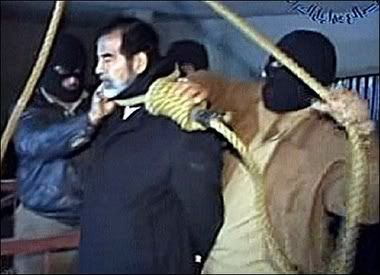


 'Iraq al-Qaeda' welcomes US poll
 Mr Rifkind said the timing was "deeply suspect"
 Saddam calls for reconciliation
 Curfew eased after Saddam verdict


 As an Iranian, I hated Saddam for what he did to my country. But, as a human being, I feel sorry for him


 Mobile images


 In the past, I was, as you all know, in the battlefield of jihad and struggle.


December 30th, 2006 at 2:22 pm
[…] Update5: If you’re looking for the latest updates, including a picture of the tyrant with his noose being fitted, and links to the video of Saddam being sent to the gallows, you’re looking for Part Two of my Saddam Hanging Coverage. CLICK HERE and feel free to comment on the dictator’s death. […]
December 30th, 2006 at 4:17 pm
Burn in hell Saddam. You won’t be missed you piece of trash.
December 30th, 2006 at 4:48 pm
i want to see the live coverage for the whole hanging… but cool pic ….. swing baby!!!
December 30th, 2006 at 4:56 pm
Call me whatever you like, but I feel that this piece of shit’s hanging should have been televised for the world to see, with a following message that his kind of people are on the way out. Everyone of the bastards that are caught will face the same punnishment.
December 30th, 2006 at 5:52 pm
I would like to see the full coverage of the hanging. We need to bring this kind of justice to the U.S. We have a lot of trash in our own jails that need to be cleaned out.
December 30th, 2006 at 6:15 pm
I for one think Bush is as much a war criminal as Saddam Hussein. Depending on whch side you are, some will say Saddam can burn in hell while he seemed to be praying prior to his hanging. If you are not with us, you’re evil type of thing. The war criminals on the winning side never meet justice. If you are poor or a minority in the United States you get the death penalty. So don’t give me this religious bullshit thing. All America wanted was to get the Iraki oil. Seems to be more difficult than they thought. The death penalty is WRONG, no matter against whom.
December 30th, 2006 at 9:00 pm
not convinced he has really been hung to be honest i wanna see the hard evidence ie rolling video footage
December 31st, 2006 at 1:43 am
Glad he is finally dead. It would be better to see it for really, show the full video so we can all enjoy seeing him die !!!!!!!!.
December 31st, 2006 at 7:28 am
I agree with Henri DeToi, Bush is also not clean. Remember Jesus when people brought a woman to him who had been caught red-handed in the act of adultery and the people wanted her stoned, Jesus said, ‘Let him without sin be the fist one to throw stones’ and there was none. Who has judged Bush and found him innocent taht he should send probably his match or even worse to the gallows? I don’t condone the attrocities that Saddam did, but two wrings don’t make a right.
December 31st, 2006 at 8:28 am
Yes, the Evil Dictator is Dead, But what about George W Bush & Tony Blair They should be tried of War Crimes for an Unjustified War in Iraq. Many more people are being killed since Pre Saddam Iraq.
Hanging Saddam Hussain will Only Stir up the Fire even more, the world in definetly not a safer place now, mankind will destroy himself and the world, for what cause, Greed, power and Wealth.
December 31st, 2006 at 10:01 am
A man put to death is but yet another crime to humanity. But this one should have been broadcast in HD worldwide. we should have been the one to do it. The only fear is that the comming year will hold more tragic loss of life to americans in the long fight for freedom abroad. FIGHTING FOR PEACE IS IMPOSSIBLE. And in order to achieve this how many Fathers, Sons, Brothers, Uncles, Cousins, and Freinds must die for the right to be free. To all the Millitary personell overseas, Keep your spirits high And you Heads down low, it cant be easy having a Red White and Blue target on your back. May god Bring them all hone safely…….
December 31st, 2006 at 11:17 am
[…] Right on the Right ? Saddam Hussein Coverage Part 2 […]
December 31st, 2006 at 12:28 pm
A great and wise President Bush went to Iraq, now Saddam is dead by legal means. A good day for the world.
At some point in the future everyone will know that Bush made the right choice for taking him out.
I would like to see a video of Saddam’s hanging.
The American news casters should show it, but they won’t because that would raise President Bush’s approvel rating.